
Le Bernardin was all glass and gold light that night — the kind of restaurant where the waiters spoke softly and the prices didn’t. My family of eight sat around a table meant for twelve, the four empty seats hanging over us like ghosts. The occasion: my father’s sixtieth birthday. The tension: invisible, but everyone could taste it between bites of halibut and forced laughter.
I sat at the far end, in a black Armani dress I’d chosen for its silence — not too showy, not too plain. My mother, across the table, was already giving it her familiar, disapproving glance. “Plain,” she would call it. “Unfeminine.” The irony was that the dress probably cost more than her pearl necklace, but she’d never believe that.
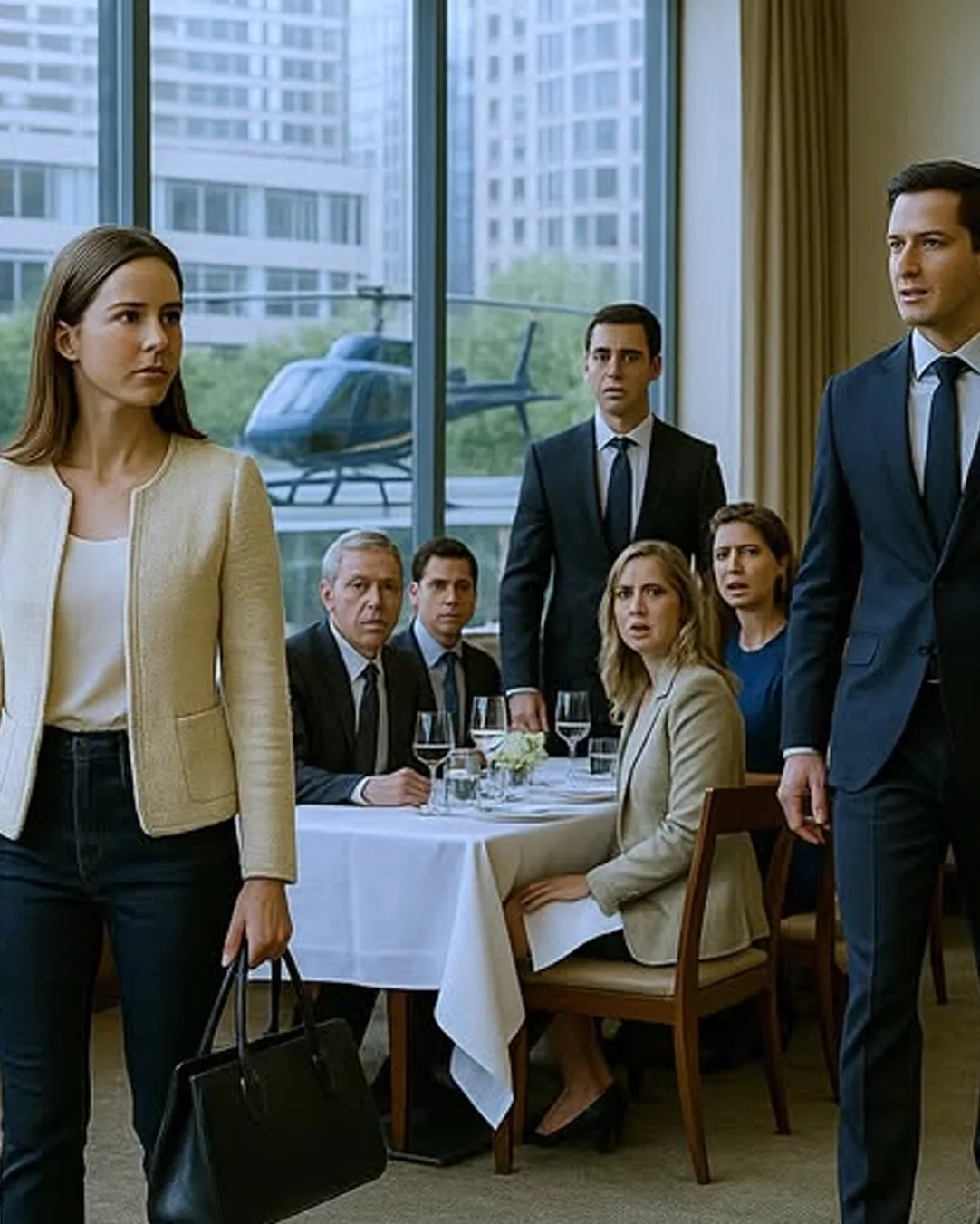
“To sixty years,” my father declared, glass raised. “I never thought I’d see this day — surrounded by such a beautiful family.”
Beautiful, yes. Whole, no.
Mom chimed in with her perfect hostess smile: “To Richard Williams, the most successful man I know — and the father of two wonderful children.”
Two. Not three. The omission sliced through me cleanly, like a scalpel.
Derek, my older brother, grinned and raised his glass higher. Harvard MBA. Partner at a law firm. Married with two perfect kids. Beside him, his wife Jennifer gave me the polite smile of a woman who’d already judged me and found me wanting. My younger sister Melissa, golden and newly engaged to a hedge fund manager, applied fresh lipstick. The entire tableau could’ve been lifted from a luxury catalog — if not for me, sitting at the end like a smudge on the picture.
I smiled thinly, lifted my glass, and drank.
My family had long since decided who I was — the one who’d drifted off-course. The one who refused to play by their rules. In their eyes, I was the daughter who couldn’t settle, who worked an undefined job that sounded suspiciously unserious, who lived downtown in a “studio apartment” like a college student instead of a “respectable woman.”
Dad’s company had once been the axis around which our entire family revolved — dinners with executives, vacations funded by bonuses, photos for the alumni newsletter. But now, the signs of strain were there if you looked: the way his hand trembled slightly when he signed the check, the wince when he ordered the $800 Bordeaux. I noticed. No one else did.
Mom turned to me, voice sharp and sugary. “We need to talk about something that’s been weighing on us.”
I braced myself.
“Sophia,” she began, using the tone that made my name sound like an accusation, “we’ve been patient with your… phase. But it’s gone on long enough. This ‘independent woman’ act, the refusal to settle down, the secrecy about your work — it has to stop.”
“I’m sitting right here,” I said evenly.
“Yes, but emotionally? You’ve been gone for years.”
I almost laughed. “Maybe because every time I share something, it gets dismissed.”
“We’ve never criticized you unfairly,” Mom countered.
That nearly made me choke on my wine.
The night unraveled quickly after that.
Dad chimed in, voice full of his old authority. “A woman needs stability, Sophia. A husband. Security. You can’t live like this forever.”
“I have financial stability,” I said, quietly but firmly.
He scoffed. “Do you? You drive an old car, live in a small apartment, and never talk about your work. It’s clear you’re struggling.”
The irony was unbearable. I made more in a month than his company had earned last quarter. But to them, appearance was truth.
Mom tilted her head. “You can’t keep pretending, sweetheart. People talk. It’s time to be honest.”
“Honest about what?”
“About the fact that you’ve failed,” she said, her voice soft but deadly.
I felt my breath slow — not from anger, but clarity. The kind that comes when you realize there’s no misunderstanding left. Only distance.
Melissa joined in, with that fragile, superior smile she wore like perfume. “There’s no shame in not succeeding, Sophia. But it’s sad to watch you pretend you have.”
I thought of the company I’d built — the one they didn’t know about. Meridian Global. 8,000 employees. Offices in six countries. A valuation north of $4 billion. And yet, to them, I was still the family’s invisible embarrassment.
“Tell us what you really do,” Derek said. “And don’t say consulting again.”
“I develop software for corporations,” I replied.
“Software?” Mom repeated, like it was a synonym for garbage collection. “And that pays your bills?”
“It does.”
“But not enough for a decent car or proper home,” Dad pressed. “You’ve given up, Sophia. You’ve stopped trying.”
That was when Mom delivered the final blow. She turned to the table, her voice calm and clear.
“She’s dead to us.”
The words hung in the air like smoke.
Jennifer gasped softly. Derek said nothing. Even Melissa looked startled.
Then, before I could reply, a deep voice spoke from behind me.
“Excuse me,” it said. “Miss Williams — your driver is waiting.”
The table fell silent.
I turned. My head of security, Tom, stood near the entrance, a wall of calm professionalism in his black suit. To them, he looked like a bodyguard from a movie set.
Dad frowned. “Who are you?”
Tom met his gaze without blinking. “Head of security for Ms. Williams. Her car is ready.”
The air shifted. You could feel it — the sudden confusion, the recalculations behind their eyes.
Mom blinked rapidly. “Security?” she echoed. “What—why would you need—”
I stood, smoothing my dress. “Because the last time someone broke into one of my offices, it cost us three million dollars in data recovery.”
Derek frowned. “Offices?”
“Yes,” I said, finally letting the truth surface. “Plural.”
I reached into my clutch and dropped my black card on the table beside the wine bottle. “For dinner. Happy birthday, Dad.”
Then I turned toward Tom. “Let’s go.”
We walked through the stunned silence — the restaurant’s lights glinting off glass, the sound of distant laughter from other tables where families pretended to be perfect.
Outside, the Maybach waited at the curb, engine humming low. The driver opened the door. I hesitated, glancing back through the window — at my mother’s rigid posture, my father’s confusion, Derek’s pale face.
For once, I didn’t feel anger. Just sadness — the quiet kind that comes from knowing you’ve already outgrown a room full of people who raised you.
As the car pulled away, I looked out at the Manhattan skyline, glowing and sharp against the night. My reflection in the glass was calm, older, freer.
For years, I’d chased their approval, mistaking it for love. I’d built an empire from the ground up, but I’d built it quietly — out of self-defense, not pride. Because I’d learned early that their kind of love came with conditions: obedience, conformity, silence.
Now, I realized something simpler.
Some families are not meant to understand your worth — they’re meant to challenge it, so you can define it yourself.
That night, I went home to my apartment — minimalist, sunlit, filled with peace — and checked my phone. A text from Tom: Everything secure, Ms. Williams.
I smiled.
In the quiet, I finally toasted my father’s birthday — alone, with a glass of Bordeaux — to the woman they had tried to bury, and the one who rose anyway.
News

A Mafia Boss Threatened Dean Martin on Stage—Dean’s Reaction Was Pure Genius
A Mafia Boss Threatened Dean Martin on Stage—Dean’s Reaction Was Pure Genius Prologue: A Gun in the Spotlight Dean…

The Billionaire Had No Idea His Fiancée Was Poisoning His Son—Until the Maid Exposed Everything
The Billionaire Had No Idea His Fiancée Was Poisoning His Son—Until the Maid Exposed Everything Prologue: A Whisper That…

The Billionaire Catches Maid ‘Stealing’ Food… But When He Sees Who It’s For, He Breaks Down in Tears
The Billionaire Catches Maid ‘Stealing’ Food… But When He Sees Who It’s For, He Breaks Down in Tears Prologue:…

The Billionaire’s Fiancée Sets a Trap for the Maid — Until His Silent Daughter Exposed the Truth
The Billionaire’s Fiancée Sets a Trap for the Maid—Until His Silent Daughter Exposed the Truth Prologue: The Whisper That…

The Billionaire Went Undercover as a Gardener — Until the Maid Saved His Children from His Fiancée
Richard Whitmore’s hands trembled on the garden shears as he watched through the kitchen window. His new wife, Vanessa, stood…

Three Flight Attendants Vanished From a Vegas Hotel in 1996 — 28 Years Later a Hidden Wall Is Opened
.Every hotel, every casino, every neon-lit alley has a story, most of them ending in forgetfulness or denial. But some…
End of content
No more pages to load






