
Rain lashed the narrow streets of Willow Creek, blurring the faint glow of porch lights into trembling halos. The gutters overflowed, carrying fallen leaves and the smell of wet earth through the dark. Daniel Moore hunched his shoulders, clutching his threadbare coat tighter around his son. Seven-year-old Noah trudged beside him, his small boots splashing through puddles, his hand gripping his father’s.
They were almost home—a small cottage at the edge of town with peeling paint and a leaky roof. For Daniel, it was more than enough. After his wife’s death two years ago, the house had become a fragile refuge, a place where laughter still echoed, even if it was sometimes drowned by the sound of bills piling on the kitchen table.
As they turned the corner, Daniel stopped. Beneath a flickering streetlight stood two girls—teenagers, twins by the look of them—drenched to the skin. Their hair clung to their faces, and their clothes were soaked through. One of them lifted her head, her voice trembling. “Please… we missed the bus. No one will let us in. Could we stay somewhere warm for the night?”
Daniel hesitated. He had two bowls of soup waiting at home, barely enough blankets, and no space to spare. But then he saw it—the fear in their eyes, the kind that comes from being completely unseen. He exhaled and opened the gate. “Come inside,” he said. “You can dry off here.”
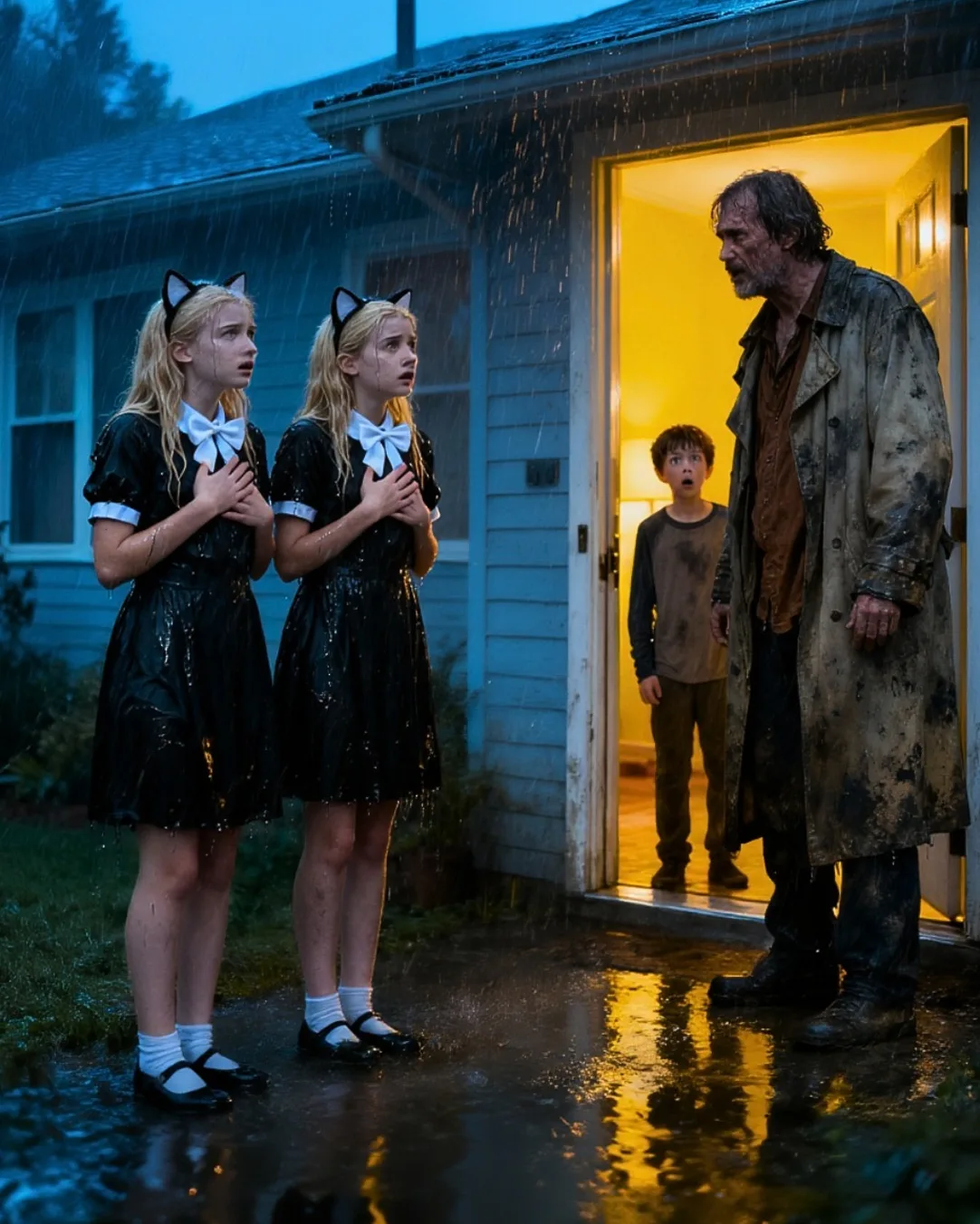
The girls’ names were Ava and Grace. They spoke softly, with the kind of manners Daniel rarely heard anymore. He gave them towels, warmed some soup on the stove, and let them sit close to the heater. Noah watched them curiously from the couch, his eyes wide as they smiled at him and thanked Daniel again and again.
They ate slowly, as if trying not to seem hungry. When Daniel asked where they lived, Ava only said their father was “away on business.” Something about their tone—the polished phrasing, the unworldly calm—didn’t match their ragged appearance. But Daniel didn’t press. People have their reasons for silence.
That night, after Noah had fallen asleep, Daniel found Ava standing by the window, her reflection ghosted against the rain. “You’re still awake,” he said.
She turned, startled. “I’m sorry. I didn’t mean to wake anyone.”
He shook his head. “You didn’t.”
Her eyes shimmered in the dim light. “Everyone else turned us away,” she whispered. “You didn’t even ask who we were.”
Daniel smiled faintly. “Didn’t seem like the kind of night for questions.”
She smiled back—a small, sad curve of her lips—and turned to look outside again. The storm eased as if in response.
By dawn, the storm had passed. The air smelled of wet grass and chimney smoke. Daniel was making pancakes when Noah shouted from the window, “Dad! There’s a car outside!”
A sleek black sedan rolled to a stop in front of the cottage, tires crunching on gravel. A man stepped out—tall, sharp in an expensive suit, his expression frantic. The moment the twins saw him, they ran for the door. “Dad!” they cried, voices breaking.
Daniel stood frozen. The man gathered both girls into his arms, relief washing over his face. “You’re safe,” he murmured. Then his gaze shifted to Daniel. “You… you’re the one who took them in?”
Daniel nodded, unsure what to say.
“I’m Richard Callahan,” the man said, extending a hand. “Their father.”
The name landed like thunder. Daniel had heard it before—on billboards, in newspaper headlines. Richard Callahan, the billionaire real estate magnate. The missing Callahan twins had made national news the night before, but Daniel had missed it; his old television had died months ago.
The man’s voice wavered. “I can’t thank you enough. You opened your home when no one else would. Please—you and your son must come with us for breakfast.”
Daniel tried to refuse. His shoes were muddy, his coat frayed. But Richard insisted, and soon Daniel found himself and Noah in the back of the car, the city unfolding in streaks of sunlight as they drove toward a world he’d never imagined entering.
The Callahan estate looked like something from another life—gates of wrought iron, marble steps glistening from the rain, and a garden that smelled faintly of roses even in winter. Inside, everything gleamed. The girls, now in dry clothes, seemed to glow with relief. They told their father everything—how Daniel had welcomed them, fed them, kept them safe.
Richard listened in silence. When they finished, he looked at Daniel with something like disbelief. “Most people would’ve called the police,” he said quietly. “You offered kindness.”
Daniel shifted in his chair. “Anyone would’ve done the same.”
Richard smiled faintly. “No,” he said. “Not anyone.”
Breakfast passed slowly, filled with polite conversation and the sound of the twins laughing with Noah in the next room. When it was time to leave, Daniel tried to thank them for the meal, but Richard stopped him. “Wait,” he said. “You mentioned you’re between jobs?”
Daniel nodded cautiously.
“I have a new property development. It needs someone trustworthy—someone with good judgment. It comes with housing, and the pay is fair. I’d like you to take it.”
For a moment, Daniel could only stare. “Sir, I don’t—”
Richard raised a hand. “You helped my daughters when no one else would. Let me help you now.”
Months later, Daniel’s life no longer felt like a tightrope walk. He managed one of Callahan’s apartment complexes—simple work, steady hours, honest pay. The tenants liked him; the children in the building called him “Mr. Moore with the toolbox.” Noah thrived at a nearby school, and on weekends, Ava and Grace visited, their laughter brightening the halls.
One evening, Richard stopped by unannounced. He watched as Daniel calmed a frustrated tenant with patient words and a steady hand. When they were alone, Richard said quietly, “When I first met you, I thought I had everything a man could want. But I was wrong. You have something I’d forgotten—heart.”
Daniel smiled. “Sometimes that’s all a man has.”
Richard nodded, his gaze soft. “And sometimes, it’s all that matters.”
That night, rain began to fall again—soft, forgiving rain that tapped gently on the windowpanes. Daniel stood in the doorway with Noah asleep in his arms, listening to its rhythm.
Once, the sound had meant loneliness, the echo of what he’d lost. Now it was something else entirely—a reminder that kindness, even the quiet kind, can change the course of more than one life.
He looked out into the wet dark, the reflection of the city lights shimmering on the puddles like small, uncertain stars. The world, he thought, is full of storms. But every so often, if you open the door, you find someone worth sheltering—and in doing so, shelter yourself.
News

A Mafia Boss Threatened Dean Martin on Stage—Dean’s Reaction Was Pure Genius
A Mafia Boss Threatened Dean Martin on Stage—Dean’s Reaction Was Pure Genius Prologue: A Gun in the Spotlight Dean…

The Billionaire Had No Idea His Fiancée Was Poisoning His Son—Until the Maid Exposed Everything
The Billionaire Had No Idea His Fiancée Was Poisoning His Son—Until the Maid Exposed Everything Prologue: A Whisper That…

The Billionaire Catches Maid ‘Stealing’ Food… But When He Sees Who It’s For, He Breaks Down in Tears
The Billionaire Catches Maid ‘Stealing’ Food… But When He Sees Who It’s For, He Breaks Down in Tears Prologue:…

The Billionaire’s Fiancée Sets a Trap for the Maid — Until His Silent Daughter Exposed the Truth
The Billionaire’s Fiancée Sets a Trap for the Maid—Until His Silent Daughter Exposed the Truth Prologue: The Whisper That…

The Billionaire Went Undercover as a Gardener — Until the Maid Saved His Children from His Fiancée
Richard Whitmore’s hands trembled on the garden shears as he watched through the kitchen window. His new wife, Vanessa, stood…

Three Flight Attendants Vanished From a Vegas Hotel in 1996 — 28 Years Later a Hidden Wall Is Opened
.Every hotel, every casino, every neon-lit alley has a story, most of them ending in forgetfulness or denial. But some…
End of content
No more pages to load






