
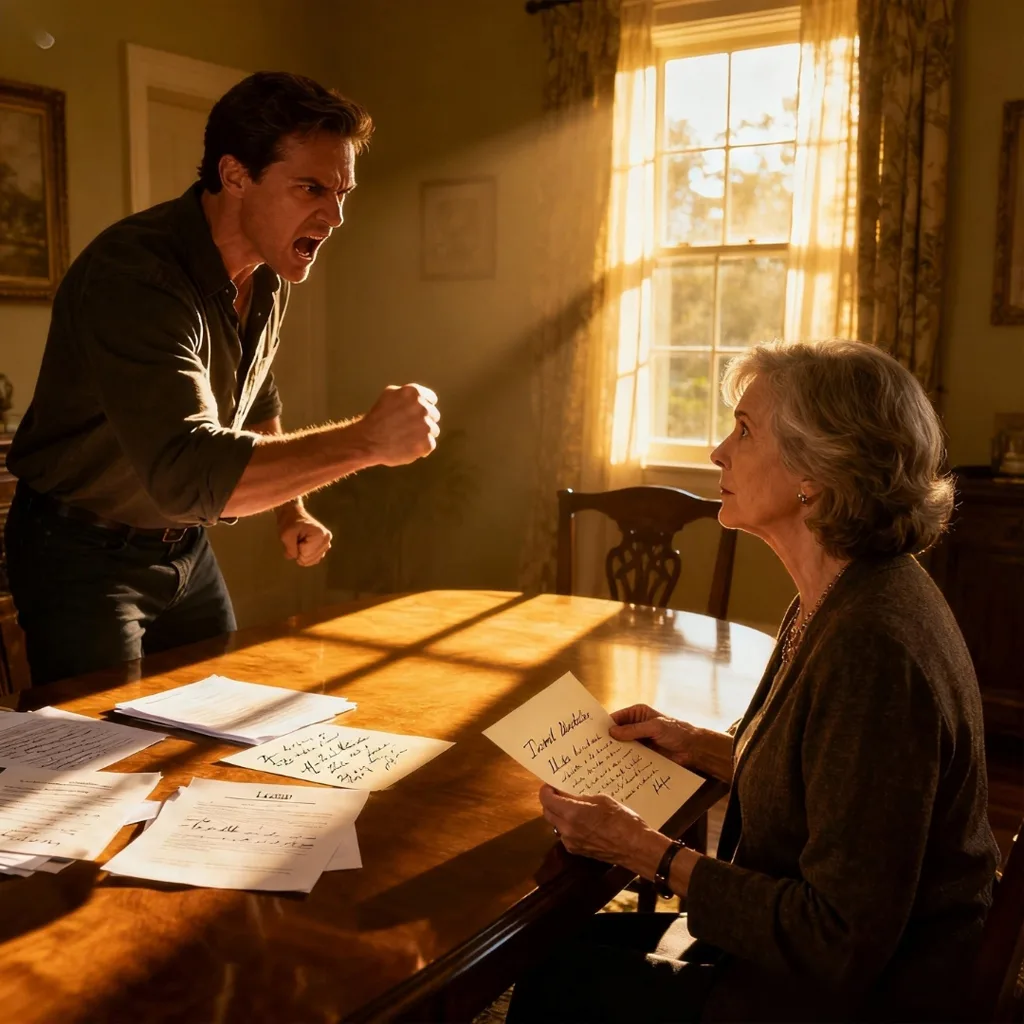
The iced tea rattled before I did. His palm hit my dining table—a sharp, flat sound that made the glass sweat jump—and the words he’d been practicing came out clean as a threat: “You don’t belong in this house, old woman.” Heat leaned against the windows like a living thing. Spanish moss hung heavy in the oaks, the marsh beyond Maple Street holding its breath. I didn’t lift my eyes to him. I unfolded my daughter’s final letter—Leora’s looping hand bright as a flare—and read the first line out loud. Grief stopped being a room I sat in and became a door I closed.
Savannah wears mourning with choreography. At St. O. Paul the lilies came in tall, obedient rows, brass polished, choir humming like a kept promise. Folks lined the aisle to watch sorrow like it was a pageant. “Bless your heart,” they told me; “She’s in a better place.” I carried the same black dress I wore when my husband went into the ground, the same steady walk, and took the last pew when the usher I’d fed on homecoming Sundays gestured me there. At the front, my son-in-law hosted grief like a maître d’, ribbon just so, shaking hands as if condolences were receipts. Rowan spoke into the microphone and built a Leora made of his verbs—“I did, I took, I managed”—a monument to the man he liked to be seen as, not the husband my daughter died with. He never said my name. Afterward the parking lot bloomed with theories and heat. He pressed a paper into my palm between platitudes and pity. Ten days to vacate, it said. Ten. As if a mother could be timed, as if the porch light on Maple Street didn’t know my hand.
I drove home behind my own headlights. The key still turned; the hinge remembered me. But the smell was wrong—coastal linen candle instead of lemon oil, something that masked rather than cleaned. Frames gone from the hallway; nail holes staring like mouths. Leora’s door half-closed. Her jewelry box open, the ballerina’s arm snapped, a staging of tenderness broken. On her laptop, one folder: For Mom. Empty. Whoever had tidied the evidence didn’t know the theater of grief well enough to leave a believable mess.
At the back door a knock. Nobody decent in Savannah uses it unless they belong. Clemens stood there with his hat in his hands, boots muddy, a man who fixes things you didn’t know had names. “Leora gave me something,” he said. “Told me to hold it in case things went sideways.” Sideways had arrived on ten white days. He slid a taped envelope over the counter. Inside: photocopied bank statements with withdrawals to Vale Holdings LLC; a draft will dated last month leaving the house and insurance in my name; three pages of notes in Leora’s steady hand. Mama, don’t let him tell you you don’t have standing. You do.
I wrote every account number into my old spiral, the paper that has saved more women than sermons. Morning brought Rowan with a blue shirt and fresh cologne, a man who mistakes grooming for virtue. “We’ll need the downstairs cleared by Friday,” he said. “You can take the small room upstairs till you move.” I slid the spiral forward. “You emptied the account ending in 3742,” I said. “Both names last winter. Just yours by spring.” He blinked. “Leora told me to—taxes, planning—she didn’t want you to struggle.” He looked at my phone, its black little eye recording without apology. “Careful,” he said softly. “People already think you’re…fragile.”
“I am not fragile,” I said. “I am documenting.”
He left hotter than he came. I spent the afternoon photographing everything—the eviction, the ledger, the letter—front and back, like a woman planting fence posts. Online he posted a tribute with three edits, each one polishing himself and shrinking me. Screenshots went into a folder named Weather, because storms repeat. My granddaughter Narin called. “Don’t delete. He’s building a paper trail to match the theft,” she said. “I’ve got backups off his Wi-Fi.” Isabel, the kind of friend who notices the time your lights go out, put coffee in my hands and said, “We’ll keep the truth moving.” Then August Lauren, an attorney whose voice makes men check their signatures, sat at my table and asked, “Do you want peace or record?” “Record,” I told him. He tapped the envelope. “Then we trap him by the book.”
Before dawn, two squad cars rolled soft to the curb, no lights, just purpose. August laid Leora’s directive at my dining table like a keel. Her name. Her inked fingerprint. The seal. “This supersedes any prior claim,” he said to the room and the officer and the man who had invited himself into a future without witnesses. “We’re not here about her mother’s mental state,” the officer told Rowan when he reached for pity. “We’re here about chain of custody.” Savannah, which forgives much, does not forgive a son-in-law evicting a widow’s mother ten days after the funeral. By noon Maple Street had changed its hello.
That evening Rowan sat across from me in the gold light he’d never earned. August stood behind my chair, silent as a bar number. I read Leora’s letter aloud. “Mama keeps the house. If they ask, the money started as mine. Don’t trust his charm; he loves the crowd more than the person.” He opened his mouth and closed it twice, a man re-learning what silence weighs. August slid him a notice: any attempt to alter accounts, dispose of property, or remove me would be exploitation under Georgia law. “This is my house,” Rowan snapped. “Incorrect,” August said. “This property is under protection. You are being advised, and you are being recorded as advised.”
I stood and walked my rooms the old way, naming what I touched: kitchen, den, hall, pantry. Claiming isn’t loud; it’s steady. I hung the photograph of me and Leora back on its nail, the nail that waited like faith. At the hall closet I slipped his spare keys off the ring and met his eyes. “From now on, you don’t walk through a door here unless I say so.” “You can’t—” he started. “Already did,” I said, opening the front door and letting the porch light baptize him honest. Ten days is what he’d given me. “You have ten to clear your things,” I said. “After that, it’s abandoned.”
The next mornings were paperwork and breath. The bank reversed transfers. The court entered a protective order with a judge’s cool hand. The deacon who’d looked at his shoes at the funeral called to apologize. “Silence is common,” I told him. “Waking up is better.” Clemens fixed the back step and refused money. Isabel brought a pecan pie and new wind chimes that caught the mariner wind like laughter. We painted the porch railings the color of forgiveness I could live with. When Rowan idled by at dusk, a cruiser idled behind him. A knock. “Mr. Vale, we have a few more questions.” Laws have teeth when you feed them receipts.
At night I sat on the top stair and read Leora’s letter again. I said her name into the house and it answered with air that finally felt cool—earned cool, honest cool. I kept the porch light on, not from fear but from stewardship. Mine, it said without shouting. Mine.
This isn’t a tale about vengeance; it’s about jurisdiction. About how grief tempts predators, and how paper—wills, ledgers, letters—can outshout performance and pity. It’s about the difference between being quiet and being erased. We like to say in church that truth sets you free; we forget to add that truth needs a file folder and a witness signature. My daughter’s last gift wasn’t the line “Mama keeps the house.” It was the instruction beneath it: Tell her the money started as mine. Tell her not to let charm write history. In a country that worships stories, make yours legible.
So here is a working creed for anyone standing in a doorway being told to leave: keep your receipts; speak like you’re under oath; borrow courage until yours comes home. Call the friend who notices the time your lights go out. Call the lawyer who treats your name like a fact. Plant a camera if you must. Hang the photo back on its nail. When the moment comes, read the letter out loud and let the truth hit the table. Then listen to the room change.
News

A Mafia Boss Threatened Dean Martin on Stage—Dean’s Reaction Was Pure Genius
A Mafia Boss Threatened Dean Martin on Stage—Dean’s Reaction Was Pure Genius Prologue: A Gun in the Spotlight Dean…

The Billionaire Had No Idea His Fiancée Was Poisoning His Son—Until the Maid Exposed Everything
The Billionaire Had No Idea His Fiancée Was Poisoning His Son—Until the Maid Exposed Everything Prologue: A Whisper That…

The Billionaire Catches Maid ‘Stealing’ Food… But When He Sees Who It’s For, He Breaks Down in Tears
The Billionaire Catches Maid ‘Stealing’ Food… But When He Sees Who It’s For, He Breaks Down in Tears Prologue:…

The Billionaire’s Fiancée Sets a Trap for the Maid — Until His Silent Daughter Exposed the Truth
The Billionaire’s Fiancée Sets a Trap for the Maid—Until His Silent Daughter Exposed the Truth Prologue: The Whisper That…

The Billionaire Went Undercover as a Gardener — Until the Maid Saved His Children from His Fiancée
Richard Whitmore’s hands trembled on the garden shears as he watched through the kitchen window. His new wife, Vanessa, stood…

Three Flight Attendants Vanished From a Vegas Hotel in 1996 — 28 Years Later a Hidden Wall Is Opened
.Every hotel, every casino, every neon-lit alley has a story, most of them ending in forgetfulness or denial. But some…
End of content
No more pages to load






