The rain came down in a thin silver curtain that softened the edges of Brookridge and turned Maple Park into a watercolor—benches glistening, swings dripping, fallen leaves pressed flat like forgotten letters. Clara Carter walked alone that afternoon, her backpack heavy against her shoulders, her footsteps quiet on the wet pavement. The bench was still there. And so was she—the woman who sat hunched under layers of mismatched jackets, a worn teddy bear tucked beneath her arm as though it were fragile cargo. For years this stranger had been a distant fixture of Clara’s walk home, but today the woman rose as Clara passed, her face lifting with a tremor of hope.
When Clara’s notebook slipped from her hand and scattered across the curb in the rain, the woman appeared beside her with a silent urgency. She crouched down, reaching with trembling fingers, and held the damp notebook as though it were something sacred. Then she whispered a single sentence that made the world tilt: “You have your father’s eyes.”
The words did not sound like fantasy. They sounded like memory.
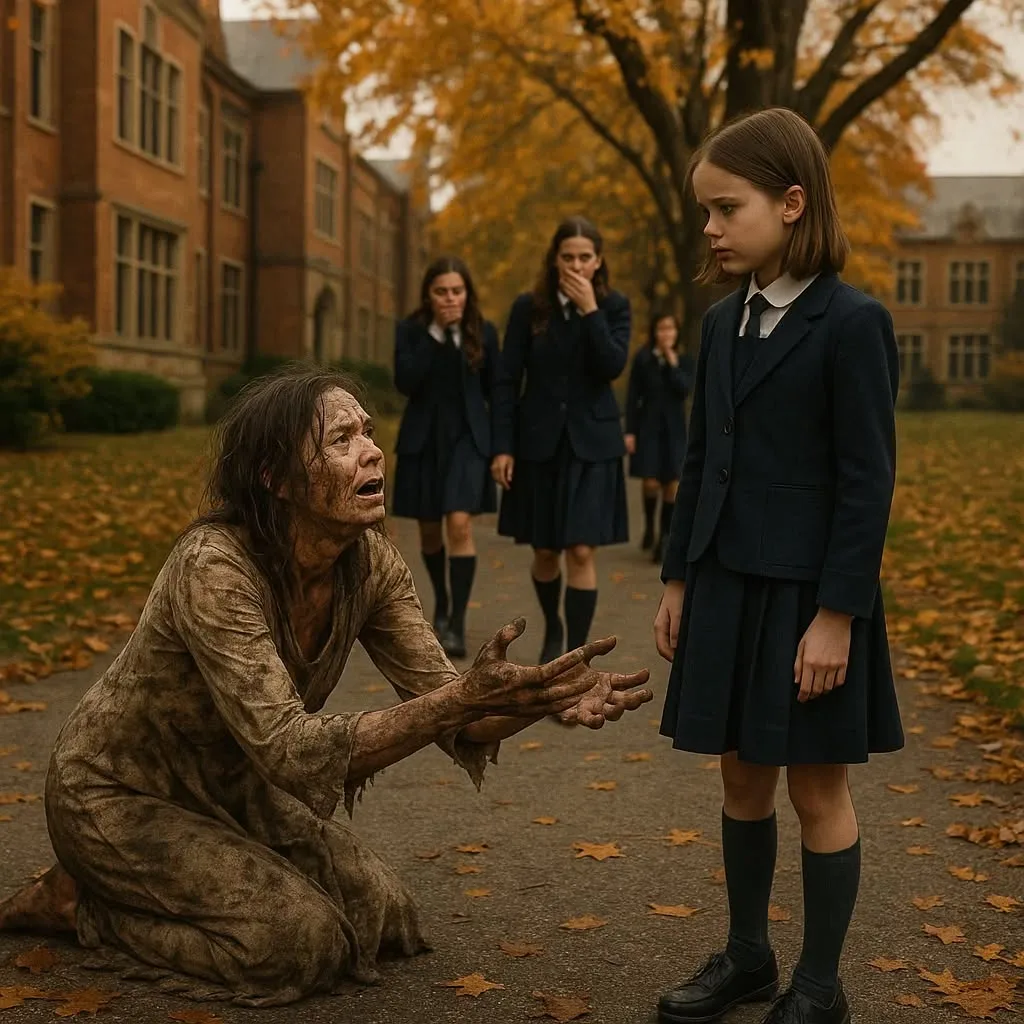
Clara stared into those rain-soaked eyes and felt an echo—faint yet undeniable—rise from a place inside her she had never known how to access. It was a name she had forgotten long ago, a name she had not heard in thirteen years. But the woman spoke it gently, reverently, like an invocation.
“Star.”In the Carter home, nothing was ever out of place. The piano was polished, the cabinets organized by quiet ritual, and the fridge covered in neat reminders about recitals and dentist appointments. Mark and Elaine Carter offered Clara warmth, structure, and a kind of curated safety. They were good people—responsible, attentive, the kind who could silence an argument with a soft look and a touch to the shoulder.
Clara had grown up believing this life was her origin story: an adoption that saved her from a past too painful to revisit. When she was younger, the explanation had been simple—her birth mother had struggled, had disappeared, had passed away. But childhood stories dissolve under teenage scrutiny, and recently Clara had begun to feel something hollow behind the walls of her perfect household. She had flashes—blue fabric, the outline of a lullaby she couldn’t quite hum, a woman’s arms holding her in the dark.
The stranger in the park had always unsettled her. Not because she looked wild or lost, but because she looked familiar. Every time Clara passed, the woman’s expression lit up with the kind of recognition that made the air tighten. Mia and Jordan always told her not to look, not to listen, to chalk it up to coincidence. But coincidence didn’t know her name. Coincidence didn’t know “Star.”
By the time Clara stormed into the kitchen, rain dripping from her sleeves, she felt as though she had outrun something much larger than her own fear. Mark set down the knife he’d been using to chop carrots. Elaine turned from the stove with a stare that wavered between worry and careful calculation. When Clara demanded answers—real ones—their faces paled.
“Who is she?” Clara asked. “Why does she know my baby name?”
Elaine swallowed. “Sweetheart, your birth mother… she struggled for years. They told us she—”
“Died,” Clara finished. “You’ve told me. But she’s not dead. She’s at Maple Park.”
Before Elaine could respond, the doorbell rang—a sharp, unplanned chord that froze the room. Mark opened the door. And there she stood: the woman from the bench, soaked through, her hands shaking but her gaze locked on Clara with a ferocity of love that made the moment throb with ache.
“You lied,” the woman said to Mark and Elaine. “You told me she was gone. You sealed the records. You erased me.”
Elaine tried to close the door, but Clara stepped forward, breath shallow. The woman reached out, not touching, just offering the air between them.
“I wasn’t perfect, Star,” she said. “But I never left you. They took you. They said I needed treatment, and I did, but they never brought you back. I searched everywhere.”
Mark insisted she was unstable. Elaine pleaded for Clara to go upstairs. The police were called. Through the chaos the woman never raised her voice—she simply kept whispering the same sentence as the officers led her away.
“Star… I love you. I never stopped.”
And for the first time in her life, Clara felt torn not between parents, but between truths.The house was quiet long after the squad car pulled away, and the silence pressed against Clara’s ribs. She sat curled on her bed, replaying the woman’s face—the familiar slope of her nose, the shape of her eyes, the way her voice cracked on the word “light.” Mark and Elaine tried to comfort her, but their explanations felt thin, patched, built from fear rather than fact. They had given her stability, but now she realized stability sometimes came with walls.
Over the next days, Clara walked home by different routes, avoiding the park bench that now sat vacant. But avoidance only deepens longing. The first night she dreamed of a woman singing to her—a lullaby without words, only rhythm. The next day she found herself at Maple Park at dusk, sitting on the cold bench, tracing the grooves in the wood as though they held answers.
When she finally asked her parents for the adoption records, they hesitated long enough to confirm what she already suspected: things had not been as simple as they’d claimed. There had been petitions, contested hearings, a medical hold, a mother who never gave consent. And an infant—Clara—who slipped through a system that preferred clean narratives to complicated love.
Clara didn’t hate her adoptive parents, but something had shifted. The truth had entered the room and refused to leave.The woman in the park did not vanish. She remained a question Clara would one day seek answers for. Not out of rebellion, but out of a deeper, quieter instinct: the need to understand every chapter of the story that built her. Love, she realized, is rarely simple. It is layered, flawed, stitched together by choices both noble and misguided.
The Carters had rescued her from chaos. The woman on the bench had never stopped trying to rescue her from loss.
And Clara—Star—stood in the fragile space between them, learning that identity is not a single truth, but the long, painful, beautiful act of searching for all of them.
News
He paused over the old script page like he’d just noticed something he’d never admitted publicly. When someone mentioned All in the Family (1971), he laughed under his breath and said, “If people knew what really happened backstage…” The room shifted. Even the host raised an eyebrow — that tone didn’t sound like a joke.
If you want to understand American television—not the business, the medium—start in a Queens living room where a loudmouth in…

She froze for a moment when the question landed — not dramatically, but like someone who’d spent decades keeping two versions of herself separated. Crystal Gayle gave a small, careful smile and said, “People saw the singer… not the rest of it.” The host leaned in, sensing she’d finally slipped. Even the crew stopped moving for a second.
There’s a particular hush that falls over a room when “Don’t It Make My Brown Eyes Blue” starts. It’s not…

She hesitated just long enough for everyone to notice — the kind of pause that tells you she’s deciding whether to finally say something she’s carried for years. At 75, Clint Walker’s daughter looked down, smiled tightly, and whispered, “People think they know him… they don’t.” The host leaned forward, sensing the shift. Even the crew stopped adjusting lights.
In the old clips, Clint Walker looks like the country’s collective daydream made flesh—nearly two meters tall, shoulders like stacked…
A small freeze-frame in Hollywood chatter turned into something sharper: a list of co-stars Harrison Ford reportedly couldn’t stand… and the order of who made the “worst seven” is nothing like fans imagined. A crew member even whispered, “You didn’t hear this from me.”
Harrison Ford’s Line in the Sand: Seven Collisions That Reveal the Man Behind the Myth Harrison Ford has been famous…

He froze for half a second before answering — the kind of pause that makes everyone wonder what memory he’d just bumped into. When someone asked, “What really happened to Ron Howard?” he let out a slow breath and said, “People only know the parts I let them see.” The room got unusually quiet after that, like even the crew sensed a line had been crossed.
Ron Howard’s Real Story: Five Turning Points That Shaped the Man Behind the Baseball Cap At some point, Ron Howard…
She stopped mid-sentence, like she suddenly realized she was about to say something she’d kept quiet for nearly two decades. After 18 years, James Brown’s ex-wife leaned forward and whispered, “What happened that night never made sense… and some people know why.” The host blinked, unsure if he should let her continue. The room felt heavier after that line.
There are artists whose lives graft onto America’s bloodstream—James Brown was one of them. He built a career on kinetic…
End of content
No more pages to load