
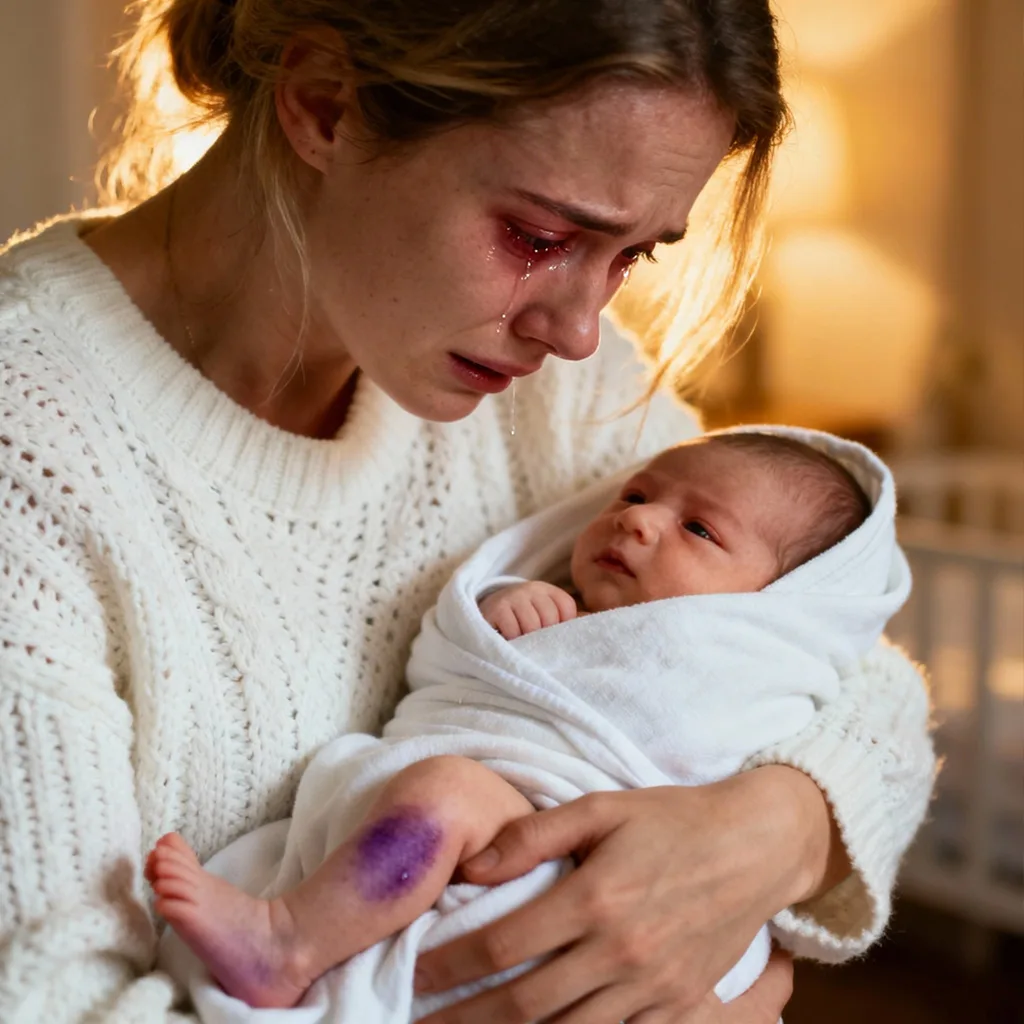
The first mark looked like a smudge the morning light had forgotten to wipe away—a faint oval on the soft fat of a baby’s thigh, red as the rim of a teacup. Samantha Reed paused, one hand steady on Oliver’s heel, the other hovering with the fresh diaper like a white flag. Outside, Los Angeles did what it always does at ten a.m.—leaf blowers, a delivery truck’s idle, the far-off hiss of the freeway. Inside the Adams house, everything was curated into calm: eucalyptus in a glass jar, a mobile turning slow above a crib, a wall of framed black-and-white beach photos pretending the Pacific was a personality trait. Oliver, nine months and all glow, blinked up at her and reached for her chin. His grin came easy. The mark did not.
She fastened the tabs, smoothed the onesie, and told herself a story about elastic and heat. Then she carried him to the window so he could bat the light. He laughed—small bells in a white room—and the sound lifted, settled, and left the mark behind it like a secret.
Samantha had been a nanny in this city long enough to know the choreography of other people’s homes. She could spot a marriage by the shoes at the door. She could time an argument by the silence of the dishwasher. She had worked for families who collected children the way they collected art—carefully, on schedule—and for families who loved like weather. The Adamses looked like the former: Emily in real estate-black with a phone glued to her palm, Daniel downstairs “in code,” a basement office declared sacred, off-limits, adult. Their son was the hinge their days swung on. Emily kissed Oliver’s hair without smudging lipstick. Daniel, pale from screen light, would surface for lunch, scoop the baby with a tenderness that softened him, and vanish again.
The first week was bliss—nap schedules that held, a baby who giggled at spoons, a house that stayed clean by muscle memory. The second week, the marks kept showing up, faint at first, then brighter, as if something in the quiet wanted an audience. Samantha mentioned it to Emily while the dryer hummed and a digital calendar chirped. Emily frowned, genuinely concerned, and promised a pediatrician. The promise slid into the day and disappeared. A new mark appeared, then another, in places a diaper doesn’t pinch. Samantha kept changing him, kept singing, kept tracing a shape she could no longer name.
There were sounds, too. The Adams house had a second heartbeat Samantha didn’t like. While Oliver slept, she’d hear footsteps above the nursery when Daniel swore from the basement he was mid-deploy. Doors clicked in rooms no one claimed to enter. Once, standing in the hallway with a basket of tiny clothes, she felt a breath of air on her forearm, the way a person walking by leaves weather in their wake. She told herself about drafts and vents. She started to watch the doors.
The bruise was the color of a storm. Small, round, blooming on the inside of a baby’s thigh. Samantha stared at it until her pulse stumbled. Then she pulled her composure on like a cardigan and bought a camera disguised as an air freshener, neutral and forgettable, a cheap trick that felt like treason. She placed it high in a corner, angling it so the crib sat clean in the frame. She told herself good nannies trust their instincts. She told herself better ones verify them.
Two days of nothing. The baby slept like a poem. The house breathed and behaved. On the third afternoon, with Oliver down for his long nap and sunlight lying in bars on the nursery rug, Samantha sat at the kitchen island and tapped play. The video did what videos do when you’re afraid—stalled, buffered, made her aware of her own breathing. Then the nursery appeared, square and silent. A minute passed. Another. The door, just a sliver at the edge, moved a fraction. Opened. A figure slid through the seam—careful, precise, an old grace wearing a faded floral dress.
Not Emily. Not Daniel.
The woman moved as if her body remembered this room from before memory. She touched the crib rail with a hand that trembled. She leaned over the baby and smiled with the kind of ache that lives behind the eyes. Samantha felt her skin turn to ice. The woman unbuttoned the onesie with deft, practiced fingers, drew something silver and small from her pocket, and pressed it—gentle, deliberate—against Oliver’s belly. He whimpered and settled, more startled than hurt. She bent, inhaled the scent of the pacifier like it was a prayer, and whispered, almost teasing the microphone: “You look just like him.”
A dozen explanations flared and died: neighbor, intruder, ghost that paid rent. Samantha didn’t drive back and kick open doors. She watched. She placed two more cameras, one in the hall, one facing the front door, because fear, properly harnessed, is a method.
The woman came again. She did not use the front door. She did not cross the hall. She rose from the basement like a memory from deep water, pushing open a door Samantha had been ordered never to touch. The next morning, when Daniel left for groceries, Samantha traveled the stairs she was not supposed to travel. The air cooled and thickened as if the house itself disapproved. At the far wall, a keypad guarded a door with scratches near the latch, as if someone inside had tried to learn the lock by feel. She put her ear to it, heard nothing but the sound of her own breath. When she rang the police that afternoon, she used a voice that belonged to no one.
Officers came, the way they do when the caller can’t name the crime. Daniel’s manners were perfect, his smile polite, his basement immaculate. He opened the keypad door. Empty shelves. Dust. The faint, lemony lie of bleach. Nothing to see. Everyone left, including Samantha’s confidence, which trailed the officers down the walk like a child. That night she didn’t sleep, which meant she saw what she might have missed: the woman again, like tide; Daniel behind her.
On the screen, he was tender. He held the stranger’s elbow, guided her with the hush parents save for babies and ailing dogs. “It’s okay, Mom,” he said. “You can see him for just a minute.”
Mom.
Something inside Samantha went cold and very still. The camera captured what the house had concealed: a man with a secret that had a pulse. The woman—Eleanor, if the records would later be true—lifted her face and looked directly into the black bead of the lens. “He looks like my little Danny,” she said, voice soaked in a past no one had told the present about. “Don’t let them take him away.”
The warrant arrived with the morning. Paper at the door, officers in boots, the steady choreography of search. Behind the finished walls of Daniel’s “office,” carpenters found a room that wasn’t on the plans—a cot, a metal shelf of pill bottles, a pile of old photographs curling at the edges, a chipped cup that had known years of hands. The air held onto bleach and something sweeter—a hint of lotion, talc, a life kept small. Eleanor sat on the bed, hair brushed and pinned, eyes skittering from face to face the way people’s eyes do when their mind unthreads time. She wasn’t bruised. She wasn’t starved. She was hidden.
The story unfolded the way these stories tend to: a son who couldn’t make peace with a mother’s decline, a lie that became a houseguest, a wife told a death so clean it could be grieved on a schedule. Daniel signed a statement with wrists that shook. He said nursing homes smelled like endings. He said his mother forgot that he was a man now and woke calling for the baby he once was. He said the basement was mercy. He said he meant no harm. No one doubted his love. The charges—unlawful confinement, obstruction—did not care about love. The law is a fence built to keep the meadow from turning back into forest. Emily, white-faced and trembling, filed for separation with a pen that scraped the paper like a match. Neighbors whispered in driveways. Daniel’s name became a lesson. The basement became evidence.
Samantha packed her tote and left the Adams house the way you leave a beach after lightning—quickly, grateful, a little shaken by the fact that thunder is just air tearing itself in two. She kept the tiny camera that had pretended to freshen the air and actually cleared it. She went back to the next nursery, the next routine, the next set of parents whose fatigue came salted with love instead of fear. She answered texts from friends with thumbs that still trembled sometimes and stood, twice, in a courtroom’s back row while a judge tried to translate motive into statute without smearing either.
Cities teach you that nothing is as it seems, and babies teach you that everything is as it feels. The marks on Oliver’s skin were not monsters under the bed. They were the fingerprints of grief arriving through a door no one knew was there. Daniel loved his mother so much he made a prison out of mercy. Emily loved her family so much she believed a loss that left no ashes. Samantha loved a child so much she broke a rule to keep a promise. None of those loves cancel the harm. They complicate it.
In the end, the camera didn’t catch cruelty. It caught confusion—an old nurse with a mind full of rooms, a son trying to live inside the best one, a house absorbing a secret until the walls bulged. The footage didn’t just save a baby; it surfaced a truth and handed it to people with tools sharp enough to separate safety from sorrow. That’s the quiet work of vigilance: not paranoia as a lifestyle, but attention as an ethic.
Sometimes protection looks like rocking a child to sleep and sometimes it looks like pointing a lens at a door and waiting for what you hope you’ll never see. Sometimes the villain isn’t a person; it’s a passageway you refuse to admit exists. Samantha keeps the little device in a drawer—not as a trophy, but as a reminder. Of how easily tenderness can get lost in rooms without windows. Of how houses speak if you learn the language. Of how the smallest red mark can be a map, if you’re willing to follow it all the way down to where the light thins and the truth, finally, comes up for air.
News
A Mafia Boss Threatened Dean Martin on Stage—Dean’s Reaction Was Pure Genius
A Mafia Boss Threatened Dean Martin on Stage—Dean’s Reaction Was Pure Genius Prologue: A Gun in the Spotlight Dean…
The Billionaire Had No Idea His Fiancée Was Poisoning His Son—Until the Maid Exposed Everything
The Billionaire Had No Idea His Fiancée Was Poisoning His Son—Until the Maid Exposed Everything Prologue: A Whisper That…

The Billionaire Catches Maid ‘Stealing’ Food… But When He Sees Who It’s For, He Breaks Down in Tears
The Billionaire Catches Maid ‘Stealing’ Food… But When He Sees Who It’s For, He Breaks Down in Tears Prologue:…

The Billionaire’s Fiancée Sets a Trap for the Maid — Until His Silent Daughter Exposed the Truth
The Billionaire’s Fiancée Sets a Trap for the Maid—Until His Silent Daughter Exposed the Truth Prologue: The Whisper That…
The Billionaire Went Undercover as a Gardener — Until the Maid Saved His Children from His Fiancée
Richard Whitmore’s hands trembled on the garden shears as he watched through the kitchen window. His new wife, Vanessa, stood…
Three Flight Attendants Vanished From a Vegas Hotel in 1996 — 28 Years Later a Hidden Wall Is Opened
.Every hotel, every casino, every neon-lit alley has a story, most of them ending in forgetfulness or denial. But some…
End of content
No more pages to load






