
The chicken had just come out of the oven when the front door opened. Rain slid down the glass windows, and the smell of rosemary and garlic filled the kitchen. Lily Carter wiped her hands on a towel and smiled toward the hallway, expecting her husband’s tired grin, the brief kiss on the cheek, the casual complaint about traffic.
Instead, Daniel walked in with another woman.
“Meet Sophie,” he said, as if he were introducing a new coworker. His tone was calm. Too calm. “She’s moving in.”
For a second, Lily thought she’d misheard him. “Moving in?”
Daniel sighed, rubbing his forehead like she was an inconvenience. “I’m tired of pretending. Sophie and I are together. You can pack your things.”
The knife slipped from her hand, clattering against the counter. Eight years of marriage, a lifetime of promises, dissolved in three sentences.
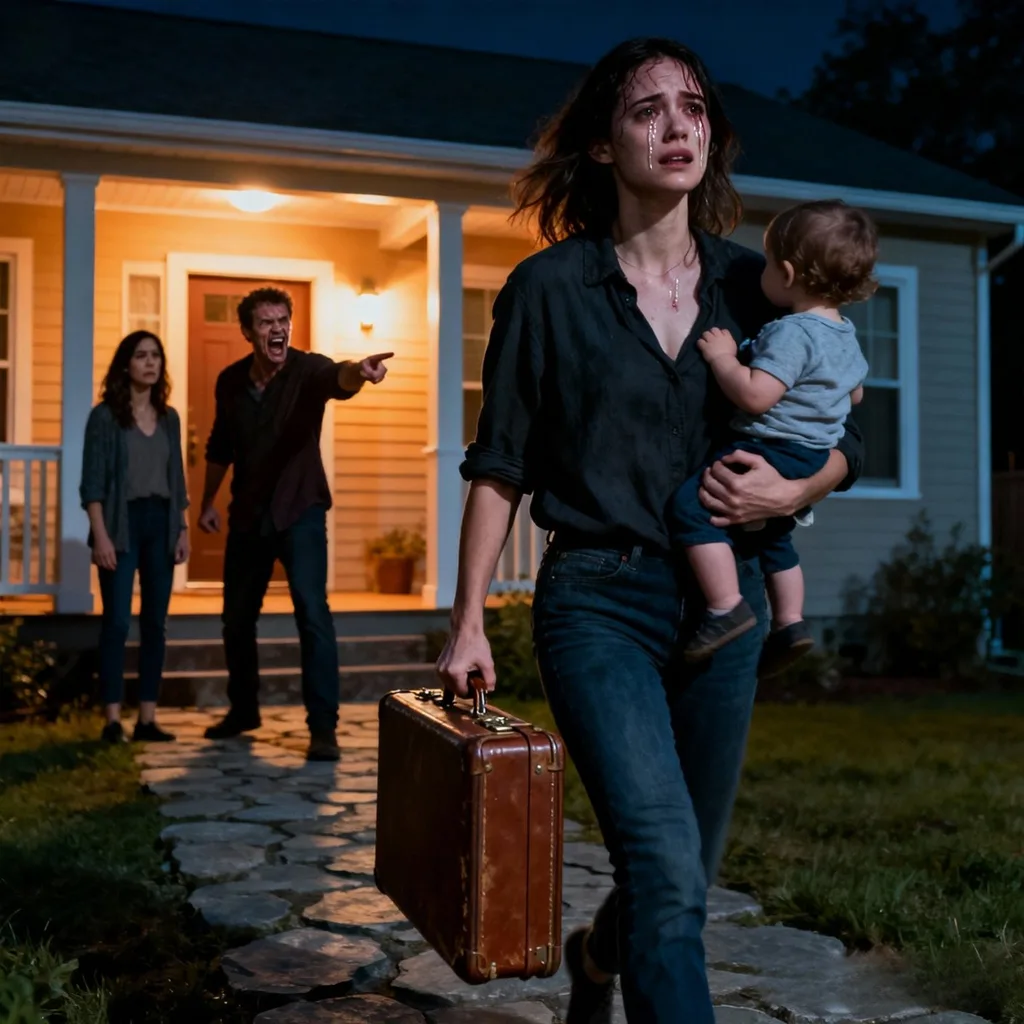
“Daniel… you can’t be serious.”
He looked at her the way a man looks at an employee he’s about to fire. “You think you can survive without me? You’ll starve out there. I’m done taking care of you.”
Behind him, Sophie’s eyes flicked over Lily’s trembling hands. “It’s best if you go quietly,” she said.
The words struck harder than shouting ever could. Lily didn’t fight. She packed the essentials into the suitcase he tossed at her feet. The rain outside swallowed her footsteps as she walked away from the home she’d built and the man she’d believed would never stop loving her.
For weeks, she lived on the couch of an old friend. The silence after everyone went to bed was unbearable. Her mind replayed Daniel’s voice again and again—you’ll starve without me.
There was truth in that, at first. She could barely eat. The exhaustion was bone-deep. She had spent years supporting Daniel through job losses, his failed business, his moods. When he was broken, she had patched him together. Now, standing in the wreckage, she realized she had nothing of her own left.
Then, one morning, she saw a small notice taped to the window of a café:
HELP WANTED — Catering Assistant.
The pay was meager, the hours long. But she walked in anyway.
Mrs. Harper, a sharp-eyed woman with silver hair and a voice like espresso—strong and steady—hired her on the spot.
That first day, Lily stood behind the counter arranging trays, her hands trembling, the smell of baked bread almost dizzying. By closing time, her body ached in every muscle, but her chest felt light. She’d earned something—small, but hers.
“I can do this,” she whispered into the quiet kitchen. And she meant it.
Months passed. Lily arrived early, stayed late, and learned everything. She studied invoices, schedules, clients. Mrs. Harper noticed.
“You’ve got discipline,” the older woman said. “The kind that builds empires.”
The compliment landed like a spark. Lily had been invisible for years; now someone saw her worth. Within six months, she was promoted to manager. Within a year, she became Mrs. Harper’s partner. They rebranded the company: Harper & Lane Events—Lane, her maiden name, the one Daniel had insisted she abandon because it “sounded small.”
Business boomed. Luxury hotels. Political fundraisers. Weddings where everything glittered but the love. Lily managed it all with quiet precision.
Then came the Windsor Gala. A massive corporate celebration. A client list full of executives and names that meant money. She was reviewing the seating chart when she saw it:
Daniel Carter – CEO, Carter Construction (acquired by Windsor Group).
The name stared back at her like a ghost.
When the night arrived, the ballroom gleamed with chandeliers and champagne. Lily stood near the entrance, clipboard in hand, calm, professional, unshakable.
And then he walked in.
Daniel looked smaller somehow. The sharpness that once filled every room had faded. He scanned the space until his eyes found her. His face paled.
“Lily?” he said, barely audible.
She smiled, all business. “Good evening, Mr. Carter. Welcome to Harper & Lane Events.”
He blinked, confused. “This… this is your company?”
“Yes,” she said simply. “Can I get you a drink?”
He didn’t answer. He didn’t have to. The silence between them was its own reckoning.
A few months later, her inbox pinged with a new message.
Subject: Request for Employment.
It was from Daniel.
His company had collapsed after a series of failed projects. Sophie, the woman he’d left her for, had walked out, taking a few of his clients with her. The email was short, almost pitiful:
I know I don’t deserve it, but I heard your company is expanding. If you could consider me for a position, I’d be grateful. Things haven’t been easy.
Lily read it three times.
The man who’d once said she would starve without him was now asking for work.
When he arrived for the interview, he looked deflated. His expensive suit hung loose on him, his eyes dull. He didn’t look like the man she once feared losing—he looked like the consequence of his own arrogance.
“Thank you for seeing me,” he said quietly.
She smiled faintly. “Of course. Everyone deserves a second chance.”
He leaned forward. “So… there’s a position open?”
“There was,” she said softly, closing the folder in front of her. “But it’s already been filled—by someone who never gave up on herself.”
For a moment, he just sat there. The silence stretched until it became unbearable.
“Lily,” he said finally, “I’m sorry.”
She stood, extending her hand across the desk. “I know you are. Take care of yourself.”
He took her hand, held it for a second, then left.
When the door closed behind him, she didn’t cry. She didn’t even smile. She simply exhaled, deeply, as if releasing the last of a weight she’d carried too long.
That night, the city glowed outside her apartment window—skyscrapers pulsing like slow, steady heartbeats. She poured herself a glass of wine and thought about everything that had happened in a single year.
She’d lost everything she thought made her safe: a marriage, a home, the illusion of dependence. But in losing it, she’d found herself—stronger, sharper, and free.
Daniel had been wrong. She hadn’t starved without him. She had learned to feast—on independence, on work that mattered, on the quiet satisfaction of building something that no one could take away.
There’s a peculiar peace that comes when the person who once broke you stands before you asking for mercy—and you realize you no longer need revenge. You’ve already won by surviving well.
Lily finished her wine and looked out at the city she’d built her second life in. The rain began again, gentle this time, tapping softly against the glass.
She thought of the woman she used to be—the one who cooked roasted chicken for a man who never saw her worth—and whispered, almost tenderly,
“You were right to walk away.”
Because sometimes the best revenge isn’t triumph or payback. It’s silence, grace, and the simple, undeniable truth that you never needed them to begin with.
News

A Mafia Boss Threatened Dean Martin on Stage—Dean’s Reaction Was Pure Genius
A Mafia Boss Threatened Dean Martin on Stage—Dean’s Reaction Was Pure Genius Prologue: A Gun in the Spotlight Dean…

The Billionaire Had No Idea His Fiancée Was Poisoning His Son—Until the Maid Exposed Everything
The Billionaire Had No Idea His Fiancée Was Poisoning His Son—Until the Maid Exposed Everything Prologue: A Whisper That…

The Billionaire Catches Maid ‘Stealing’ Food… But When He Sees Who It’s For, He Breaks Down in Tears
The Billionaire Catches Maid ‘Stealing’ Food… But When He Sees Who It’s For, He Breaks Down in Tears Prologue:…

The Billionaire’s Fiancée Sets a Trap for the Maid — Until His Silent Daughter Exposed the Truth
The Billionaire’s Fiancée Sets a Trap for the Maid—Until His Silent Daughter Exposed the Truth Prologue: The Whisper That…

The Billionaire Went Undercover as a Gardener — Until the Maid Saved His Children from His Fiancée
Richard Whitmore’s hands trembled on the garden shears as he watched through the kitchen window. His new wife, Vanessa, stood…

Three Flight Attendants Vanished From a Vegas Hotel in 1996 — 28 Years Later a Hidden Wall Is Opened
.Every hotel, every casino, every neon-lit alley has a story, most of them ending in forgetfulness or denial. But some…
End of content
No more pages to load






