
The library smelled faintly of lemon polish and old paper; chandeliers threw slow, polite shadows across the Persian rug. Emma’s wedding gown had been folded away hours earlier, but the house still hummed with the afterglow of ceremony — linens being counted, bouquets pressed into vases, champagne glasses washed and stacked. She moved through the east wing like a guest in her own life, following a sound so soft she almost convinced herself it was the house settling. A voice answered: thin, urgent, the sort of whisper that comes from the wrong place. Emma pressed her palm to the carved panel of the bookshelf on impulse; the wood sighed and, to her astonishment, yielded. A narrow passage opened, damp and impossible, the air cooler than it had any right to be on that humid Manhattan afternoon. At the end of the corridor a door stood like a secret with a heart. Someone knocked from the other side. “Hello?” a woman said. “Please—help me.” Emma’s knees went steady with a new kind of fear. Behind that locked door was a person who had been erased, hidden inside the man she’d just promised to marry.
Daniel Whitmore was polished in public: interviews, charity galas, the glossy profiles that call a fortune “legacy” and a smiling family “stability.” New Yorkers spoke his name in the same breath as the firm he helmed. When he asked Emma to marry him, she said yes fast as shock: it felt like rescue from a life she’d learned to manage without much luck. The mansion was a fairy tale with marble stairs and servants who knew just how the silver should sit. But from the first night, there were little cold places that didn’t belong to drafts — a careful distance when he entered a room, a polite hand that never bridged their shoulders, corridors his staff steered her away from with professional eyes.
People who live inside pedigrees construct private rooms the way others build garden fences — for privacy, for power. Emma assumed their marriage might be a quiet puzzle she could learn to solve. She did not assume she would be a piece to be moved. Curiosity built like a pressure in her chest: small things noticed and stored away — a guard who checked one wing twice a night, CCTV angles that avoided a certain hallway, an office with its key always clipped to Daniel’s belt. The voice behind the door was not just complaint; it was proof the house itself hid things in shadow.
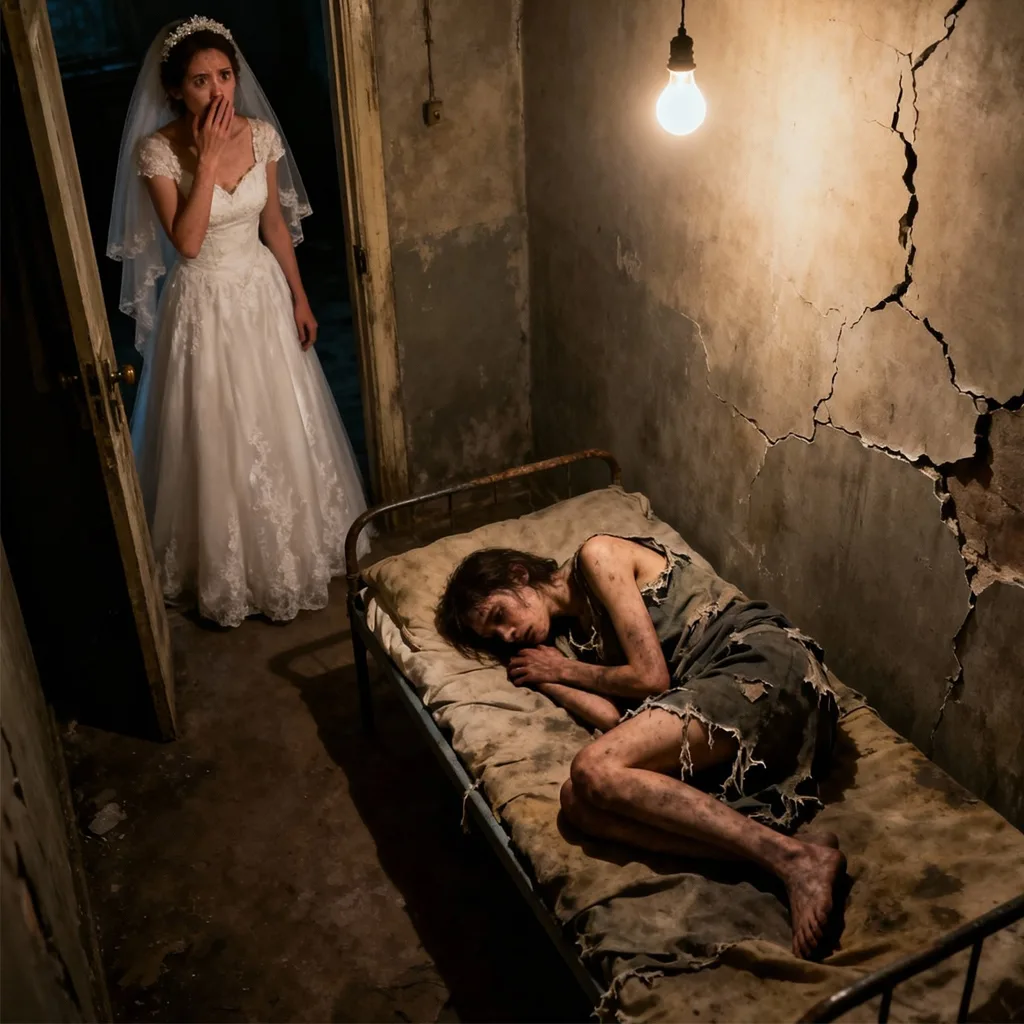
Claire’s face when the door opened was paper-thin with relief and fear. She was thinner than Emma had imagined, eyes ringed with a fatigue that had no reason inside the walls of a man of Daniel’s means. “He won’t let me leave,” she said, each word a stone. “I tried once. He…he said no one else could have me. He put the lock on me. He said I would ruin everything.” The story fell into place too cleanly: a brilliant man who wears secrecy like a coat, a lover kept not in bedrooms but in basements and back corridors, a wife used for appearance while a private obsession was held under key. Emma’s world rearranged itself in seconds from fairy tale to indictment.
What followed was arming of the small human things: trust and cunning, patience and a stopwatch. Emma could have raced to authorities and risked everything — the staff, the cameras, Claire’s safety. She could have confronted Daniel mid-gala, made him stumble in public and perhaps invited violence. Instead she learned the house like a map. She watched guard shifts, tracked the silence in Daniel’s phone calls, found the loose brick behind the fireplace that kept the key Daniel thought only he had. Every step was a decision not to be heroic for spectacle, but to be methodical for survival.
The night of the escape was a movie without music: muffled curses as Emma staged a false maintenance call, the guards shuffling away to check a plumbing leak, the click of the key she had hidden in her palm. Claire’s legs trembled when she stumbled through the door; Emma wrapped her in the spare shawl that had been in the trunk of her wedding car. Soundless as dawn, they slipped down servant stairs, past kitchens where the cooks pretended not to notice, into the street that smelled of hot pretzels and old tires. For a few walking breaths they were simply two women moving toward daylight.
But the reveal had to come next. Daniel returned to find an empty room and a house that still smelled of the woman he’d hidden. His calm fractured into a noise that Emma had only seen in the very late-night news: fury dressed like someone who had had his ledger disturbed. He threatened, he lied, he offered silence for agreement. Emma chose evidence over argument: photographs of the lock, Claire’s note with dates, CCTV stills she had managed to capture on a borrowed phone. She leaked to a reporter who still believed journalism mattered and then to platforms that turned outrage into pressure. The machine of reputation is fast; the machine of law is slower, but when both point the same way, a man who hides cannot hide forever.
Within forty-eight hours, the house had visitors it had never invited — investigators with badges, a lawyer who read Claire’s statements and kept his face flat, reporters who were not shamed into silence by a name. Daniel tried to compose his public person into innocence. The footage, the ledger, Claire’s testimony were not anecdotes; they were blueprints. Security staff who had once looked away began to speak. The charges — unlawful confinement, coercion, obstruction — landed like winter. The firm that had once bowed to Daniel’s calendar began to distance itself in press statements that used the language of detachment.
Claire’s recovery was slow and private, the way trauma carefully stitches itself into a future. Emma did not make a speech that night; she made a phone call to every woman she’d met in small rooms, in volunteer hours and book clubs, encouraging them to keep their eyes open. The narrative that had tried to turn her into a prop became, instead, an example of how witness can look like ordinary life — pressing a palm, finding a key, making a call.
The story ends not with a parade but with a quieter justice: a woman who entered a gilded marriage and found a cell instead of a husband made a choice that cost her the easy life and returned a life to someone who had been erased. Power disguises itself as decorum; wealth often buys silence. But secrecy is brittle when ordinary people practice uncommon courage — the neighbor who loans a charger, the intern who keeps a log, the bride who stays in the house long enough to notice a wrong and the patience to turn that notice into action.
Freedom, in the end, is not a headline. It is the small, dangerous work of opening doors that ought never have been locked. Emma did not want attention; she wanted what was basic and unspectacular: another human being back on the sidewalk, breathing air that belonged to her. She found that in the city’s bright, ungenerous light, courage does not require a cape. It requires attention, and a willingness to press where wood will open.
News
A Mafia Boss Threatened Dean Martin on Stage—Dean’s Reaction Was Pure Genius
A Mafia Boss Threatened Dean Martin on Stage—Dean’s Reaction Was Pure Genius Prologue: A Gun in the Spotlight Dean…

The Billionaire Had No Idea His Fiancée Was Poisoning His Son—Until the Maid Exposed Everything
The Billionaire Had No Idea His Fiancée Was Poisoning His Son—Until the Maid Exposed Everything Prologue: A Whisper That…

The Billionaire Catches Maid ‘Stealing’ Food… But When He Sees Who It’s For, He Breaks Down in Tears
The Billionaire Catches Maid ‘Stealing’ Food… But When He Sees Who It’s For, He Breaks Down in Tears Prologue:…

The Billionaire’s Fiancée Sets a Trap for the Maid — Until His Silent Daughter Exposed the Truth
The Billionaire’s Fiancée Sets a Trap for the Maid—Until His Silent Daughter Exposed the Truth Prologue: The Whisper That…

The Billionaire Went Undercover as a Gardener — Until the Maid Saved His Children from His Fiancée
Richard Whitmore’s hands trembled on the garden shears as he watched through the kitchen window. His new wife, Vanessa, stood…
Three Flight Attendants Vanished From a Vegas Hotel in 1996 — 28 Years Later a Hidden Wall Is Opened
.Every hotel, every casino, every neon-lit alley has a story, most of them ending in forgetfulness or denial. But some…
End of content
No more pages to load






