
The call came at 2:47 a.m. The dispatcher could barely hear the voice over the static and sobs.
“My dad and his friend… they’re hurting Mom again.”
It was a little girl. Seven, maybe eight. There was glass breaking in the background, then a muffled scream. The operator’s voice softened instinctively. “Sweetheart, what’s your name?”
“Lila,” came the whisper. “Lila Harper. Please hurry. Mommy’s screaming.”
Outside, the Ohio suburbs were asleep under a sheet of cold rain. Streetlights flickered through the mist as two patrol cars tore through the empty streets, red and blue lights cutting through the fog. Officers Julia Meyers and Derek Collins didn’t speak. They didn’t have to. They knew the kind of call this was.
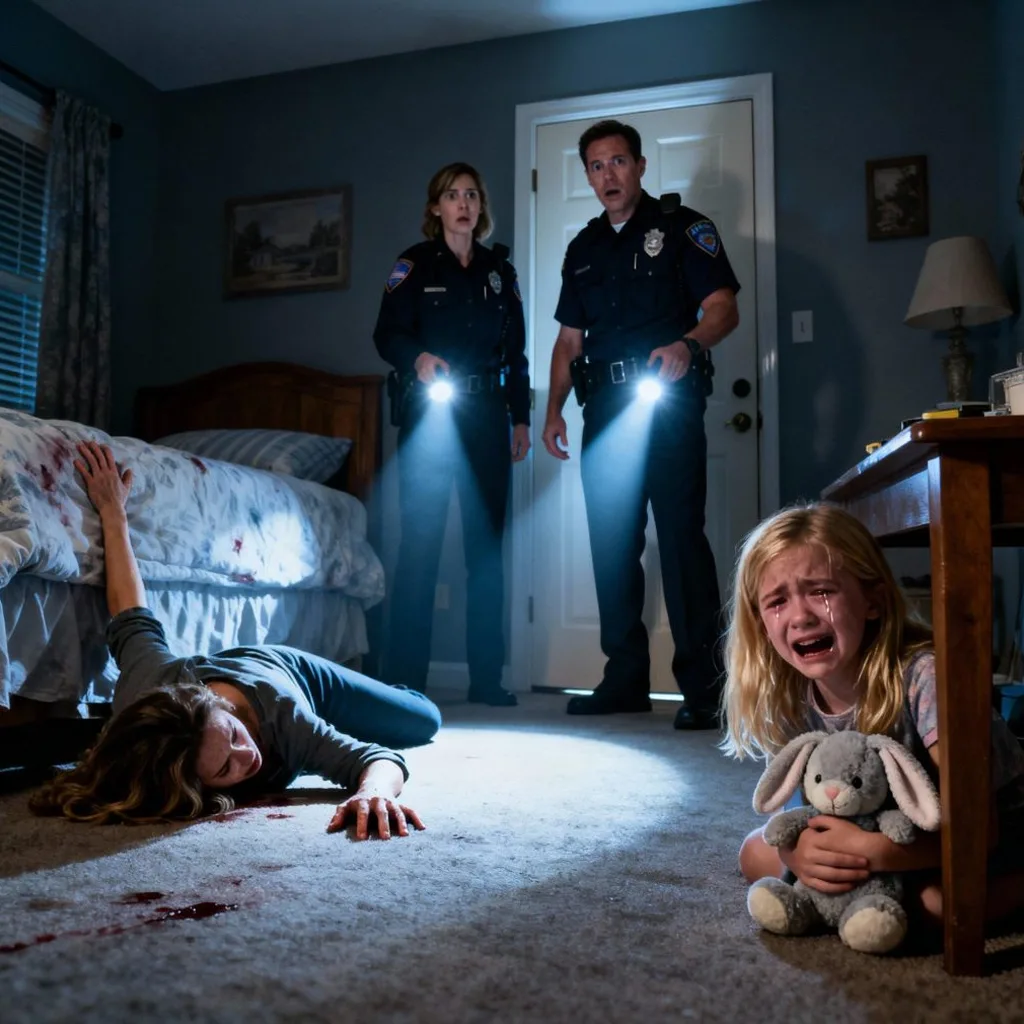
When they pulled up to the Harper house, they could hear the shouting before they reached the door — a man’s voice, slurred and cruel, followed by the sound of a body hitting the floor. Julia kicked the door open.
What they saw froze them in place. A woman lay crumpled on the carpet, bruised and half-conscious. Two men towered over her, both smelling of alcohol. Behind the couch, a little girl clutched a stuffed bear to her chest, her eyes too wide for her small face.
“Police!” Julia shouted, gun drawn. “Step away from her!”
The men stumbled backward, shouting incoherently. Collins moved first, tackling one to the ground while Julia restrained the other. The child ran to her mother, sobbing, “It’s okay, Mommy. They can’t hurt you now.”The ambulance lights painted the rain red as paramedics carried Amanda Harper out on a stretcher. Broken ribs, deep bruising, and a silence too heavy to name. Lila rode with her, gripping her hand all the way to the hospital.
By sunrise, Amanda was lying beneath the soft hum of fluorescent lights. Her face was swollen, but her eyes were dry now—tired, hollow, but dry. A social worker named Rachel Donovan sat beside her, hands folded patiently. “You’re safe now,” she said. “Your husband and his friend are in custody. But we need to talk about what comes next.”
Amanda’s gaze stayed on the ceiling. “He’s done this before. I always said I’d leave… but he’d always find me.” Her voice broke. “This time, Lila saw everything.”
In another room, Lila was drawing with crayons, under the gentle watch of a child advocate. Her picture was simple—three people holding hands under a bright yellow sun. When Officer Meyers stepped in, the girl looked up, eyes red but hopeful. “Is Mommy okay?”
“She’s going to be,” Julia said softly. “You saved her, Lila.”
The girl smiled faintly. “I was scared. But I didn’t want Mommy to die.”
The case hit the news within hours. “Man Arrested After Daughter Calls 911 to Report Domestic Assault.” Neighbors who once dismissed the shouting behind the Harper’s walls now spoke to cameras, shaking their heads. One said, “We heard them fighting for years… I guess we thought it wasn’t our place.”
That morning, Brian Harper stood before a judge, hands cuffed, reeking of stale whiskey. His lawyer muttered something about “alcohol dependency” and “a misunderstanding,” but the prosecutor’s voice was sharp as glass. “Aggravated assault. Domestic battery. Child endangerment.” The charges filled the courtroom air like thunder. Bail was denied.
For Amanda, recovery was slow. Each breath hurt; each hour dragged. But every time she opened her eyes, Lila was there—reading to her, brushing her hair, humming lullabies the way her mother used to. The hospital staff called her “the little guardian.”
When they were released days later, a women’s shelter welcomed them. Amanda stood in the doorway, holding Lila’s hand. The shelter smelled faintly of coffee and laundry detergent, but to Amanda, it smelled like freedom. “We can have a new house now, right?” Lila asked. Amanda smiled through her tears. “Yes, baby. A safe one.”
But safety, she soon learned, wasn’t permanent—it was something you had to keep fighting for.
Two weeks later, Monica—Brian’s attorney—filed an appeal. She argued emotional distress, claimed Amanda had “provoked” the violence, and demanded custody review. It was a last, desperate act. But Daniel Reeves, the young prosecutor on the case, wasn’t having it. He presented bank records showing Brian had emptied Amanda’s savings account, used threats to control her movements, and even coerced neighbors into silence. The judge’s gavel fell hard. The appeal was dismissed.
When the final sentencing came—twelve years without parole—Amanda sat in the courtroom holding Lila’s hand, her shoulders trembling not with fear, but relief.The months that followed were quieter, though the echoes of the past never fully left. Amanda and Lila moved into a small apartment near the lake—a one-bedroom with peeling paint and a broken heater, but it was theirs. Amanda found part-time work at a bookstore, and Lila started second grade under a new name.
Each night, Amanda tucked her daughter into bed, humming softly until Lila’s eyes closed. Then she would sit by the window and stare at the reflection of the city lights on the water. She was still afraid sometimes—afraid of footsteps in hallways, of unknown numbers calling—but she was learning to breathe again.
One evening, a knock came at the door. It was Rachel, the social worker who’d stood by her in the hospital. “There’s a local advocacy group starting up,” she said. “They help women like you tell their stories. I think you’d be good at it.”
Amanda hesitated. For years, her voice had been drowned out by shouting, by fear. But she thought of Lila—of the courage it had taken for that small voice to call 911—and she nodded.
Weeks later, she stood before a classroom of college students, hands trembling only slightly as she spoke into the microphone. “No woman should ever feel trapped in fear,” she said. “And no child should have to call for help because the adults didn’t listen.”
Lila sat in the front row, drawing pictures again—this time of a house with open doors and wide windows.One night, long after the talks had ended and the reporters had moved on, Amanda tucked Lila into bed. “Mommy,” the little girl whispered, “you’re not scared anymore, right?”
Amanda brushed a strand of hair from her daughter’s face. “Not anymore, honey. You gave me courage.”
Outside, the night was calm. Somewhere in the distance, a siren wailed and faded away—a sound Amanda no longer feared. She turned off the light, pausing in the doorway to watch her daughter sleep. The child who had once whispered into the phone for help now dreamed in safety.
Amanda looked out the window, the city lights glowing faintly in the fog. She whispered a quiet promise—to the women still living in silence, to the little girls still waiting for the sound of sirens. You can get out. You can start again.
The world would never know Lila Harper’s name. But somewhere, because of her courage, doors would open sooner, neighbors would listen harder, and voices—small, trembling, defiant—would finally be heard.
News

A Mafia Boss Threatened Dean Martin on Stage—Dean’s Reaction Was Pure Genius
A Mafia Boss Threatened Dean Martin on Stage—Dean’s Reaction Was Pure Genius Prologue: A Gun in the Spotlight Dean…

The Billionaire Had No Idea His Fiancée Was Poisoning His Son—Until the Maid Exposed Everything
The Billionaire Had No Idea His Fiancée Was Poisoning His Son—Until the Maid Exposed Everything Prologue: A Whisper That…

The Billionaire Catches Maid ‘Stealing’ Food… But When He Sees Who It’s For, He Breaks Down in Tears
The Billionaire Catches Maid ‘Stealing’ Food… But When He Sees Who It’s For, He Breaks Down in Tears Prologue:…

The Billionaire’s Fiancée Sets a Trap for the Maid — Until His Silent Daughter Exposed the Truth
The Billionaire’s Fiancée Sets a Trap for the Maid—Until His Silent Daughter Exposed the Truth Prologue: The Whisper That…

The Billionaire Went Undercover as a Gardener — Until the Maid Saved His Children from His Fiancée
Richard Whitmore’s hands trembled on the garden shears as he watched through the kitchen window. His new wife, Vanessa, stood…

Three Flight Attendants Vanished From a Vegas Hotel in 1996 — 28 Years Later a Hidden Wall Is Opened
.Every hotel, every casino, every neon-lit alley has a story, most of them ending in forgetfulness or denial. But some…
End of content
No more pages to load






