
A widow’s vulnerable sentence can become the spark for a national melodrama.
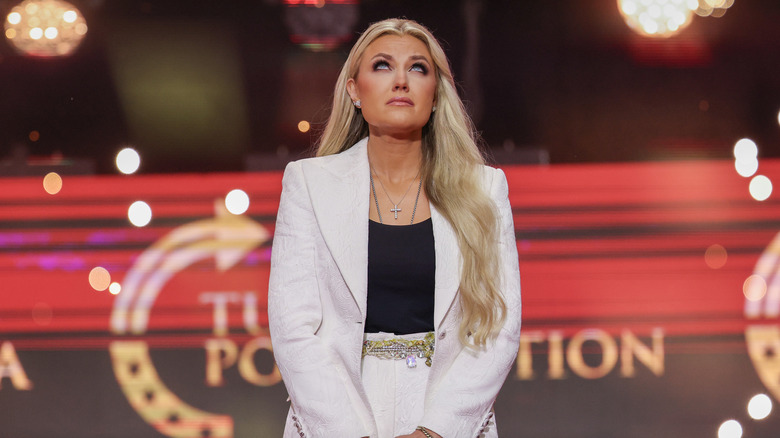
That is the hard lesson of late 2025, when Erika Kirk—thrust into conservative leadership after her husband Charlie’s killing—told an interviewer she had prayed she might be pregnant at the time of his death.
The line was tender, a human reach for permanence in the aftermath of violence.
Online, it became kindling.
Within hours, timelines were wielded like weapons, a hug was recast as a confession, and a bare ring finger in one photo morphed into a referendum on a marriage.
The frenzy says as much about the culture of scandal as it does about the people inside this particular story.
To keep faith with readers, let’s pin down what’s actually known and separate it from what’s been asserted without proof.
Erika sat for a high-profile interview and, in a moment of grief, voiced a wish that would have tied her husband’s memory to a new life.
She did not announce a pregnancy.
She has publicly said she is not pregnant, and early gestational estimates—often cited by rumor threads—are imprecise by weeks in the absence of medical records.
A widely circulated hug between Erika and Vice President J.D.
Vance did occur at a Turning Point USA event; the clip shows a moment of comfort onstage.
Images of Usha Vance appearing without a wedding ring exist; rings sometimes come off for ordinary reasons.
These points are visible.
What they are not is conclusive proof of an affair, a fractured marriage, or a conspiracy.
Turning optics into evidence is the rumor economy’s favorite trick.
The narrative escalated because the ingredients are familiar.
First, a charismatic commentator questioned the official arc of events and promised “receipts” to come.
In the modern attention market, that promise deputizes followers to play detective, building timelines and decoding gestures.
Second, the parasocial lens took over: viewers who’ve watched hours of Erika’s public life felt entitled to read micro-expressions and hugs as signals.
Third, partisan incentives amplified everything.
Scandal is currency; it mobilizes bases, monetizes streams, and satisfies priors.
In that environment, restraint looks like confession and silence looks like guilt.
Erika’s own posture has been measured and, to some eyes, too composed.
She mixed humor with discomfort when asked about the hug, describing herself as an “intense” hugger and reaching for levity to deflate a tense thread.
To supporters, that sounded like dignity—refusing to let grief be manufactured into scandal.
To critics, it sounded like deflection—evidence that she knows more than she’s saying.
Both interpretations are feelings.
Neither is proof.
The ring discourse around Usha Vance follows a similar pattern.
A photo from a service event showed her without a ring.
In other moments across years, she has also appeared with a ring.
Life is not a storyboard.
Mothers wash dishes, exercise, travel, and sometimes forget a piece of jewelry.

A spouse’s religious differences—J.D.
has spoken openly about his conversion and hopes for Usha’s faith—add texture to a marriage but do not supply the plot points rumor demands.
If a marriage were legally changing, filings, statements, or named-source confirmations would appear.
As of this writing, none have entered the public record related to this specific online narrative.
That matters.
This episode has also revived an uncomfortable truth about grief in public life.
The double bind is relentless: share more, and you’re performative; share less, and you’re cold.
A widow who continues to lead an organization and appear on stages will be measured not just by choices but by posture—how she holds herself when she says “we’re moving forward,” whether her voice catches, whether her hand lingers on a shoulder.
Audiences assign meaning to those micro-moments.
Some of that meaning is kind.
Much of it is projection.
Underneath the projection is a political reality.
Turning Point USA is an ecosystem—donors, staff, students, media allies, elected figures.
Ecosystems strain when a central figure dies violently.
Ambition jostles with loyalty; narratives compete; optics matter more than normal because people are looking for signals in a fog.
In those conditions, rumor can be a tool.
It can be used to pressure rivals, force clarifications, or reroute attention.
It can also cause collateral damage—especially to families—with no upside for truth.
The pregnancy whisper campaign has been particularly corrosive because it targets a body and a private hope.
It treats a woman’s fertility as a public puzzle.
It drags medicine into a meme war and then declares victory when the math looks neat on a timeline without medical context.
Responsible reporting does not publish insinuations about intimate matters without on-the-record sources and documents.
It does not treat a hoped-for pregnancy as a plot twist.
That line—“I prayed I was pregnant”—was a plea for permanence, not a confession.
The hug backlash reveals another structural problem: body-language analysis is not forensics.
Decades of research and hard-won wisdom from interrogators and interviewers arrive at the same caution.
You cannot reliably infer romance, deceit, or guilt from a hug or tone in a short clip.
Context matters more than posture; history matters more than a single gesture; and the pressures of a stage—lights, expectations, grief—distort the naturalness of any moment.
In normal life, humans hug.
On stages after a killing, humans hug more.
The ringless riddle speaks to our appetite for symbols.
Rings are powerful because they compress commitment into metal.
But symbols without context are dangerous.
Maybe the ring was off for mundane reasons.
Maybe it was off as a personal signal.
If it were the latter, that meaning belongs to the person wearing—or not wearing—it.
The public has no claim to decode a marriage from one image.
Marital changes show up in paperwork, not comments under a photo.
So where does that leave a reader who wants clarity without cruelty? With a slower, steadier method.
Verify before amplifying.
Treat optics as optics.
Demand names and provenance.
Ask whether a claim can, in principle, be disproven.
If every counterfact gets absorbed as “cover-up,” you’re looking at a belief system, not a report.
Separate public interest from prurience.
A rumor’s popularity is not the same as newsworthiness; the question is whether the information changes civic understanding or merely satisfies curiosity.
Respect grief.
When death and mourning meet influence, the humane move is to pause.
Applied here, that method yields a sober picture:
– Erika voiced a vulnerable hope about pregnancy at the time of her husband’s death and has stated she is not pregnant.
Without medical records or on-the-record medical confirmation, gestational arithmetic is not sufficient to justify public allegations.
– A hug between Erika and J.D.
Vance was widely shared and overinterpreted.
It is not evidence of an affair.
It is a frame from a larger moment of communal grief.
– Photos of Usha Vance without a ring exist alongside photos in which she wears a ring.
Rings come off for ordinary reasons; no public filings indicate a marriage is legally changing in connection with this narrative.
– Commentary and counter-commentary from prominent voices escalated suspicion.
Skepticism is healthy.
Proof is different.
Claims that move from critique to allegation must clear a higher bar.
– Reports and rumors about law enforcement interest have circulated in various forms.
Official language—as commonly used by agencies in live matters—has been generic.
Without dates, names, scopes, and filings, the claim remains unverified.
At this point, a different kind of responsibility enters the story: the responsibility of audiences to hold uncertainty without letting it sour into cynicism or whip into certainty.
Doubt is not bad.
Doubt is care when it prevents reputational harm done by conclusions that outrun facts.
Empathy is not indulgence.
Empathy is ballast when a family is asked to carry public projections on top of private pain.
What would real confirmation look like if the explosive version of the rumor were true? You would see migration from feed to record: filings with courts, requests with scope and date, transcripts that specify language and context, documents with provenance that can be checked, and parallel reporting from multiple independent outlets arriving at the same core findings.
You would see on-the-record responses from principals and counsel engaging specifics.
You would see consequences tied to verified facts—interviews, motions, sanctions, resignations.
You would not need to read tea leaves in hugs or rings.
The inverse is also possible.
Verification stalls because there is nothing to verify beyond public moments and online speculation.
In that world, the story recedes and leaves behind the usual residue: a thinner layer of trust and a sense that attention was spent recklessly.
That outcome is common.
It is also preventable.
Readers can raise their standards on their own.
This entire episode has surfaced an awkward mirror for a movement that prizes moral clarity.
If “family values” are more than a slogan, then family life should not be mined for entertainment, and grief should not be a drafting table for scandal calendars.
A widow’s prayer for permanence should not be twisted into a plot device.
A spouse’s ring should not be a hook for strangers to hang a theory.
A hug should not carry more weight than a record.
There is an alternate path available right now: cover what is documented, decline what is speculative, and keep dignity constant.
That approach is slower.
It is less thrilling.
It is more American in the best sense—a commitment to fairness over frenzy, to proof over projection.
It asks media to resist velocity incentives and audiences to practice digital patience.
It asks movements to treat their own with the kindness they demand from others.
Erika continues to lead under scrutiny.
She embraces people with more intention than before because she understands how comfort reads.
She speaks about faith and forgiveness because rage steals from the children she is raising.
That choice will offend some who prefer punishment to grace.
It will reassure others who see strength in refusing to let rumor draft the terms of a life.
Usha continues to appear at service events.
Sometimes a ring is on; sometimes it isn’t.
The internet will not stop reading meaning into that.
She does not have to supply it.
J.D.
stays quiet.
Silence in politics is a fraught tool—equal parts prudence and risk.
In this case, it may be the only option that does not add oxygen to a fire built on images.
Strip the story down to its cleanest shape and you get this: a widow’s prayer was misread as a confession; a hug became a screen onto which audiences projected suspicion; a ring became an anchor for narratives about a marriage; commentary inflated timelines into verdicts; and a country already primed to see scandal behind every curtain used those elements to test its own moral core.
The test is ongoing.
The grade will be determined by whether we let proof, not projection, decide what’s true.
Until documents and names arrive, restraint is not weakness; it is discipline.
It shields the vulnerable from unnecessary harm.
It guards readers from becoming instruments of damage.
It keeps the public square worth inhabiting.
In the meantime, the fairest sentence about this saga is the quiet one: a compelling narrative is being told without corroboration.
If the next headline is real, it will come from the record.
If it doesn’t, the decency we practice now will matter more than any clip we watch twice.
News

A Mafia Boss Threatened Dean Martin on Stage—Dean’s Reaction Was Pure Genius
A Mafia Boss Threatened Dean Martin on Stage—Dean’s Reaction Was Pure Genius Prologue: A Gun in the Spotlight Dean…

The Billionaire Had No Idea His Fiancée Was Poisoning His Son—Until the Maid Exposed Everything
The Billionaire Had No Idea His Fiancée Was Poisoning His Son—Until the Maid Exposed Everything Prologue: A Whisper That…

The Billionaire Catches Maid ‘Stealing’ Food… But When He Sees Who It’s For, He Breaks Down in Tears
The Billionaire Catches Maid ‘Stealing’ Food… But When He Sees Who It’s For, He Breaks Down in Tears Prologue:…

The Billionaire’s Fiancée Sets a Trap for the Maid — Until His Silent Daughter Exposed the Truth
The Billionaire’s Fiancée Sets a Trap for the Maid—Until His Silent Daughter Exposed the Truth Prologue: The Whisper That…

The Billionaire Went Undercover as a Gardener — Until the Maid Saved His Children from His Fiancée
Richard Whitmore’s hands trembled on the garden shears as he watched through the kitchen window. His new wife, Vanessa, stood…

Three Flight Attendants Vanished From a Vegas Hotel in 1996 — 28 Years Later a Hidden Wall Is Opened
.Every hotel, every casino, every neon-lit alley has a story, most of them ending in forgetfulness or denial. But some…
End of content
No more pages to load






