
“DAD SAID MY SISTER DESERVED MY SUV — UNTIL I SHOWED HIM WHAT SHE’D DONE”
The house smelled like roast chicken and drugstore air freshener—the scent of every Sunday I’d ever forced myself to attend. My mother called “Simon’s here!” as if I were a polite guest and not the mule expected to bring dessert and the car seats for my sister’s kids. I set the apple pie on the counter and kept the gray folder tucked under my arm, pressed tight to my ribs like a second sternum. In the dining room, my father lorded over the head of the table with a beer; Uncle Ron smiled the way only honest people do, brief and unadorned; Tessa and her husband, Dan, scrolled their phones. From the living room, cartoons shrieked while my niece and nephew competed with them. I took the chair with the empty place setting and rested the folder there. I’d promised myself I wouldn’t need it. I’d promised myself, again, we could talk like adults. Promises, I reminded myself, are the first casualties in this family.
Small talk shuffled around the table like tired cards: Dad’s property taxes, Mom’s new vague ailment, Tessa’s latest pediatric rash. I offered my usual monosyllables, my jaw a locked gate. The week before, I’d seen a screenshot on my cousin’s story: a group chat called “Family Planning”—Mom, Dad, Tessa, Dan, even Uncle Ron. Not me. The caption chirped: Teamwork makes the dream work! They had coordinated an ambush. My life reduced to an agenda item, my property a line to be reassigned.
Mom delivered the chicken like a sacrament. When the plates filled and the room got loud with chewing, Dad tapped his glass—tap tap tap—the sound of a man who believes announcements are the same as truth. “It’s decided,” he said, not looking at me, looking instead at his coalition. “Your sister gets your SUV.” In the silence that followed, the room didn’t fall still; it busied itself with justifications. “She has kids,” he added, like an incantation that makes theft a virtue. “It’s done.”
Words descended—practical, inevitable, patronizing. You don’t need it. You can afford another. She needs space. Family looks out for family. Their logic wore my history like a mask.
I glanced at the folder and didn’t open it. Not yet. The therapist’s instruction surfaced: state facts, not feelings. Breathe. Let silence do a little of the labor you always do for it.
“You held a meeting without me,” I said finally, evenly. “To give away my property.” Dad’s gaze hardened. “Don’t you start. Family looks out for family.” I slid the folder onto the table beside the gravy boat. “Then let’s talk about what family does to family.”
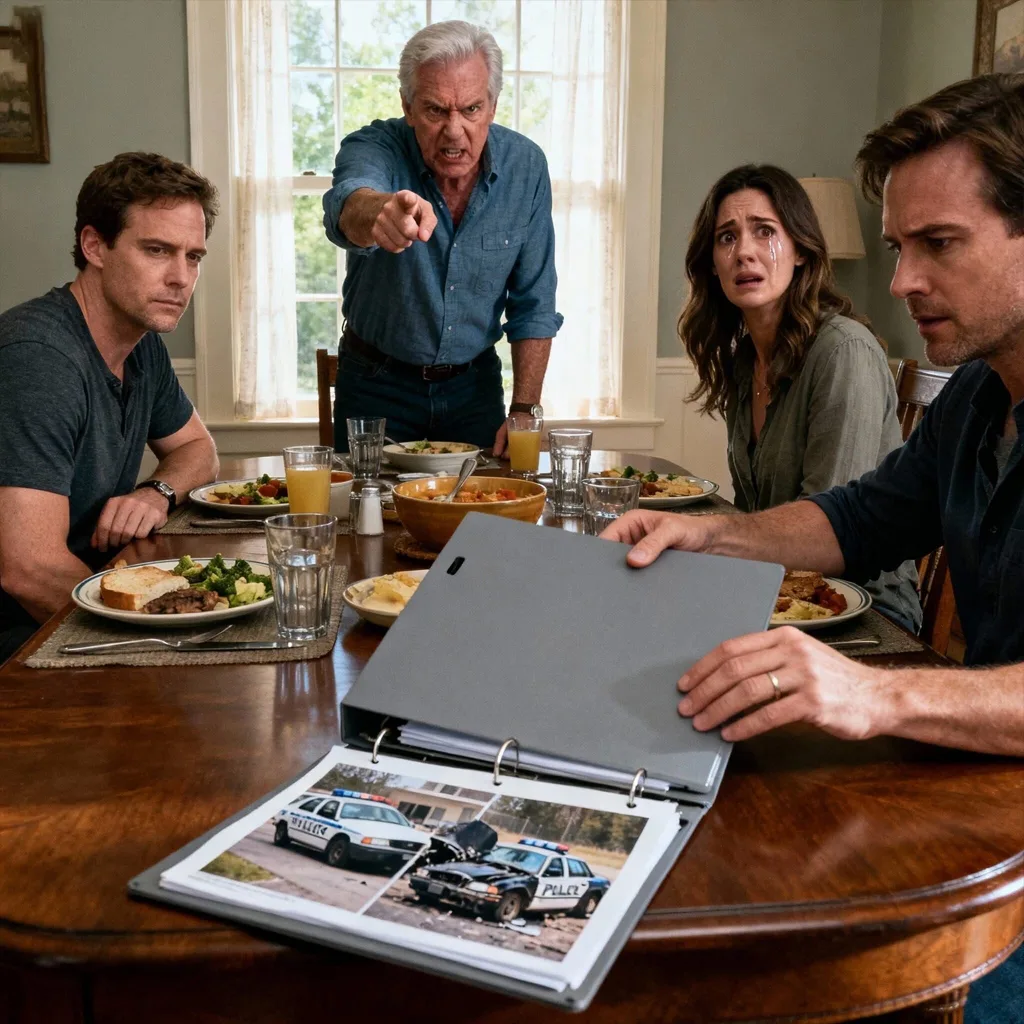
The first page was a full-color police photo: a crumpled hood, a bent street sign, airbags ghosting the interior. Uncle Ron leaned in despite himself and let out a genuine “Jesus, Tess.” Tessa’s smile tried to stay and then fell off her face. I turned the page to the report: last October, 1:47 a.m., driver—Tessa. Breathalyzer—0.11. The legal limit—0.08. “It was one mistake,” she stammered. “The curb was weird,” Dan said, as if the curb had begged to be jumped.
“Here’s the actual problem,” I said, sliding out the next page. The commercial auto policy for my company, with the clause highlighted: only listed drivers permitted; any DUI voids the policy and triggers termination. “That SUV,” I said, “isn’t a family shuttle. It’s my livelihood. If she drives it and drinks again, we don’t just lose a claim—we lose the company. My employees lose jobs. My clients lose deposits. I get sued. All because your stroller won’t fit in your hatchback.”
Silence, finally—the good kind, the refrigerator-hum kind that means reality has entered the room. Dad’s face purpled. Mom’s mouth opened and forgot to close. Tessa cried real tears, which, in this family, are often an opening bid. “You’re cruel,” Mom said, switching to her concerned-matriarch voice. “You’re single. You don’t need that much car.”
I pulled the spreadsheet next: three years of quiet arithmetic. Venmo requests, “emergencies,” soccer fees, a plumber who “didn’t take cards,” the co-signed loan, the “hold” on my business card that became a weekend in Palm Springs. No repayment marked. The total sat at the bottom, bold and undeniable. “Families don’t invoice,” Dad scoffed. “No,” I said. “But families also don’t call your boundary cruelty when their entitlement finally meets it.”
Tessa slammed her palm on the table. Glasses jumped. “We came to talk like grown-ups. You brought props.” “You came to collect,” I said. “You held a meeting to decide that something I built should belong to you because you want it and I’m too polite to stop you. I am done being polite.”
Dad rose so fast his chair screeched. “You walk out with that attitude, don’t come back when you need us.” I stood too, gathering the papers, the weight suddenly very light. “I haven’t needed you since I learned to make instant noodles,” I said. I took a step, then paused. “One more fact, since we’re so practical: I’ve already removed you from my roadside assistance plan.” Uncle Ron breathed, almost pleased, “Good for you, kid.”
I didn’t slam the door. I closed it and felt the lock click like a spine straightening.
In the driveway I sat with the engine off, hands shaking with the unfamiliar freedom of having spoken. My phone pulsed: the family group chat performed its predictable liturgy—cruel, unhinged, embarrassment, unforgivable, bro not cool. I archived it. A text from Leah, my operations manager: How’d it go? I wrote: I didn’t hand them the keys. She replied: Good. Your 10 a.m. tomorrow is the School Travel Council. You okay to present? I stared at the dashboard, at the part of my life no one in that dining room would ever honor. Yes, I wrote. I can do that.
That night I changed the gate code, removed every family member from every account that made me responsible for their emergencies, and emailed my agent to confirm that the only permitted driver on the policy was me. Then I asked Leah to schedule the vinyl decals—large, unmistakable—so that no one could pretend the vehicle’s purpose was sentimental.
Mom left a voicemail that toured the entire spectrum: wounded, concerned, logistical. “The kids are the ones who’ll suffer,” she concluded. “When they ask why Uncle Simon doesn’t love them enough to keep them safe in a good car, I hope you have an answer.” I deleted it, then stood in my apartment and touched the photo on my bookshelf—my team at our first office party, exhausted and proud. My family, the kind that says thank you and means it.
The next morning, I presented on risk and itineraries to a roomful of parents who asked practical, hopeful questions. Afterwards, a committee chair pressed a deposit check into my hand. “We heard you always show up,” she said. My hand was steady when I took it. Two weeks later Tessa called. “I’m not asking for your SUV,” she said quickly. “Do you know anyone who sells used minivans from a fleet?” “I do,” I said. “You’ll pay him directly. Not me.” “Right,” she whispered. “I get it.”
Uncle Ron asked me to meet him at a diner. “Your dad confuses decisions with commandments,” he said, stirring his coffee. “They’re planning an ‘intervention’ called ‘reconnecting,’ which is a guilt-trip with props. Don’t go. Or bring the folder.” I laughed, a laugh with oxygen in it. I sent flowers to the intervention and drove to the coast instead, watched a gray sea on a gray day, and booked a school trip over the phone.
Back home, I drew a thick black line beneath the last entry on the spreadsheet and wrote, in clear letters: NO NEW ENTRIES. Then I put the folder in a drawer—not to hide it, but to rest it. Sunday came. I ran instead of driving across town. I cooked pasta and watched a film. My cousin Laura sent a photo of Tessa’s kids in a battered secondhand minivan, crumbs everywhere, both grinning. The caption read: They did it. I sent a simple thumbs-up. Sometimes a boundary looks like brevity.
My father says “family looks out for family,” and for years that meant I bled on command. I’m revising the definition. Family looks out for family means I protect the people I’m responsible for—my employees who count on paychecks, my clients who trust me with their children, and the man in the mirror who finally learned to say no. A deed doesn’t prove a home; a pattern does. An SUV isn’t a lifeboat; boundaries are. You can love people and still refuse to be their insurance policy. You can be generous without being harvested.
I keep the SUV, with the decals on the doors, as a small moving testament: this is not yours to take because you want it. On quiet mornings the engine ticks softly after I park, and I sit a beat longer, listening to that cooling metal, to my own breathing. It is a modest sound, steady and unremarkable. It is also the sound of a life that finally belongs to me.
News

A Mafia Boss Threatened Dean Martin on Stage—Dean’s Reaction Was Pure Genius
A Mafia Boss Threatened Dean Martin on Stage—Dean’s Reaction Was Pure Genius Prologue: A Gun in the Spotlight Dean…

The Billionaire Had No Idea His Fiancée Was Poisoning His Son—Until the Maid Exposed Everything
The Billionaire Had No Idea His Fiancée Was Poisoning His Son—Until the Maid Exposed Everything Prologue: A Whisper That…

The Billionaire Catches Maid ‘Stealing’ Food… But When He Sees Who It’s For, He Breaks Down in Tears
The Billionaire Catches Maid ‘Stealing’ Food… But When He Sees Who It’s For, He Breaks Down in Tears Prologue:…

The Billionaire’s Fiancée Sets a Trap for the Maid — Until His Silent Daughter Exposed the Truth
The Billionaire’s Fiancée Sets a Trap for the Maid—Until His Silent Daughter Exposed the Truth Prologue: The Whisper That…

The Billionaire Went Undercover as a Gardener — Until the Maid Saved His Children from His Fiancée
Richard Whitmore’s hands trembled on the garden shears as he watched through the kitchen window. His new wife, Vanessa, stood…

Three Flight Attendants Vanished From a Vegas Hotel in 1996 — 28 Years Later a Hidden Wall Is Opened
.Every hotel, every casino, every neon-lit alley has a story, most of them ending in forgetfulness or denial. But some…
End of content
No more pages to load






