
The lace sleeve of my wedding gown brushed against the window as I leaned forward, breath fogging the glass. Beyond it, the world of my perfect morning—rose petals, warm lantern light, soft violin rehearsals drifting up from the garden—collapsed into a single, shattering image. My fiancé, Daniel, stood at the far end of the parking lot. My maid of honor, Claire, stood with him. She laughed at something he said, a sound I knew as well as my own heartbeat. And then he brushed a strand of hair from her cheek and kissed her with the kind of ease that comes from practice, not impulse.
My niece, Lily, hovered at my side, trembling. “I told you,” she whispered. Her voice felt far away, like someone calling from the bottom of a lake. I stood frozen in my own reflection—veil slipping, eyes widening, everything inside me clenching into stillness. The wedding gown suddenly felt like a costume for a play I’d never agreed to star in. The violin rehearsal faded. Only the quiet thud of my pulse remained.
The old countryside inn had promised magic. I’d chosen it for its creaking floors, its honey-colored beams, its sprawling view of autumn trees that painted the world in amber. That morning, sunlight filtered through lace curtains and brushed my face with a softness that felt like blessing. My bridesmaids had circled me in laughter; my mother had fussed with my earrings; someone had whispered, “It’s your day, Hannah.”
Yet beneath the warm glow of celebration lurked a restlessness I couldn’t name. Claire had been distant for months, distracted in ways I had explained away. Daniel had grown quieter, brushing off questions with tired smiles. I told myself this was normal pre-wedding stress. Every couple stumbled into the altar with a few bruises. Love wasn’t perfect; it was persistent.
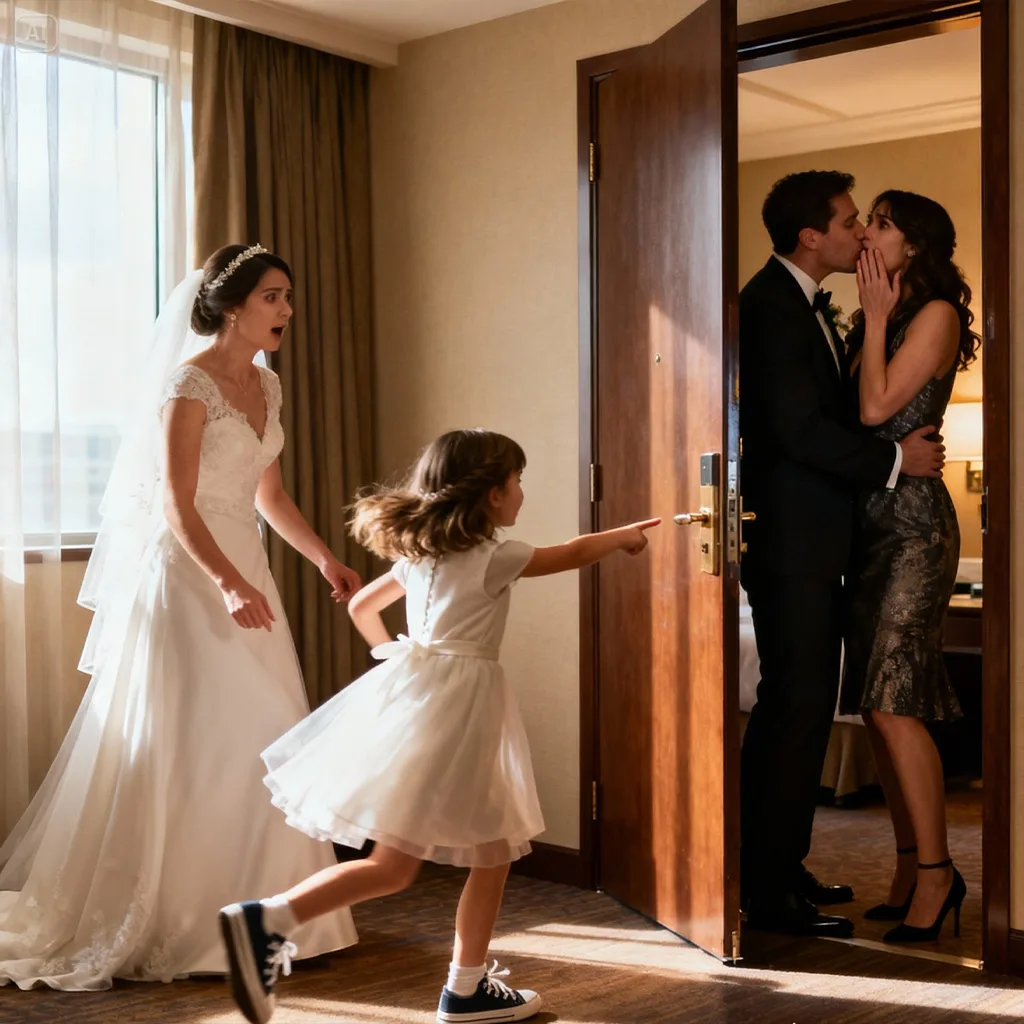
But the truth had been waiting for its moment. It chose to arrive an hour before the ceremony, carried by a fourteen-year-old girl with tear-streaked cheeks and more courage than the adults around her. Lily’s small hand had tugged mine, guiding me down the hall, past the bouquets, past the laughter, into a room where innocence ended and clarity began.
Back in my suite, the air felt thick. The flowers seemed too bright. The mirror too honest. I tore the veil from my hair, fingers shaking, as messages buzzed across my phone—questions from the planner, reminders from the photographer, a cheerful text from Daniel that made my stomach twist:
“Ready to make this official?”
I typed instead to Claire:
Come to my suite. Alone.
She arrived breathless, cheeks flushed as if she’d run here. She started to speak, but I raised a hand and the room stilled around us. “I saw you,” I said. Two words, sharp enough to cut the air.
She froze. Denial flickered first, then died. A strange relief washed across her face, as if she’d been holding her breath for months. “It wasn’t supposed to happen like this,” she whispered.
“How was it supposed to happen?” I asked. “Before the ceremony? After the honeymoon? When was betrayal supposed to fit into your schedule?”
She sobbed into her palms, words tumbling out—apologies, excuses, confessions. She said she never planned it, that it just happened, that she tried to stop. I felt myself detach, observing her breakdown as if she were a stranger collapsing on a stage.
Then Daniel appeared in the doorway. His face was pale, panic sharpening every line. “Hannah, please. We can talk about this.”
“Talk?” I stepped toward him, the gown brushing the floor like a ghost trailing behind me. “You kissed my best friend an hour before the wedding.”
He reached for me; I stepped back. The engagement ring felt heavy, suddenly meaningless. I slid it off and set it gently on the table between them. “The two of you deserve each other,” I said quietly. And then I walked out—past their stunned faces, past the murmuring guests, through the sunlit doors, and into the crisp Vermont air.
Still in my gown, I got into my car and drove until the inn disappeared in the rearview mirror like a discarded chapter.
Two weeks later, I lived in my sister’s guest room in Portland. I kept the curtains drawn. News headlines called me “the runaway bride,” as if my leaving was an impulsive sprint instead of the most conscious choice I’d made in years. My voicemail filled with Daniel’s apologies. I deleted them all.
Grief settled slowly—not for him, but for the version of myself who had once believed she needed to be chosen to be valuable.
My sister coaxed me outside one gray afternoon. “Just a walk,” she insisted. “You don’t have to talk.” The Willamette River moved in slow folds beside us, indifferent to heartbreak. At a little café along the water, we ran into Mark, an old college friend whose smile carried no curiosity, no pity—just recognition.
We talked about nothing monumental. Books. Bad campus coffee. The professor who always wore mismatched socks. And somehow, between sips of warm tea, I laughed for the first time in weeks. Not a polite laugh. A real one.
Days slipped into weeks. Mark appeared often—with lattes, with stories, with long silences that didn’t require filling. I began therapy, learning how my loyalty had stretched far past the point of dignity. I walked along the river most mornings, letting the cold air fill my chest, letting the world feel new again.
Then one evening, a letter arrived. Lily’s handwriting spilled across the envelope.
I’m sorry you were hurt, Auntie. But I’m glad you know the truth. You’re the bravest person I know.
I held the letter for a long time. When I cried, it wasn’t from sorrow—it was from being seen.
A year later, I met Mark again at the riverside café. The sun shimmered on the water, gilding every ripple. He smiled the same warm, patient smile that had carried me through the hardest winter of my life. This time, I didn’t look away.
Some chapters close with slammed doors. Others close quietly, like a book set gently on a nightstand. Mine closed somewhere in between—painful, necessary, transforming.
Heartbreak isn’t the end of a story. It is the clearing of a path. The wedding I didn’t have became the life I finally did. I learned that walking away isn’t abandonment—it’s reclamation. Love isn’t proven in ceremony or vows or rings. It’s proven in stillness, in choice, in truth.
And as the river moved steadily beside me that day, I understood at last: sometimes the most courageous thing a person can do is step out of the picture that was never meant to hold them.
News

A Mafia Boss Threatened Dean Martin on Stage—Dean’s Reaction Was Pure Genius
A Mafia Boss Threatened Dean Martin on Stage—Dean’s Reaction Was Pure Genius Prologue: A Gun in the Spotlight Dean…

The Billionaire Had No Idea His Fiancée Was Poisoning His Son—Until the Maid Exposed Everything
The Billionaire Had No Idea His Fiancée Was Poisoning His Son—Until the Maid Exposed Everything Prologue: A Whisper That…

The Billionaire Catches Maid ‘Stealing’ Food… But When He Sees Who It’s For, He Breaks Down in Tears
The Billionaire Catches Maid ‘Stealing’ Food… But When He Sees Who It’s For, He Breaks Down in Tears Prologue:…

The Billionaire’s Fiancée Sets a Trap for the Maid — Until His Silent Daughter Exposed the Truth
The Billionaire’s Fiancée Sets a Trap for the Maid—Until His Silent Daughter Exposed the Truth Prologue: The Whisper That…

The Billionaire Went Undercover as a Gardener — Until the Maid Saved His Children from His Fiancée
Richard Whitmore’s hands trembled on the garden shears as he watched through the kitchen window. His new wife, Vanessa, stood…

Three Flight Attendants Vanished From a Vegas Hotel in 1996 — 28 Years Later a Hidden Wall Is Opened
.Every hotel, every casino, every neon-lit alley has a story, most of them ending in forgetfulness or denial. But some…
End of content
No more pages to load






