
THE MAN BEHIND THE MASK
The wedding gown didn’t fit right. It shimmered too brightly under the lights, a cruel reminder that it belonged to someone else’s dream.
Outside the chapel in Tagaytay, a cold fog rolled over the hills, muffling the sound of distant church bells. Inside, Ella stood trembling at the altar beside a man everyone called Don Armando — a name that carried both fear and fortune.
He was large, older, his belly pressing against his vest, his face glistening with sweat under the chandelier. When he smiled, it was careful, almost shy.
“From now on,” he said in a low, rumbling voice, “you’ll never have to worry about money again.”
Ella managed a nod. Her lips curved into something that looked like a smile, though it wasn’t one. Her mother was in the hospital, her brother out of school, and the rent two months overdue. Somewhere deep in her chest, a small voice whispered: I’m doing this for them. I have to.
When the vows ended, no applause followed — just polite murmurs, and rain beginning to fall against the chapel windows. That night, while her new husband slept in the grand, unfamiliar mansion, Ella lay awake in the dark, listening to the rain and wondering what kind of prison she had built for herself.
Life in the mansion was strange, like living inside a portrait — quiet, airless, and watched.
Servants bowed when she passed. Meals arrived like clockwork. Her husband, Don Armando, treated her kindly, always speaking softly, always watching her with those unreadable eyes.
He wasn’t cruel. Just… controlled. There was a precision to him — the way he moved, the way he ate, the way he seemed to study her every word.
And there were other oddities.
His hands, she noticed one evening at dinner, were not the hands of an aging man. They were smooth, strong, and unlined. When he lifted his wine glass, she saw no tremor. When he laughed, it was too rich for someone his age.
“Don Armando,” she ventured carefully, “how old are you really?”
He smiled, eyes gleaming. “Old enough to know what truly matters in a person.”
The words lingered in her mind long after he’d left the table.
Days later, one of the house stewards, a soft-spoken man named Luis, approached her discreetly.
“Ma’am,” he whispered, glancing toward the hallway, “don’t be alarmed if you notice strange things about the boss. He has his reasons.”
His reasons.
The phrase echoed in her thoughts as the mansion fell into its nightly silence.
That night, unable to sleep, Ella slipped onto the veranda for air. The moon hung low and pale over the garden, casting long shadows across the marble path.
And then she saw him.
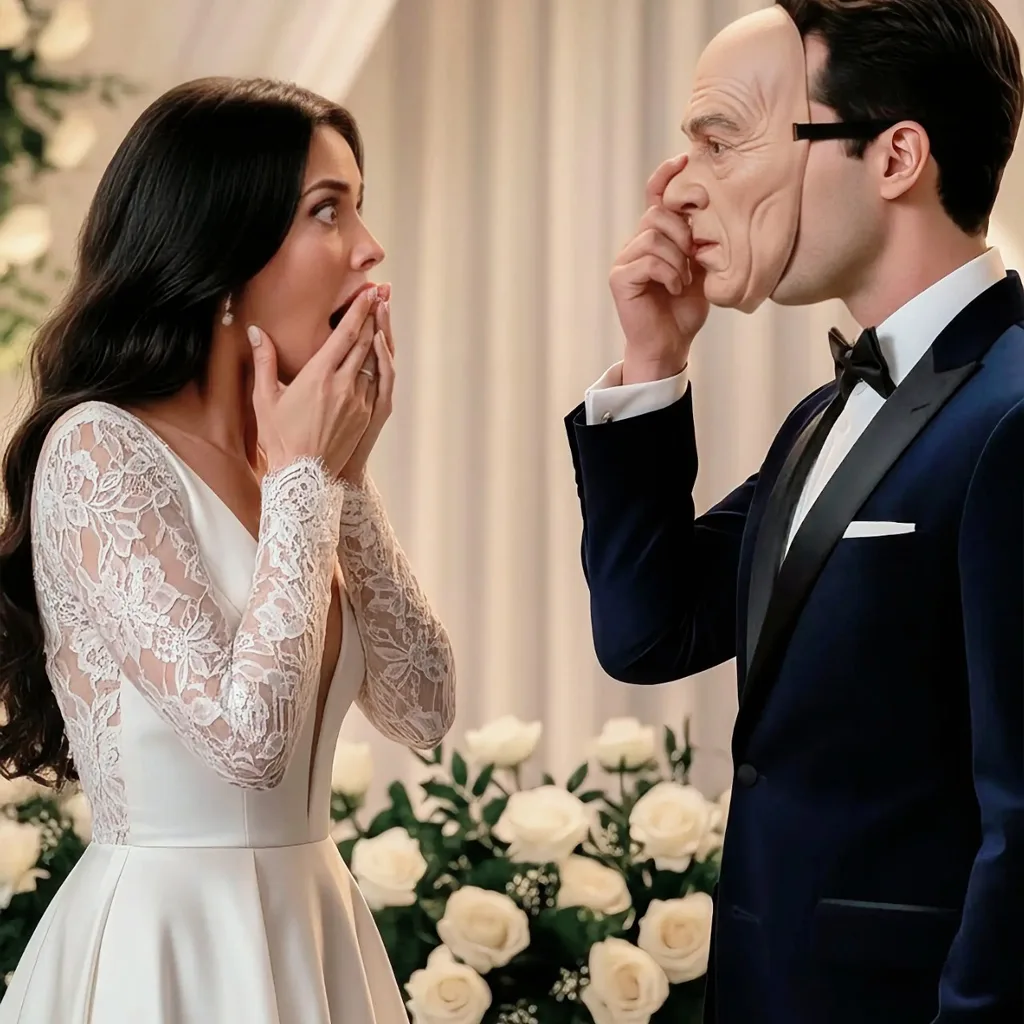
Don Armando stood near the fountain, his back turned. His hands moved to his neck, fumbling with something — a clasp, perhaps. She squinted through the dark.
Then she saw skin — lifting, peeling.
Her breath caught. Her hand flew to her mouth. Beneath the loose, sagging flesh of the old man’s face was another — younger, sharper, alive.
He turned suddenly, startled by her gasp.
“Ella,” he said, stepping forward quickly. “Please, don’t be afraid.”
But she was frozen, her heart hammering. “Who are you?”
The man hesitated. Then, slowly, he peeled away the rest of the mask.
The face beneath was striking — not old, not worn, but that of a man barely in his thirties, with strong features and eyes that held both fear and sorrow.
“My name isn’t Don Armando,” he said quietly. “It’s Ethan Vergara.”
She stared, shaking. “You— you’re the CEO? The one everyone thought was abroad?”
“Yes,” he said. “I created Don Armando to see the world without my name attached to it. To see people for who they really are.”
She could barely breathe. “So all this— the marriage— it was an experiment?”
Ethan’s gaze softened. “Not an experiment. A search. Everyone wants me for what I have. No one ever wanted me. But you— you said yes to a life without glamour, without comfort. I wanted to know if your heart could love in hardship.”
Her eyes filled with tears — not of anger, but shame.
“I didn’t marry you for love,” she whispered. “I did it to save my family. I’m no better than the rest.”
He reached out, but she stepped back. “Ella, you don’t understand—”
But she was already running.
Weeks passed. The city swallowed her easily. She rented a small room above a bakery, found a job cleaning offices, and tried to rebuild a life that no longer made sense.
Every night, she replayed his words — I wanted to know you without the shine. And every night, she wondered if he’d truly seen her, or just what he wanted to see.
Then, one morning, a knock came at her door.
A deliveryman handed her a white envelope with her name written in a neat, familiar hand. Inside was a single note.
“Ella,
I don’t need a perfect woman.
I need someone who knows how to love — even after breaking.
If you’re ready, I’ll be waiting at the same church.
Not as Don Armando. As myself.
—Ethan.”
For a long time, she just stood there, the paper trembling in her hands. Then she packed her bag, took a deep breath, and boarded a bus toward Tagaytay.
The church was quiet that morning. Light streamed through stained glass, painting the aisle in colors too beautiful for her to deserve.
At the altar stood Ethan — no disguise, no mask, no pretense. Just a simple barong and a look that was neither pity nor pride, but something truer.
Ella walked toward him slowly, her heart in her throat.
“I’m sorry,” she whispered. “For marrying out of desperation. For not seeing what mattered.”
He smiled gently. “You don’t have to pay for the past. You just have to live honestly in the present.”
When he took her hands, she didn’t pull away.
And there, before the same God who had witnessed their hollow vows months ago, they began again — not as strangers bound by need, but as two people willing to meet each other without masks.
A year later, they returned to her old neighborhood — this time not in desperation, but in gratitude. The house where her mother once coughed through sleepless nights had been rebuilt, and the small school at the end of the street now carried a new sign: The Vergara Scholarship for Women.
Ella spoke at the opening ceremony, her voice calm, her words careful.
“I once thought love was a luxury,” she said. “Something you bought with comfort and safety. But love isn’t a reward. It’s a mirror. And when you finally stop pretending — when you dare to show the truth of who you are — that’s when it finds you.”
The crowd clapped softly. Behind her, Ethan watched, his face unmasked, his expression quietly proud.
Later, as they walked home under the same kind of rain that had once trapped her in fear, Ella smiled to herself.
She’d married for survival, yes. But she had learned something far deeper — that love, when real, doesn’t need disguises. It only asks for courage.
And in that courage, she had finally found her freedom.
News

A Mafia Boss Threatened Dean Martin on Stage—Dean’s Reaction Was Pure Genius
A Mafia Boss Threatened Dean Martin on Stage—Dean’s Reaction Was Pure Genius Prologue: A Gun in the Spotlight Dean…

The Billionaire Had No Idea His Fiancée Was Poisoning His Son—Until the Maid Exposed Everything
The Billionaire Had No Idea His Fiancée Was Poisoning His Son—Until the Maid Exposed Everything Prologue: A Whisper That…

The Billionaire Catches Maid ‘Stealing’ Food… But When He Sees Who It’s For, He Breaks Down in Tears
The Billionaire Catches Maid ‘Stealing’ Food… But When He Sees Who It’s For, He Breaks Down in Tears Prologue:…

The Billionaire’s Fiancée Sets a Trap for the Maid — Until His Silent Daughter Exposed the Truth
The Billionaire’s Fiancée Sets a Trap for the Maid—Until His Silent Daughter Exposed the Truth Prologue: The Whisper That…

The Billionaire Went Undercover as a Gardener — Until the Maid Saved His Children from His Fiancée
Richard Whitmore’s hands trembled on the garden shears as he watched through the kitchen window. His new wife, Vanessa, stood…

Three Flight Attendants Vanished From a Vegas Hotel in 1996 — 28 Years Later a Hidden Wall Is Opened
.Every hotel, every casino, every neon-lit alley has a story, most of them ending in forgetfulness or denial. But some…
End of content
No more pages to load






