
THE MAN WHO SAT AT THE BUS STOP
Fog lay low along Brookside Avenue, a damp ribbon threading through cracked sidewalks and the dull glow of a bus shelter’s fluorescent bar. Lila Dawson cupped a steaming paper soup in both hands and watched her breath wisp into the cold. The same bent wheelchair waited in its corner, the same figure sat cloaked in a tired coat, hands resting like empty birds in his lap. People slid past as if hurry were a kind of armor. Lila stepped out of their stream, set the soup on his knees, and smiled the way you do at someone you’ve seen enough times to feel responsible for. He lifted his head. Those blue eyes held a quiet that wasn’t emptiness, more like a tide going out. “Thank you,” he said, as he always did, words sanded down by weather. “Kindness is rare.” She sat on the curb beside him and let the city move around them like a river around two stones.
Routine became a rope she held onto: morning soup, afternoon lectures, night shifts folding other people’s clothes until her fingers ached. She lived on scholarship and stubbornness, stretched dollars until they squeaked, and taught herself to be grateful for small heat—an industrial dryer, a crowded bus, a single cup of coffee that lasted the walk between classes. He was always there. He didn’t ask for money. He didn’t look at people the way the desperate do. He watched the street as if it were telling him something and he had all day to hear it.
She started calling him Eli because the name fit the way the fog did—soft and inevitable. He almost smiled when she said it. “I haven’t heard that in years.” She asked nothing that might rupture the fragile privacy they had built. They spoke in safe shapes: bus schedules, the merits of thick socks, the superior kindness of stray cats. And yet sometimes he answered questions she hadn’t asked. “Here,” he said when she wondered why this corner, “no one expects me to be anything else.” A sentence too careful for a man who was supposed to be broken. His posture stayed straight even when he slumped. His hands were calloused but not ruined. His silence was not empty; it was practiced.
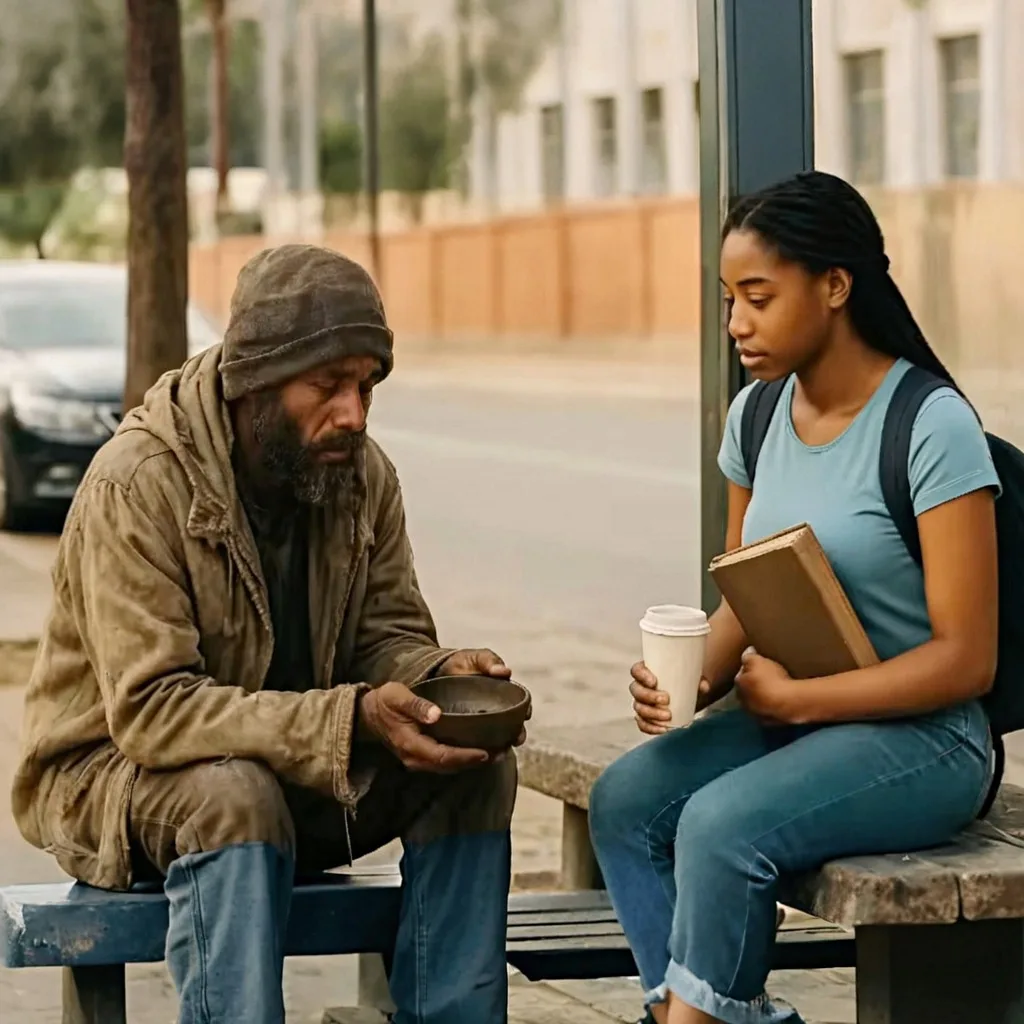
Then one morning the wheelchair was gone. The corner was bare. The invisible place he had occupied reverted to what the city prefers: nothing. She asked drivers and clerks and regulars. No one knew. For three days the fog thickened. She skipped lectures she could not afford to miss and meals she could not afford to skip. By the fourth, she sat on the stone bench holding a new winter coat she had bought with tips and a promise, grief pooling in her elbows.
The sedan arrived like a quiet verdict. Deep black, glass like a mirror. The rear window slid down. The same eyes met hers—no longer dimmed by street cold, but illuminated by recognition and an edge of command. “Lila,” he said softly. “Please. Get in.”
Leather. Cedar. Silence. The city smeared past, all neon and wet pavement. She watched his profile—shaved, clean, impossibly composed—and felt her own reflection fracture into too many versions to hold. “Who are you?” she asked.
“I’m someone who forgot who he was,” he said, eyes on the road. “Until you reminded me.” She let the line sit. “That’s not an answer.” He exhaled. “My name is Elias Ward.” The recognition hit like a dropped dish. Ward Industries—the cranes and glass towers, the scholarship stamp on the bottom corner of her aid letter. “You’re that Ward?” He nodded. “I was. Until I walked away.”
He didn’t say fallen-from-grace or exiled. He said he had stepped out of a machine that turned blood into contracts. After his parents died, the company became a war dressed as a family. One day he didn’t recognize the man who signed his name. So he vanished into a world where names didn’t buy anything. “People don’t lie to a beggar,” he said, finally turning to face her. “They show you exactly who they are when they think you have nothing to give.”
The gate ironed open on its own. The drive curved toward a house that looked like a museum of power—stone, glass, the clean geometry of inherited money. Inside, the light fell gold over marble and oil portraits wearing his eyes. Lila’s thrift-store coat absorbed brightness and returned nothing; she felt it happen. “Does anyone here know?” she asked. “No one,” he said. Not until now.
A photograph caught her: Elias beside a woman with carved cheekbones and a victory smile. “Your mother?” He nodded. “She loved control more than people,” he said, and the sentence cost him something.
In the morning, the dining table stretched like a runway between them. He smiled. “You don’t have to be anyone else here.” “Don’t I?” she meant it to be a joke. It came out like a bruise. Then a woman’s voice broke the quiet. She arrived in heels and a perfect red mouth, eyes bright with cruelty honed into charm. “Ava,” Elias said. Sister. She took in Lila with one sweep, a judge measuring a defendant. “Do you know what happens to people who fall for my brother?” she murmured. “They drown—in things they can’t afford. Secrets. Shame.” Lila stood too fast, chair legs scraping marble. “I didn’t come here for your approval.” “Good,” Ava said, and left the air colder.
That night, a “small family gathering” bloomed into chandeliers and speculation. Elias offered her his hand at the top of the marble staircase. “No more masks.” She descended into a sea of practiced laughter, the whispers landing like ash. At the long table under his parents’ portrait, he lifted his voice without raising it. “This is Lila Dawson,” he said, and the pronouncement hushed cutlery. “She is the reason I came home.” The room held its breath. Ava’s smile sharpened. “Tell them why,” she purred, then turned to Lila with counterfeit pity. The truth she released was not small.
He hadn’t just walked away. There had been an accident at a Ward site. Two workers dead. A foundation misread, a decision made in a clean office that resulted in a mess that could not be cleaned. The company closed ranks. He could not. He chose penance disguised as anonymity. “You didn’t save him,” Ava said sweetly. “You were just his altar.”
Lila looked at Elias until everything else disappeared. “Is it true?” He did not reach for the script that money writes. “Yes,” he said, voice unadorned. The room’s judgment swelled—the richest incense in houses like this. He set his glass down too hard. “I will pay for it for the rest of my life,” he said, not to the room, but to the memory that never lets him sleep. He turned back to Lila. “I wanted you to see who I am before you had to learn what I did.”
Her eyes filled and didn’t spill. “You hid behind your pain,” she said, “and I fell in love with it.” She took a breath that steadied and hurt. “You can’t fix the past.” She watched hope flicker in him like a match cupped against wind. “But maybe you can live differently from it.”
He reached for her hand. She didn’t step back. “I’ll stay,” she said, “if you stop running.” He turned to the table—the family, the board members pretending not to be—and said the only sentence that mattered: “No more pretending.” Files would reopen. Debts would be paid. The company that had learned to launder regret would be made to do something harder: atone. Someone began to clap. Another followed. Ava didn’t.
When the last guest left and the house exhaled, they walked into the courtyard where the roses held what was left of the day. The fountains threw little golds onto their faces. “You took me home,” Lila said, more wonder than accusation. “And it shocked everyone.” He laughed, low and human. “Including me.” She rested her head against his shoulder and felt the tension leave him the way evening leaves heat from stone.
“Tomorrow,” she said, “we go back to the bus stop.” He nodded. “Together.” Dawn unclenched beyond the hedges, a soft widening of light. In that gray-blue seam between night and day, the labels loosened their grip: billionaire and charity case; heir and interloper; guilt and grace. What remained were two people who had met each other in their worst corners and now stood, not remade, but re-aligned.
Inside, Ava watched from a high window, her reflection paired with the world outside. Envy and admiration braided under her ribs into something uneasy, something new. For the first time she looked less like a gate and more like a witness.
They stood where they had started—stone bench, bus shelter, the street waking into buses and coffee steam. A coat waited folded over Lila’s arm for whoever would need it next. Elias touched the metal frame of the shelter the way a person touches a grave and a chapel at once. He didn’t apologize to the air or to the city. He simply stood still long enough to hear it.
What changed them hadn’t been the reveal—the gate or the marble or the name on buildings. It was the ordinary insistence of kindness. A paper cup passed into cold hands. A corner of a morning given away. Seeing when looking was inconvenient. Love did not erase the wreckage. It taught them to live in front of it, not behind it. To answer it with work and with truth.
Some grief sets like concrete; you can’t pull it up. You build differently around it. You leave a window where there should have been a wall. You make room for air and for the sound a city makes when it forgives slowly. On Brookside Avenue, buses sighed and people hurried. Two of them did not. They moved, together, in the honest weather of a day that would not flatter them. And as light lifted fully, the corner where a man once disappeared learned a new trick: how to keep him visible.
News

A Mafia Boss Threatened Dean Martin on Stage—Dean’s Reaction Was Pure Genius
A Mafia Boss Threatened Dean Martin on Stage—Dean’s Reaction Was Pure Genius Prologue: A Gun in the Spotlight Dean…

The Billionaire Had No Idea His Fiancée Was Poisoning His Son—Until the Maid Exposed Everything
The Billionaire Had No Idea His Fiancée Was Poisoning His Son—Until the Maid Exposed Everything Prologue: A Whisper That…

The Billionaire Catches Maid ‘Stealing’ Food… But When He Sees Who It’s For, He Breaks Down in Tears
The Billionaire Catches Maid ‘Stealing’ Food… But When He Sees Who It’s For, He Breaks Down in Tears Prologue:…

The Billionaire’s Fiancée Sets a Trap for the Maid — Until His Silent Daughter Exposed the Truth
The Billionaire’s Fiancée Sets a Trap for the Maid—Until His Silent Daughter Exposed the Truth Prologue: The Whisper That…

The Billionaire Went Undercover as a Gardener — Until the Maid Saved His Children from His Fiancée
Richard Whitmore’s hands trembled on the garden shears as he watched through the kitchen window. His new wife, Vanessa, stood…

Three Flight Attendants Vanished From a Vegas Hotel in 1996 — 28 Years Later a Hidden Wall Is Opened
.Every hotel, every casino, every neon-lit alley has a story, most of them ending in forgetfulness or denial. But some…
End of content
No more pages to load






