
“SO I MARRIED A HOMELESS WOMAN?”
Saturday evening settled into the building like steam, curling under doors and fogging up windows. In the third-floor apartment of a concrete nine-story block, the air smelled of fried potatoes, hot oil, and a conversation already on the verge of catching fire. Anna shrugged off her coat and hung it on the crooked hallway peg that never quite held straight. Her slippers whispered along the linoleum as she moved into the kitchen.
Denis sat at the table with the posture of someone awaiting a verdict. In front of him, a mug declared Best Husband in cheerful letters that felt like a joke that didn’t land. The kettle, always slightly dented, began its quiet metal rattle.
“Why the long face?” Anna asked, reaching for the switch.
“Mom called,” he said, and the room cooled by a few degrees.
The apartment hummed: a fridge breathing its old-man wheeze, the radiator ticking like it was telling beads. The day had been ordinary until this moment. Then, like a pane of thin glass, it started to tremble.
The question was simple and poisonous: whose name was on the deed. Anna’s laugh came out dry. Her parents had bought the apartment when she was still in school, a head-down student with cheap notebooks and a part-time job. The plan had always been to transfer it to her. Life, like a train that never stops quite where you expect, kept moving. The papers never changed hands.
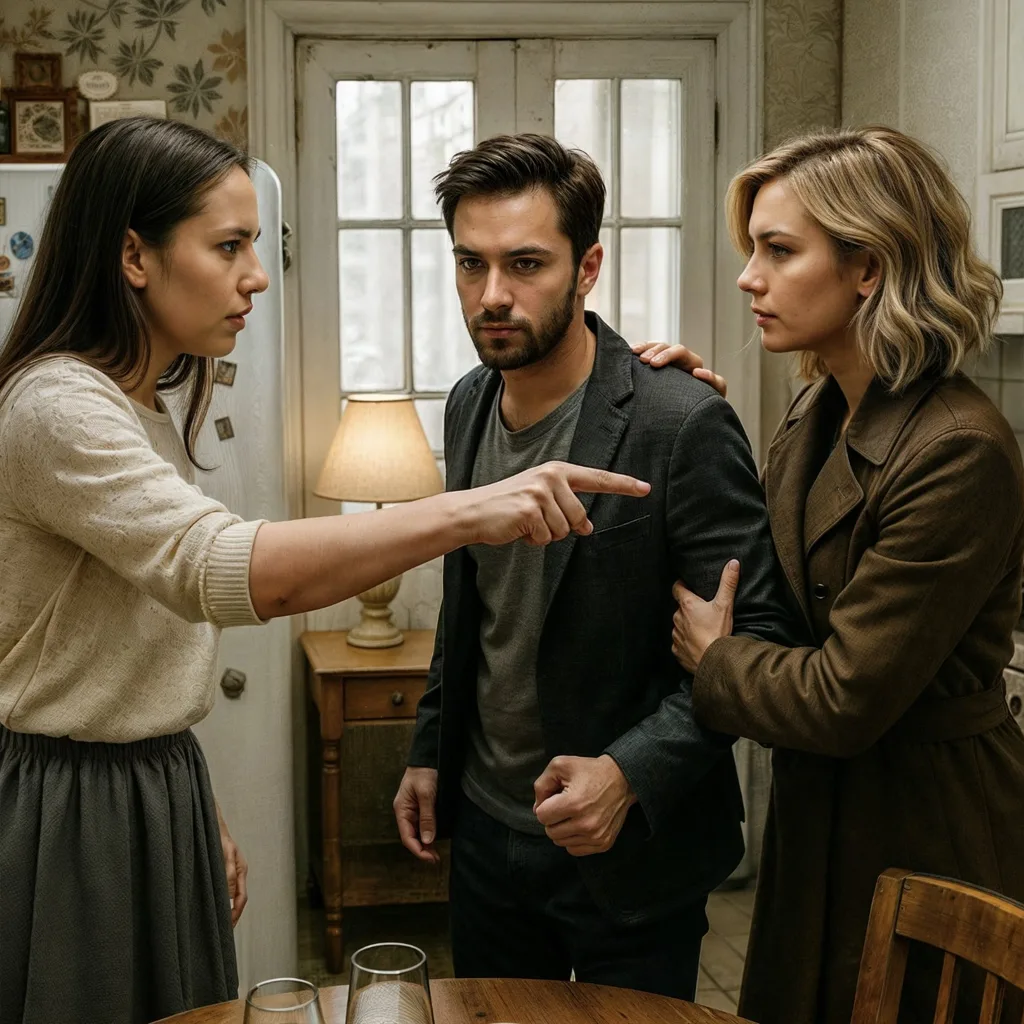
“We live here,” Anna said, setting two cups on the table. “We pay the bills. I paid for the renovation. How does ink on a registry outweigh dinners, repairs, winters?”
Denis rubbed his neck, not meeting her eyes. The argument was already gathering its tools.
That evening, the door opened without a knock. Tatiana Ivanovna stepped in like a draft—sharp, disapproving, familiar. She had a key. She had always had a key.
“What have we got here?” she said, the kind of hello that wasn’t a greeting at all. “Dirt on the mat. Hair. No one keeps a home these days.”
She pulled pies from a bag, setting them down with ceremony. Denis brightened, a reflex from childhood. Anna stared at the flour-dusted packages as if they were a line being crossed.
The talk was “serious,” Tatiana said, and became quickly less talk and more verdict. Anna’s apartment—so-called—belonged to her parents. A son, meaning Denis, shouldn’t be a lodger in his own marriage. A man should provide, not sponge. There were words about pride, words about the future, words so polished by use they had lost connection to any real life.
Anna felt heat climb her throat, not rage yet, but the coil of it. “We build together,” she said evenly. “That’s the only deed that matters in a marriage.”
Tatiana’s smile was not a smile. “A deed is exactly what matters.”
The pies cooled between them like little moons.
The fight arrived in full, not loud at first, but with the merciless clarity of a scraped plate. By morning there was a backpack on a chair and Denis’s jacket folded too neatly on top. A text blinked on Anna’s phone: I went to Mom’s. I need to think. Silence poured into the rooms, heavy and oddly bright. The kettle hissed. The oatmeal overthickened. The window showed a slice of sky with no weather at all.
When he returned that night, the key snagged in the new lock. “Why did you change it?” he asked, more wounded than angry.
“Because your mother had one,” Anna said. “I don’t want her running my life while I’m at work.”
He moved through the kitchen in impatient lines, poured water, swallowed it like a dare. “You lied,” he said finally. “You let me believe this place was yours.”
“I told you it was my apartment,” she said. “It is. I live here. I maintain it. My parents kept the paperwork. That’s not deception; that’s bureaucracy.”
“It’s principle,” he snapped, hitting the table with the side of his fist. “I need stability. Rights.”
Her laugh had an edge. “You’ve had the run of this place and my heart for three years. That wasn’t stable?”
“It’s not the same.”
“And love?” she asked, stepping closer, not blinking. “Is that not a principle?”
He looked away, and the look-away was its own answer.
The next days blurred: a suitcase zipped for emphasis, a threat to leave hanging like a cord from the ceiling. Tatiana arrived with a grocery bag in one hand and a folder of printed forms in the other. She walked past Anna as if stepping over a puddle.
“Have you decided how you’re going to live?” she asked.
“Without you,” Anna said, and felt the truth settle into her bones like heat.
There were proposals that weren’t proposals at all—sell the flat, divide the money, let the parents move to the country. There were lectures dressed as concern. There was Denis, repeating phrases that did not sound like his own, saying foundation as if concrete could love him back.
One evening, the scene compressed to a point. Denis sat with his hands clasped like a boy before a teacher. “I don’t know what to do,” he said. “On one side, you. On the other, Mom.”
“You’re a man,” Anna said quietly. “Stand somewhere.”
He asked for time. She shook her head. “Your suitcase is by the door.”
He left. She closed the door. The click was not loud, but it traveled.
That night, sleep came in shredded strips. Sometimes she cried. Sometimes she laughed at nothing. She lay awake listening to the neighbor’s asthmatic cough and the pipes knocking softly in the walls, as if the building were reminding her it had outlasted larger storms than this.
A week passed like a long exhale. The apartment became an organism that breathed with her—no socks abandoned under furniture, no cabinet doors left open, no debates over dinners. She learned the shape of her own quiet.
Then the doorbell rang. On the threshold: Denis and his mother, formal as emissaries. The talk returned to ownership, to who deserved what, to how fairness looked when defined by someone else. Denis’s words came out strained and certain: if the apartment wasn’t hers, then nothing was theirs. He said trust as if it were a document requiring signatures.
Anna listened, and something inside her unclasped.
She took his jacket from the hook and placed it in his arms like a final kindness. “Take your mother, your principles, and go,” she said. Tatiana erupted. Denis hesitated. Then the corridor swallowed them, and the quiet returned, truer this time.
Divorce was a formality that moved with the slow determination of state paper. Anna filed on a weekday morning, emerging into fine weather that felt almost impolite. When her parents learned what had happened, they offered the transfer they’d always meant to complete. She shook her head. “Let it stay as it is,” she said. “It tells the truth faster than I can.”
Days arranged themselves into a rhythm: work, the patient choreography of chores, the small ceremonies of surviving. She fixed the wobble in the hallway peg with a strip of folded cardboard. She oiled the hinge that had squealed like a child for months. She aired the apartment on cold evenings and learned the scent of the stairwell at different hours. She kept the pies’ empty plastic box to line the drawer where utensils clinked. Nothing wasted, nothing rushed.
Sometimes she found a memory waiting in practical places: in the cupboard, a scratch on the shelf from when they’d assembled it together; in the bathroom mirror, a faint trace of steam that held the shape of their mornings. The memories weren’t enemies. They were evidence.
Denis did not call. Or he did and didn’t press send. The life they’d built, it turned out, had doors on both ends. People could walk in and out, leave their weather behind. The building stood, indifferent and loyal.
On a Sunday, Anna stood at the window with her mug—no slogan, just white ceramic with a hairline crack that did not leak. Children below chalked borders onto the asphalt, inventing countries where no one asked for deeds. A neighbor carried groceries past the curb and paused to stretch her back. Life sorted itself without permission.
Later, Anna opened the hall closet and took out a small box of documents. She tucked a note on top in her neat handwriting: Utilities paid through July. Taxes set aside. To whoever needs to know. She placed the box back on the shelf. The box was not a shield. It was a statement: I live here fully.
That evening she called her parents, told them she was fine, and believed it even as her voice dipped. Her mother asked about dinner. Her father asked about the leaky radiator. They did not ask about the papers. They had learned too: some love does not interrogate; it warms.
Before bed, the apartment drafted its usual lullaby—pipes, the far elevator, a television laughing through a wall. She stood in the doorway of the empty bedroom and felt the space the way you feel a healed bruise—tender, but whole.
It turned out the argument had never been about an address. It had been about grammar: what “ours” means, what “home” means, what love does with fear when it runs out of places to hide. A deed is a noun, heavy and stamped; a marriage is a verb, daily and breakable. One can exist without the other. The mistake is thinking they are the same.
Anna kept the apartment as it was. Not to test anyone, exactly, but as a compass. If a future visitor arrived and asked first for the certificate, she would know the route to the door by heart. If he asked how she liked her tea, she might answer.
Sometimes, on her way out, she would touch the crooked peg and feel its steady give beneath her palm. Not everything needs to be straight to hold what matters. Not every paper needs a signature to be true.
On good days, the building smelled of frying onions and laundry soap. On bad days, of burnt toast and someone’s impatience. The elevator was slow, the stairwell cold, the window latches stubborn in winter. It was, unquestionably, a life.
When people say “foundation,” they usually mean walls and floors. Anna learned another meaning: the quiet certainty of choosing dignity over permission, tenderness over possession. She learned that being loved is not the same thing as being claimed. And that freedom, once it arrives, is rarely loud. It sounds like keys placed gently in a dish, like the soft click of a door that closes and does not need to lock.
If love is a house, its rooms are built from the simple miracles—trust given without notarization, loyalty that doesn’t require a witness, two people who can stand in a kitchen while the kettle begins to sing and choose, again, to stand there together. When one person leaves and the singing remains, it is not the end of music. It is the first clear note of a new song.
News

A Mafia Boss Threatened Dean Martin on Stage—Dean’s Reaction Was Pure Genius
A Mafia Boss Threatened Dean Martin on Stage—Dean’s Reaction Was Pure Genius Prologue: A Gun in the Spotlight Dean…

The Billionaire Had No Idea His Fiancée Was Poisoning His Son—Until the Maid Exposed Everything
The Billionaire Had No Idea His Fiancée Was Poisoning His Son—Until the Maid Exposed Everything Prologue: A Whisper That…

The Billionaire Catches Maid ‘Stealing’ Food… But When He Sees Who It’s For, He Breaks Down in Tears
The Billionaire Catches Maid ‘Stealing’ Food… But When He Sees Who It’s For, He Breaks Down in Tears Prologue:…

The Billionaire’s Fiancée Sets a Trap for the Maid — Until His Silent Daughter Exposed the Truth
The Billionaire’s Fiancée Sets a Trap for the Maid—Until His Silent Daughter Exposed the Truth Prologue: The Whisper That…

The Billionaire Went Undercover as a Gardener — Until the Maid Saved His Children from His Fiancée
Richard Whitmore’s hands trembled on the garden shears as he watched through the kitchen window. His new wife, Vanessa, stood…

Three Flight Attendants Vanished From a Vegas Hotel in 1996 — 28 Years Later a Hidden Wall Is Opened
.Every hotel, every casino, every neon-lit alley has a story, most of them ending in forgetfulness or denial. But some…
End of content
No more pages to load






