
THE BILLIONAIRE WHO SPENT CHRISTMAS ALONE — UNTIL SIX WORDS OPENED THE DOOR
New York glittered like a promise it had no intention of keeping. From forty floors up, the city’s December looked festive—streets sequined with headlights, windows glowing in miniature constellations, steam rising from grates like the city whispering to itself. Inside, the penthouse was cathedral-quiet. The tree stood perfect, a regimented geometry of glass and ribbon—beauty without warmth, music without sound. Charles Stone—thirty-eight, immaculate coat, watch that kept multiple time zones and none of the human ones—held a glass of red wine and tasted nothing.
A keycard beeped. Soft footsteps crossed the Persian rug. Lena Brooks, his housemaid, wrapped her scarf tighter against the draft and checked the last list on her phone: dishwasher, set; gifts for employees, labeled; wreath straightened. Behind her, a small red blur: her four-year-old daughter, Mia, Santa hat slipping over one eye, curiosity leading like a lantern.
Mia stopped, craned up at the towering tree, then at the man by the window. “Mommy,” she asked, sincere as snowfall. “Why is he celebrating Christmas alone?”
Lena winced, already apologizing. But Charles didn’t flinch with offense. He went still, as if the air had turned to glass and the city’s brightness had dimmed just for that question.
Lena cleared her throat, choosing gentleness over distance. “Mr. Stone… my family’s having dinner. Nothing fancy. Music, food, too many people and not enough chairs. If you’d like—” She hesitated, bracing for the polite refusal. “You’re welcome.”
He had never been invited without a price. No cameras. No networking. No strategy masquerading as cheer. Just a yellow house, a crooked wreath, and a child’s fairness. He smiled the way men smile when something inside them misaligns. “Thank you,” he said. “I’ll be fine.”
Mia tugged his sleeve, tiny mitten against fine wool. “Nobody should be alone on Christmas.”
The door closed. The elevator’s hum sank out of the room. Silence returned with the weight of winter.
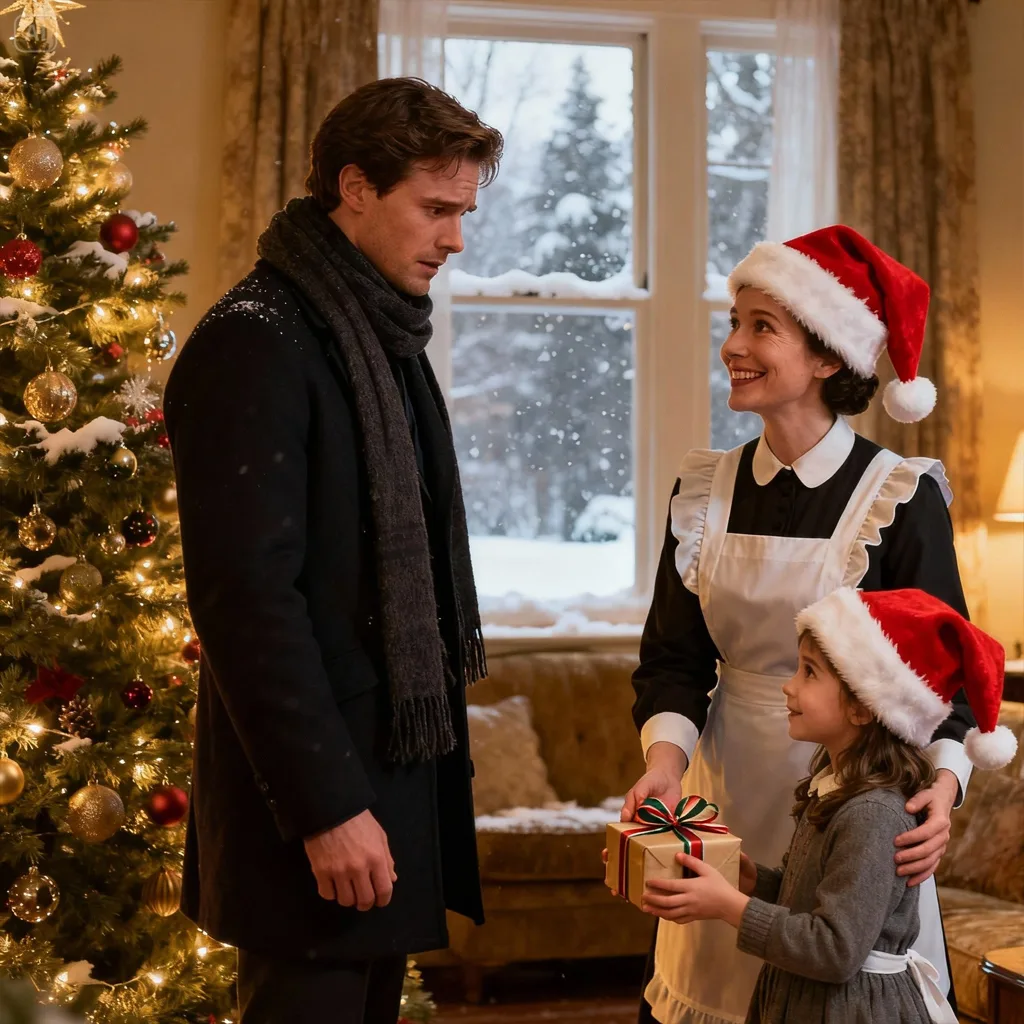
At 8:58, he reached for his coat.
At 9:06, he stood at a yellow house with a crooked wreath and a porch light that buzzed faintly like a nervous heart.
He raised his hand to knock. The door opened on warm light, loud laughter, cheap tinsel doing its best. Something in him stepped forward before the rest of him had decided.
It smelled like cinnamon and baked cod and a dozen lives layered into one small space—wool drying on a chair back, pine from a real tree, the faint soap of clean hands. People crowded around a too-small table—Lena, her mother with flour on her forearms, two brothers jostling good-naturedly, a neighbor squeezing in sideways, Mia orchestrating chaos with a wooden spoon. They made room the way families do: by accepting that chairs are theoretical.
“Mr. Stone,” Lena said softly, her Santa hat now at a jaunty angle she hadn’t intended. “You came.”
“If the invitation still stands,” he answered, unsure where to put his hands, moving like a tall man in a small elevator.
“It does.”
He sat next to Mia because Mia had already decided this. He passed bread. He misjudged the size of a ladle. He loosened his shoulders without announcing it to himself. People spoke over one another, paused to listen, forgot to be impressive. Someone’s off-key carol turned into a chorus because being right wasn’t the point. The ornaments were handmade and chipped in honest places. The tree leaned a fraction and no one corrected it. Nothing matched. Everything fit.
After dinner, a scratched speaker played an old playlist that remembered summers and breakups. Lena’s brothers danced with their mother; Mia hopped from rug to rug like the floor was lava and happiness was the only safe island. When Mia crowned him with a tiny Santa hat, the room laughed. Charles laughed too—a surprised, unguarded sound that felt like breathing after holding a breath for an entire year.
When the evening thinned—coats found, leftovers packed, someone promising to bring the folding table next time—Lena pressed a small wrapped box into his palm. “For you,” she said, suddenly shy.
“I didn’t bring—”
“You being here is enough.”
Inside: a hand-carved wooden heart, sanded smooth, the word Belong etched with a patient hand. It weighed almost nothing. It weighed a life.
His phone buzzed. The screen lit the ornament with a cold square of light: his father’s name. Old power, old rules. He watched the call until it stopped. It rang again. He answered. The voice did what it always did—assessed, arranged, commanded. When he hung up, the room felt remeasured. The warmth didn’t vanish; it held its ground. But his posture changed, as if the air had asked him to stand trial.
“What is it?” Lena asked.
“My father knows about… this,” he said. “He wants me to end it. Or he will end me.”
The music paused. Mia listened the way children do—by feeling the adults change shape.
The next morning he didn’t go to the office. He stayed in the penthouse with the wooden heart on his desk, the word Belong staring at him like a question with only one honest answer. He walked the length of the living room and back, window to window, skyline to skyline, like pacing within a snow globe. The calls kept coming: his father, then a board member, then the lawyer who had been paid for years to translate cruelty into policy. He let them ring, then he didn’t.
Two days passed. Lena didn’t come to work. Her absence was not punitive. It was a space in which to think clearly. He practiced sentences aloud—grown-man sentences, not son sentences. He threw some away. He kept one.
On the third morning, he drove to Maple Street. The yellow house didn’t look different in daylight, which is how he knew the night before hadn’t been a trick of lights.
Lena opened the door. Her hair was back; her eyes were steady. “I’m sorry,” he said, surprising himself with how quickly the apology rose. “I don’t care about the empire if it means being a stranger to the life I want. I care about you. About Mia. That night—” He swallowed. “I felt… real.”
“Are you sure?” she asked. Not a test. A kindness.
“Yes,” he said. “And I’m going to prove it.”
The boardroom carried the temperature of marble. His father sat at the head like a verdict. Men and women arranged their expressions into neutral—a corporate survival skill. Charles set the ornament on the table. It looked out of place and also like the only honest object in the room.
“I’m choosing my life,” he said. No speech. No slides. “If that costs me this company, it costs me this company.”
He expected thunder. He got weather changing. The board didn’t look at his father. They looked at him—the version who had finally picked a side that wasn’t profit. Power shifted without fanfare, as power sometimes does when everyone’s been waiting for permission to tell the truth.
His father’s silence was the loudest sound in the room.
He returned to Maple Street in the blue hour when lamps turn rooms into harbors. He didn’t knock. He did. The door opened on the same crooked wreath, now more beloved for being crooked. In his hands, the wooden heart looked less like a symbol and more like a map.
He held it up. Lena stepped forward—the kind of embrace that answers without words. Mia wrapped her arms around both of them and, because she is four, declared an outcome: “You’re staying.”
Staying wasn’t a move-in bag. It was a reorientation. He learned the choreography of a small kitchen—where the good pan lives, how to fold a dish towel that will be used again that night. He discovered the utility of a coat hook that tilts. He bought a sturdier table and learned to love the old one anyway because grooves record laughter. He asked Lena’s mother to teach him the cod recipe and failed twice in ways that tasted fine. He kept failing. He kept learning. They put Belong on the tree and left space around it on purpose.
At the office, he measured decisions against the plainness of that word. Some things didn’t survive the test. He let them go. Other things did—health plans improved, hours softened where they could, bonuses moved down the ladder. The company didn’t collapse. It exhaled.
On Christmas Eve a year later, the yellow house held more people than physics should allow. Charles lifted Mia—taller now, still a conductor of joy—to place a paper star on a tree that leaned in the other direction this time. When the room quieted for a minute—between songs, between cookies—Lena handed him a narrow box. Inside: a second ornament. Two words this time, burned into the grain with a steadier hand: Still Here.
He didn’t make a speech. He put the new ornament beside the first and sat, with his hand on the back of a chair someone else would soon need, content with the mathematics of enough.
The city still glittered in December, but no longer to distract. It glittered like background to a smaller, sturdier story. Charles never learned a tidy lesson about choosing love over money because love isn’t a choice you make once; it’s a rhythm you return to when the old score tries to reclaim you. He learned how to show up with nothing to trade—how to bring a coat, a casserole, an apology, a willingness to wash dishes. He learned that family is not what blood demands but what a table proves. That wealth rearranges a room; belonging furnishes it.
If you need the short version, it’s this: sometimes a life pivots on six words spoken by a child who doesn’t know enough to be careful—nobody should be alone on Christmas—and the courage it takes, days later, to say two more in a room built to make you small: I choose.
News
A Mafia Boss Threatened Dean Martin on Stage—Dean’s Reaction Was Pure Genius
A Mafia Boss Threatened Dean Martin on Stage—Dean’s Reaction Was Pure Genius Prologue: A Gun in the Spotlight Dean…
The Billionaire Had No Idea His Fiancée Was Poisoning His Son—Until the Maid Exposed Everything
The Billionaire Had No Idea His Fiancée Was Poisoning His Son—Until the Maid Exposed Everything Prologue: A Whisper That…

The Billionaire Catches Maid ‘Stealing’ Food… But When He Sees Who It’s For, He Breaks Down in Tears
The Billionaire Catches Maid ‘Stealing’ Food… But When He Sees Who It’s For, He Breaks Down in Tears Prologue:…
The Billionaire’s Fiancée Sets a Trap for the Maid — Until His Silent Daughter Exposed the Truth
The Billionaire’s Fiancée Sets a Trap for the Maid—Until His Silent Daughter Exposed the Truth Prologue: The Whisper That…
The Billionaire Went Undercover as a Gardener — Until the Maid Saved His Children from His Fiancée
Richard Whitmore’s hands trembled on the garden shears as he watched through the kitchen window. His new wife, Vanessa, stood…
Three Flight Attendants Vanished From a Vegas Hotel in 1996 — 28 Years Later a Hidden Wall Is Opened
.Every hotel, every casino, every neon-lit alley has a story, most of them ending in forgetfulness or denial. But some…
End of content
No more pages to load






