
The chandeliers above the Sterling estate threw light like broken promises—cut and glittering, each facet throwing judgment in a thousand directions. Anna stood near the ballroom’s outer edges, clutching the silver locket at her throat as if it were a life preserver. She could feel the weight of a hundred eyes, not curious but precise: the way people measure a stranger against a pedigree. Her linen dress, the nicest thing she owned, felt suddenly thin as tissue in a room stitched together by inheritance and habit.
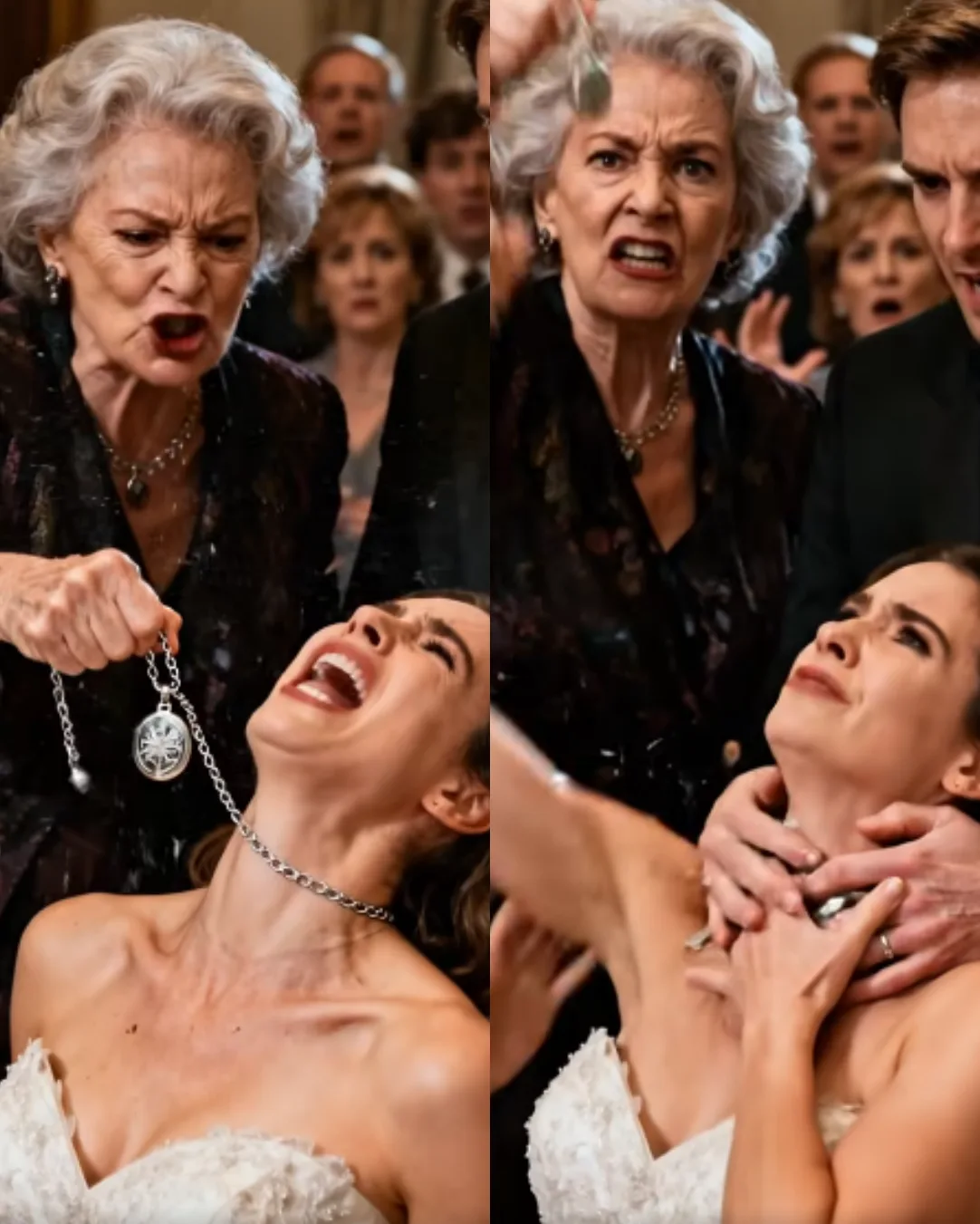
Across the parquet, her fiancé laughed with a cluster of men whose names were bank accounts. Alex Sterling looked as if he belonged in a portrait, every line of his face practiced to the role of heir. He had promised he would be at her side. Instead he seemed swallowed by the room’s gravity, held mute by the ritual of belonging.
That is when Brenda moved. Like a hand choreographed to land, she stepped forward—silk, pearls, an expression trained to coldness—and plucked the locket from Anna’s neck. The chain snapped under the force; the locket spun through the air and clattered on the Italian marble. For a heartbeat the room was a fishbowl and every head tilted in the same direction.
“This is cheap,” Brenda declared, loud enough for the chandeliers to echo. “A Sterling wedding requires diamonds.” As if possessions were not objects but verdicts, her laugh was a gavel. Guests murmured assent. Anna’s cheeks burned; the locket had been all that remained of her mother.
Then the hall went quiet in a way that has the sound of a held breath. From the corner of the room, where a high-backed chair sat like a throne, a cane tapped the floor in three slow, deliberate ticks. Augusta Sterling rose.
Augusta moved as if the room were a map she had navigated her entire life—an old atlas rubbed into knowing. At nearly ninety, she carried an authority that made her family’s theatrics look like amateur theater. She did not hurry. She did not scream. She simply requested, in a voice that drew attention the way a bell draws pigeons, a pair of white silk gloves.
The waiter returned, trembling, and Augusta laid the gloves on her hands with the care of someone putting on ritual. The gloves made her movements surgical; they also made them solemn. And then, with the same deliberate care, she bent and picked the locket off the marble.
Brenda gasped and moved like a woman whose stagecraft had lost its cue. “Mother, please—” she began, the sentence collapsing under the weight of the moment. Guests straightened, as if someone had pulled the strings on the room’s posture. Alex hovered by the bar, his hand halfway to his glass, a man baptized in wealthy etiquette but apparently unarmed for disgrace.
Augusta turned the locket over under the crystal light as a jeweler examines a rare stone. Her eyes narrowed not with greed but with recognition. The markings on the back were small, obscure to most but perfectly legible to a kind of memory born from years of auction catalogs and private viewings. The air in the ballroom changed its temperature; things that had been small swelled.
“This is not costume jewelry,” Augusta said, and the syllables became a kind of accusation and a revelation at once. “This is a one-of-a-kind commission. Charles Lewis Tiffany. Late nineteenth century. A private piece for imperial use.” The silence that followed felt like the room being drained of humidity.
Anna’s trembling stopped. The locket had been pressed against her mother’s chest for years, packed in a suitcase across borders and wars. It had survived avalanches of history in a pocket, in the dark. To have it recognized—by the matriarch of a family built on lineage—was to have her past acknowledged in a place that had tried to erase it.
Augusta’s words were a scalpel. Brenda’s face went ashen; she had not only humiliated a guest but desecrated an artifact. The assembled gathered like a school around a sudden cut, murmuring provenance and price in offhanded whispers, their language clipped to appraising nouns. Alex’s posture curdled into the shape of a man who had been caught between filial obligation and a better impulse; his quiet, a coward’s retreat, became the room’s second wound.
Augusta faced Alex as if she saw through him to the fragile ledger of bravado he kept in his bones. “You stood by,” she said without artifice. “You allowed your intended to be humiliated. That is not the behavior of a man who will preserve a family—only of one who will preserve a chair at a table.” Her disappointment cut deeper than a rebuke; it was a removal of confidence, a subtraction from expectation.
Then she looked at Anna—not at the classless dress, not at the torn chain—but through the woman to the name that might yet hang behind the object. “Who are you?” she asked.
Anna drew a breath and said the truth in a calmness she hadn’t known she had. “My name is Anastasia Rostova. My mother was Duchess Alena Rostova. She escaped Russia with this locket during the 1917 revolution. It is all I have of what we lost.”
Silence pressed harder. Names in that room were not given—they were claims. Anastasia said hers with the steady weight of one who had carried exile and memory in equal measures. The locket, once a private relic, became a contested witness that refused to be filed away as mere sentiment.
The reckoning widened. Augusta, who had spent decades curating access to history and lineage, spoke then in the cadence of someone addressing both insult and opportunity. Brenda’s cruelty had become her own undoing: by flinging the locket, she had revealed her ignorance. By exposing the locket’s value and provenance, Augusta overturned the hierarchy the Sterlings had been rehearsing.
“You have disgraced this house,” Augusta told Brenda, her words like a verdict. “You have shown vulgarity and a blindness that undermines everything we teach our children. And you,” she added, turning to Alex, “have shown yourself unworthy of the name you claim.”
The room convulsed with a new order. Guest whispers turned to small, sharp re-evaluations. Alliances shifted like weather.
Augusta’s attention softened in a way that suggested strategy rather than mercy. She folded the locket into her gloved palm and walked directly to Anna. The gesture was an invitation, and an elevation. “If you would have the grace to sit with me,” Augusta said, “we will speak. Family is not only blood; it is stewardship. There are things to negotiate.”
It was not an embrace so much as an acknowledgment: a woman who had known the tilt of bloodlines and the weight of heirlooms was offering partnership, not pity. Anna accepted, not because she wanted to be part of anything that had nearly suffocated her, but because she saw a future in which the locket’s provenance mattered less than the person to whom it had belonged.
Brenda’s outrage turned inward as the room’s attention slid away from her. Alex, confronted with the fact of his own failings, could either step forward or be left to step back. He remained uncertain; words failed him where conscience demanded action. Augusta did not indulge him. Instead she proposed practicalities: repairs for the broken chain, provenance to be properly documented, and an inquiry into the locket’s history—handled with the discretion she commanded.
Guests dispersed slowly, the verdicts they carried quiet but palpable. Some congratulated Anna in tones that had re-learned manners; some fled, not because of mercy but because their assumptions had been destabilized. The evening had become a pivot point, not merely for one engagement party, but for the unspoken codes that stitched lives together.
In the weeks that followed, life braided itself into new shapes. The locket was authenticated by experts, its story traced in careful, meticulous lines that proved it to be a singular relic from an old world. Augusta convened a small circle—lawyers, historians, silent arbiters—to see that the object would be treated according to its history, not its use as a social cudgel. Anna found allies where she had expected only sharp teeth.
Brenda retreated into her satin and fury, nursing a bruise that would not be visible to the naked eye: the knowledge that her performance had been exposed as ignorance. Alex was left with himself and a question he did not yet know how to answer—whether his allegiance would be to an easy conformity or to the person who had stood before him with a locket of survival and said, truthfully, who she was.
Augusta, for her part, had done something she had done little of in public life: she had chosen a successor not by fortune but by an alignment of character and fate. She had seen in Anna not a passerby, but someone who carried a line through catastrophe and enforced memory into presence. To Augusta, legacy was not simply jewels and houses; it was the capacity to steward what mattered when history intruded upon the modern table.
At the center of it all, Anna did not emerge entirely unscarred. The chain would be repaired; the locket would be catalogued. But something sturdier had been re-forged: a recognition that belonging is not merely an inheritance of name but a labor of truth. She learned that dignity, even when stripped by a quick cruelty, can be reclaimed with a plain declaration of identity and with allies who know how to listen to history.
If the ballroom ever forgot the clatter of silver against marble, it would remember how quickly a room’s power can shift when an old object meets an older eye and an honest name. The locket, once a talisman against loss, had become a fulcrum: proof that history will outlast snobbery, that lineage is not simply the passing down of things but the passing down of stories, and that the person who carries them matters more than the audience that wears them like armor.
On a clear morning not long after, Anna walked through the Sterling gardens with Augusta at her side. The matriarch’s gloved hand rested briefly against Anna’s arm—an acknowledgment heavy with possibilities. She did not make promises; she offered something subtler: a place at the table to be earned and a standard to be maintained. Anna touched the locket, now mended, and felt the small, steady weight of survival against her palm. The sun went on its slow trajectory. The world—aristocratic, messy, and human—moved forward, altered.
News

A Mafia Boss Threatened Dean Martin on Stage—Dean’s Reaction Was Pure Genius
A Mafia Boss Threatened Dean Martin on Stage—Dean’s Reaction Was Pure Genius Prologue: A Gun in the Spotlight Dean…

The Billionaire Had No Idea His Fiancée Was Poisoning His Son—Until the Maid Exposed Everything
The Billionaire Had No Idea His Fiancée Was Poisoning His Son—Until the Maid Exposed Everything Prologue: A Whisper That…

The Billionaire Catches Maid ‘Stealing’ Food… But When He Sees Who It’s For, He Breaks Down in Tears
The Billionaire Catches Maid ‘Stealing’ Food… But When He Sees Who It’s For, He Breaks Down in Tears Prologue:…

The Billionaire’s Fiancée Sets a Trap for the Maid — Until His Silent Daughter Exposed the Truth
The Billionaire’s Fiancée Sets a Trap for the Maid—Until His Silent Daughter Exposed the Truth Prologue: The Whisper That…

The Billionaire Went Undercover as a Gardener — Until the Maid Saved His Children from His Fiancée
Richard Whitmore’s hands trembled on the garden shears as he watched through the kitchen window. His new wife, Vanessa, stood…
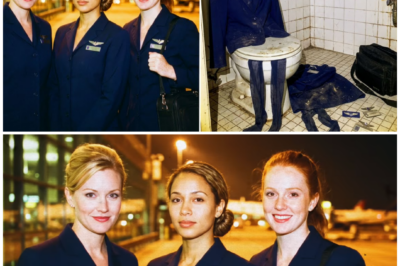
Three Flight Attendants Vanished From a Vegas Hotel in 1996 — 28 Years Later a Hidden Wall Is Opened
.Every hotel, every casino, every neon-lit alley has a story, most of them ending in forgetfulness or denial. But some…
End of content
No more pages to load






