
The wind that day carried the bite of early winter — a wind that scraped at the stone pillars of the Whitmore estate, a wind that had no business mixing with begging voices. But it did.
“Sir? Please… do you need a maid? Anything. My daughter is hungry.”
Charles Whitmore didn’t turn at first. He’d trained himself not to. The rich learn early that compassion costs time, and time was his most expensive currency. The gravel crunched beneath his shoes as he reached for the gate’s latch — one of those heavy iron things meant to keep the world out.
Then came the second sound. A whimper. Not from the woman’s throat but from the bundle in her arms.
He turned.
She couldn’t have been more than twenty. Her dress was threadbare, her shoes the kind that no longer pretended to keep the cold away. She held a baby close, swaddled in what looked like torn curtains. Her face was pale with exhaustion but her eyes — large, brown, defiant — held steady.
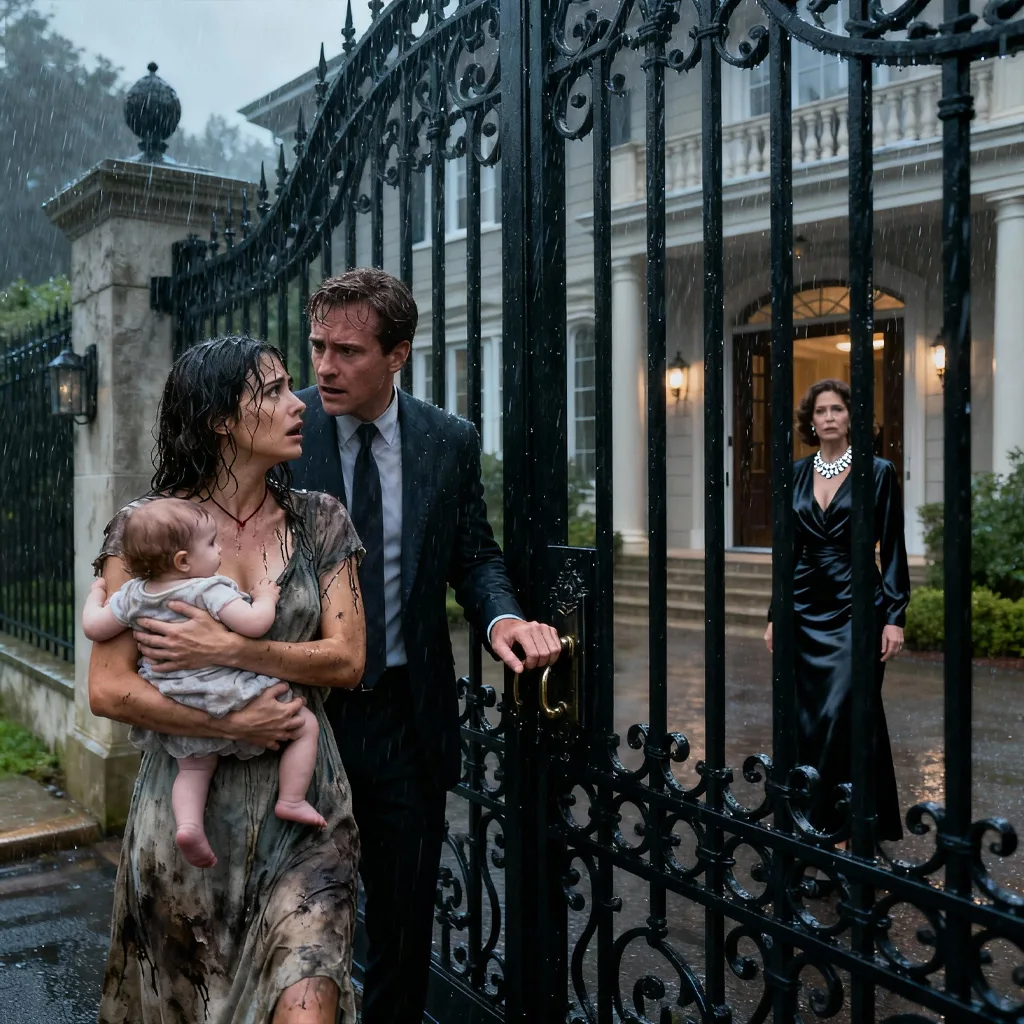
And just there, where the wind had tugged her collar aside, was a small crescent birthmark under her ear.
The world stopped breathing. Charles stared at that mark as if it were burning. Twenty-one years fell away in a single blink. He saw again the grand foyer, his father shouting, his sister Margaret clutching a baby while the servants pretended not to hear. That baby had a crescent mark too. He hadn’t seen either of them since that night.
Now, here she stood — the same eyes, the same mark — begging at his gate.
“What’s your name?” he asked, voice thin and cracking.
“Elena,” she whispered. “And this is Sophia. My daughter.”
“Come inside,” he said.
The girl hesitated, confused by the sudden softness in his tone. When she stepped over the threshold, she entered a world so far removed from hers it might have been another planet.
Charles Whitmore was a man built from guilt and silence. The empire he managed was his father’s before him, a fortress of glass and marble born out of family cruelty disguised as discipline. His sister had been the only one who ever challenged it. Margaret — bright, reckless, in love with a man their father called beneath them — had been banished the day she chose love over inheritance. Charles had done nothing.
He’d spent the next two decades repairing the family name, marrying Clarissa — cold, ambitious, and impeccably proper — and turning his silence into power. But guilt never dissolves; it calcifies.
Now, standing in the foyer with a trembling young woman whose features echoed the sister he’d betrayed, that guilt cracked open like a fault line.
Clarissa’s heels clicked on the marble as she entered. “Charles,” she said, her tone brittle. “Who is this?”
The girl bowed her head instinctively. “I’m sorry, ma’am. I was only—”
“Leave,” Clarissa snapped. “We don’t take in beggars.”
Charles didn’t answer. He couldn’t. The past had returned wearing the face of a starving child.
“Elena,” he said, almost gently, “who was your mother?”
The girl hesitated. “Margaret Whitmore. She died when I was little.”
Clarissa froze. Charles’s chest tightened. The name hung in the air like an invocation.
The revelation moved through the Whitmore household like fire through dry leaves. Within hours, the estate was divided — servants whispering, lawyers summoned, and Clarissa demanding answers she already feared. Margaret’s bloodline meant inheritance, legitimacy, and exposure.
Charles sat in his study that night, the girl’s quiet sobs echoing down the hall where a maid was bathing the baby. Clarissa stood in the doorway, arms crossed like a queen sentencing a traitor.
“You’re not seriously considering keeping them here,” she said.
“She’s Margaret’s child.”
“She’s an embarrassment. You think the board will accept a street beggar as your niece? Do you have any idea what this will do to us?”
He turned slowly, exhaustion etched into every line of his face. “To us, Clarissa? Or to you?”
Her eyes flashed. “Don’t you dare—”
“Twenty-one years ago, I let my father destroy my sister’s life because I was too afraid to lose mine. I’m not doing it again.”
The argument cracked open the fault lines in their marriage. By morning, the staff had split into factions — those loyal to Clarissa and those quietly loyal to Charles. Rumors spread: the old man’s hidden granddaughter, a scandal buried by the Whitmores, a fortune now in question.
When Clarissa discovered that Charles had contacted the family’s attorneys to include Elena and her daughter in the inheritance, she retaliated with the precision of someone who’d spent her life winning invisible wars. She leaked stories to the press about a “fraudulent impostor,” hired private investigators to smear Elena’s name, and arranged for the board to question Charles’s mental stability.
By the time Charles realized how far she’d gone, it was too late. The tabloids had already christened the conflict The Whitmore War.
But fate — that quiet, cruel architect — has a way of repaying old debts.
At the inheritance hearing, Clarissa arrived with photographers in tow, perfectly composed. Elena, pale and shaking, clutched her daughter in a borrowed coat. Charles sat between them, a man trying to bridge two worlds that could no longer coexist.
The lawyers began reading. Decades-old documents surfaced: one letter from Margaret herself, written before she died, naming her child as her rightful heir and accusing her family of cruelty. The birthmark was noted, the records verified. The truth was undeniable.
Clarissa’s face drained of color as the verdict came: half of the Whitmore estate would transfer to Elena and her daughter, heirs by blood. The other half remained in trust until the child came of age.
The reporters swarmed, flashing bulbs like gunfire. Clarissa turned on Charles, her voice low and shaking with venom. “You’ve destroyed everything.”
He looked at her for a long moment. “No,” he said quietly. “I’ve finally built something worth keeping.”
When the noise settled, Charles led Elena and the baby outside. The wind had softened, carrying the scent of rain. He stood there for a moment, staring at the same gates where she’d begged him days before.
“Your mother used to say the Whitmore name was a curse,” he said. “Maybe now it can mean something else.”
Elena looked at him, unsure whether to trust the man who had once abandoned her mother but had now given her a home. “Do you really believe that?” she asked.
He exhaled. “I’m learning to.”
Wealth builds walls high enough to keep out guilt — until one day, guilt climbs higher. Charles Whitmore had spent half a lifetime mistaking power for redemption. It wasn’t money that repaired what he’d broken; it was the courage to open a door.
Elena didn’t inherit just property; she inherited truth — the kind that comes with the weight of history and the burden of forgiveness. For Charles, redemption arrived not in grand gestures but in a small, hungry cry that forced him to see the cost of silence.
And in the quiet that followed the storm, a family once destroyed by pride began again — fragile, imperfect, but alive. The empire remained, but for the first time, someone inside its gates understood that legacy isn’t built from marble or fortune.
It’s built from the moment you stop walking past the voice calling your name.
News

A Mafia Boss Threatened Dean Martin on Stage—Dean’s Reaction Was Pure Genius
A Mafia Boss Threatened Dean Martin on Stage—Dean’s Reaction Was Pure Genius Prologue: A Gun in the Spotlight Dean…

The Billionaire Had No Idea His Fiancée Was Poisoning His Son—Until the Maid Exposed Everything
The Billionaire Had No Idea His Fiancée Was Poisoning His Son—Until the Maid Exposed Everything Prologue: A Whisper That…

The Billionaire Catches Maid ‘Stealing’ Food… But When He Sees Who It’s For, He Breaks Down in Tears
The Billionaire Catches Maid ‘Stealing’ Food… But When He Sees Who It’s For, He Breaks Down in Tears Prologue:…

The Billionaire’s Fiancée Sets a Trap for the Maid — Until His Silent Daughter Exposed the Truth
The Billionaire’s Fiancée Sets a Trap for the Maid—Until His Silent Daughter Exposed the Truth Prologue: The Whisper That…

The Billionaire Went Undercover as a Gardener — Until the Maid Saved His Children from His Fiancée
Richard Whitmore’s hands trembled on the garden shears as he watched through the kitchen window. His new wife, Vanessa, stood…

Three Flight Attendants Vanished From a Vegas Hotel in 1996 — 28 Years Later a Hidden Wall Is Opened
.Every hotel, every casino, every neon-lit alley has a story, most of them ending in forgetfulness or denial. But some…
End of content
No more pages to load






