
The courtroom smelled of lemon oil and old paper, sunlight slicing through high windows and turning dust into slow-moving constellations. I pushed open the heavy door and froze for a second, not because I was afraid of the judge or the reporters, but because my mother rolled her eyes at me—full, theatrical, the kind that said she’d already written the script for her performance. That small, contemptuous gesture landed like a stone.
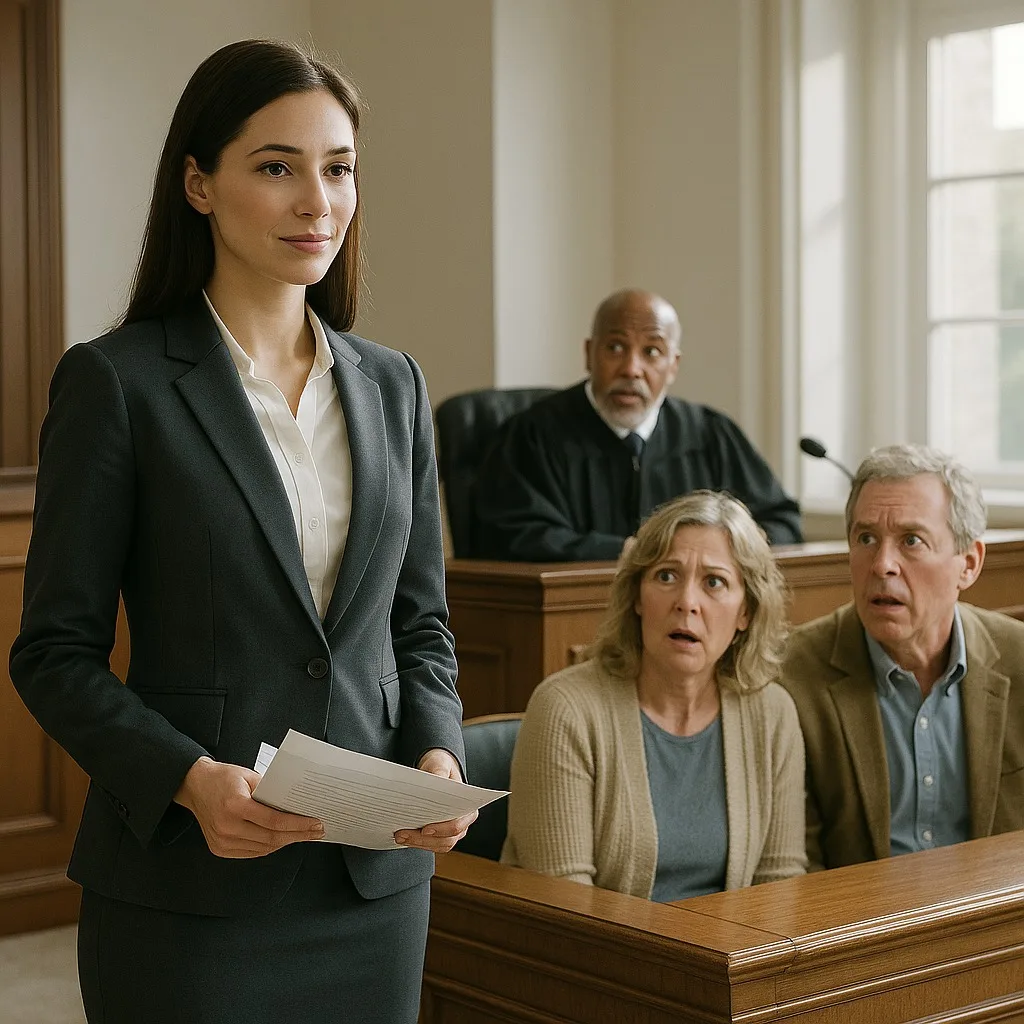
Judge Brennan, gray-haired and precise, looked up from his notes and blinked. “Wait,” he said, as if the world had rearranged itself in the space between breath and word. “These allegations are against you? You’re the defendant?”
For a beat the room went quiet in the way you feel before thunder. The people at the plaintiff’s table—my parents—looked like children caught in a secret they hadn’t expected to be exposed. I didn’t smile. I simply lifted my chin and let the moment find its weight. I was Haley Morrison, Assistant District Attorney. I’d spent years putting manipulators in cuffs. Today the people trying to dismantle my life were the ones who’d abandoned it.
My earliest memory is buttered cookie dough in a Brooklyn kitchen. Grandma Helen with flour on her hand, Grandpa William Parker in his robe, asking, “What cases did you win, Counselor?” They taught me to listen, to show up, to be measured. My mother and father—Diane and Scott—had a different syllabus: glamour, convenience, flight. When I was three months old they drove away and left me on my grandparents’ stoop. They called every few years, staged brief returns for a camera, and kept the image of themselves alive while the work of family lived elsewhere.
Grandpa wasn’t just kind; he was deliberate. He taught me law from the dinner table: definitions through stories, ethics through example. When Grandma died, his hands dug in the garden and he kept planting tulips we would never see together. He also wired my mother three thousand dollars a month for two decades. He believed in helping people. She treated it like an entitlement. I learned that generosity could look like love and like a target.
When Grandpa died, he left me the house, the savings, and a note: “You earned this through love, patience, and presence.” My parents sued, accusing me of undue influence. The irony—people who abandoned me accusing me of manipulating a dying man—was a bitter kind of comic cruelty. I had to go to court not as a prosecutor, but as a woman defending the only family that had been faithful.
Inside Courtroom 3B, Palmer—my mother’s lawyer—painted grief with broad theatrical strokes. He told the story of a lonely father, manipulated in his twilight, of a daughter coerced into theft of blood and legacy. The gallery leaned forward. The photos of my Sunday dinners with Grandpa were met with silence.
Thomas, my attorney, was cool and methodical. He offered a different truth: Grandpa was lucid, deliberate, and he had the ledger to prove it. He’d made transfers, kept calendars, and chosen to reward presence—not lineage.
Cross-examinations became small detonations. Palmer’s witness, a psychiatrist with no personal evaluation of my grandfather, spun a diagnosis out of summaries—an expert hovering at the edge of facts. Thomas dismantled it. Then came evidence: calendars with my mother’s sparse visits; bank statements showing eight hundred thousand in transfers; emails where my parents asked for “help” and left. The most damning thing wasn’t legal paper; it was absence.
When my parents took the stand, Diane’s practiced sadness dissolved under Thomas’s calm questions. She’d visited less than once a year. Scott fumbled over dates and promises. The performance cracked and the mask slid. At one point I was called to the stand. I spoke simply of dinner tables and the smell of pot roast and of a man who chose to be present. “If inheritance were my goal,” I told the courtroom, “I would have spent my life chasing money, not Sundays.”
Judge Brennan listened and, in a sentence that felt like closure, declared the will valid. He awarded attorney fees to me and called their claim meritless. The gavel landed like a verdict on the end of being dismissed.
After the ruling, my mother approached me—her face wet with a shame she had not earned. “Haley, please, can we talk?” she asked.
There are people who will forever ask for what they never gave. I looked at the woman who’d left me with strangers, who’d treated my grandparents as sponsors for her life, and I felt only the clear, tired border of my limits. “There’s nothing to talk about,” I said. “You had thirty-two years. You chose not to come.”
The sound of the courthouse doors closing behind me felt less like an exit and more like the start of breathing again. I drove to the old house in Brooklyn that night and sat on the porch where Grandma had taught me to fold dough. The tulips Grandpa planted still came up every spring. I took his fountain pen from the study and found his note—guard it, he’d written—and for the first time in my life the weight of his faith felt like armor rather than burden.
I didn’t gloat. I did what he would have wanted: I kept showing up. I returned to the prosecutor’s office, to cases that mattered. I taught, I argued, I listened. The house was mine now, but more than property it felt like permission: permission to be rooted where I chose to be rooted.
The law can measure documents and signatures; it takes a court to measure devotion. My grandfather’s legacy wasn’t a sum on a ledger. It was the small, ordinary acts that don’t make headlines: Sunday dinners, steady presence, the habit of showing up when others do not. Blood does not guarantee loyalty. Family is forged in the daily choices to stand by one another.
There is a strange justice in the quiet: those who spend their lives chasing image discover finally that image costs less than fidelity. The judge’s ruling did not erase my parents’ past or their choices. It simply affirmed a simpler truth—that integrity, demonstrated over decades, can outweigh the noise of entitlement.
When the papers ran the next day—my name on page A1—I didn’t seek the spotlight. I went home, planted another row of tulips, and wrote a brief note in Grandpa’s kitchen: “Show up.” It felt like passing the only kind of torch that matters.
News

A Mafia Boss Threatened Dean Martin on Stage—Dean’s Reaction Was Pure Genius
A Mafia Boss Threatened Dean Martin on Stage—Dean’s Reaction Was Pure Genius Prologue: A Gun in the Spotlight Dean…

The Billionaire Had No Idea His Fiancée Was Poisoning His Son—Until the Maid Exposed Everything
The Billionaire Had No Idea His Fiancée Was Poisoning His Son—Until the Maid Exposed Everything Prologue: A Whisper That…

The Billionaire Catches Maid ‘Stealing’ Food… But When He Sees Who It’s For, He Breaks Down in Tears
The Billionaire Catches Maid ‘Stealing’ Food… But When He Sees Who It’s For, He Breaks Down in Tears Prologue:…

The Billionaire’s Fiancée Sets a Trap for the Maid — Until His Silent Daughter Exposed the Truth
The Billionaire’s Fiancée Sets a Trap for the Maid—Until His Silent Daughter Exposed the Truth Prologue: The Whisper That…

The Billionaire Went Undercover as a Gardener — Until the Maid Saved His Children from His Fiancée
Richard Whitmore’s hands trembled on the garden shears as he watched through the kitchen window. His new wife, Vanessa, stood…

Three Flight Attendants Vanished From a Vegas Hotel in 1996 — 28 Years Later a Hidden Wall Is Opened
.Every hotel, every casino, every neon-lit alley has a story, most of them ending in forgetfulness or denial. But some…
End of content
No more pages to load






