
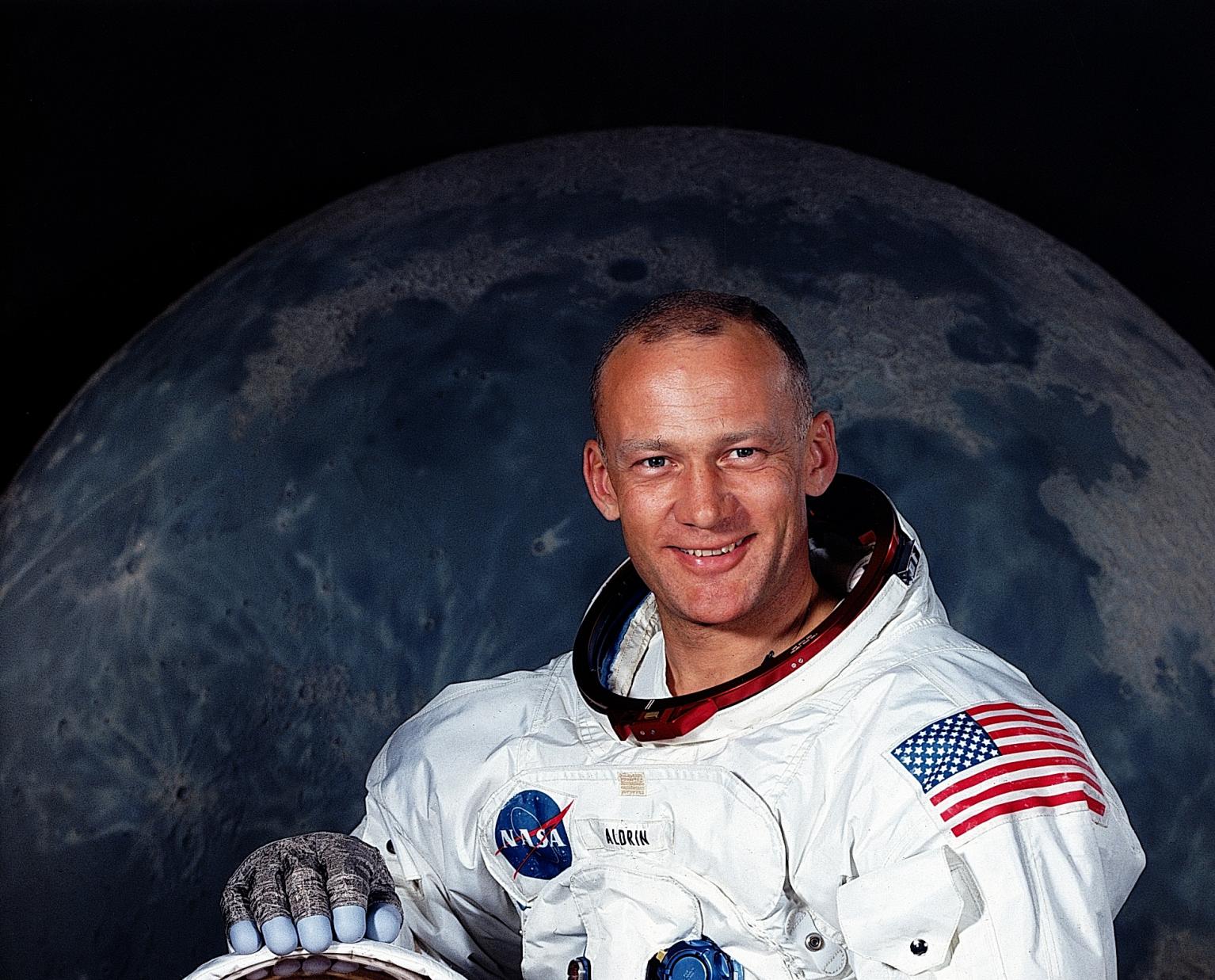
Here’s the thing about Buzz Aldrin at 95: the rumor economy keeps trying to cash him out for something he never bought. “Aliens on the moon,” the headline writers whisper, as if a man who helped park a spaceship in the Sea of Tranquility owes them a late-life twist. Aldrin, as ever, declines to perform. He sticks to the same stubborn posture he’s held for decades: facts over fantasy, engineering over the supernatural, wonder without wishful thinking. If there’s a revelation to be had, it’s the persistence of that stance, not a confession to feed the sensationalists.
He didn’t get to this point by accident. Aldrin grew up fluent in aviation—the son of an Air Force officer and airline executive—so the grammar of lift and drag came early. West Point sharpened it. He graduated third in his class in mechanical engineering, then shipped to Korea and flew more than sixty combat missions. Two MiG-15s downed. Real stakes. No filters or narrators needed. After the war, he didn’t stall out in the glow of medals. He went to MIT, earned a PhD in orbital mechanics, and wrote a thesis that would turn “Dr. Rendezvous” from a nickname into a technical credential. He joined NASA not because he looked good next to a flag, but because he could think clearly under pressure and put math between his nerves.

Gemini 12 further sanded off the mythology. Aldrin performed long EVAs—spacewalks—without drama, proving that not all heroics need a crisis. Then came Apollo 11. The alarms—1201 and 1202—chirped during descent, the computer choking on radar, and Armstrong took manual control while Aldrin watched the numbers. They landed with seconds of fuel. Facts, not fate. He stepped onto the moon nineteen minutes after Armstrong, looked at a landscape of powder and silence, and called it “magnificent desolation.” The line endures because it fits: no poetry gilded, no sentiment forced.
There’s a temptation now, in the late chapters of Aldrin’s life, to rewrite him as a keeper of mysteries. He’s the last living eyewitness from that flight, after all; you can see why people poke him for something he never saw. But the record—interviews, speeches, reports—has remained consistent. He considers extraterrestrial life “probabilistically possible.” He’s said that for years. The universe is too big to insist on human exclusivity. Yet he’s equally clear: he has not seen aliens, not on the moon, not anywhere. He has never witnessed a phenomenon he couldn’t, eventually, square with technical knowledge. That’s dull as a pull quote and durable as a principle.
The Gemini-era “luminous object” gets thrown into the rumor mill every few years. Aldrin reported it; he also reported the likely cause: a piece of the booster drifting as separated hardware tends to do. No speed change, no signal, no intrusion on the systems. The paperwork followed. The incident ended. Later, the story became fodder for edited clips and conspiracy-friendly narrative. The original context stays where it always was—in the mission logs and a pilot’s memory of objects behaving like objects.
If that sounds unsatisfying, it’s because clear answers rarely compete well with the thrill of ambiguity. The internet harvests fragments, stretches audio, reframes quotes until “probabilistically possible” becomes “he admitted it.” He didn’t. He’s been weirdly patient about it, for a man who once punched a moon-denier who got in his face demanding a Bible oath. That 2002 incident still flickers across YouTube, a kind of blunt footnote to an otherwise meticulous public record. No charges were filed. Aldrin never apologized. You can make of that what you like; the throughline is his intolerance for people who trade in manufactured doubt.
It’s worth saying out loud: after Apollo, Aldrin struggled hard. The mythology often skips the part where a man who walked on the moon ended up selling cars, drinking too much, and sitting in psychiatric care. He wrote about it plain in Return to Earth—no heroic varnish, no post-mission glow. There’s a particular kind of emptiness that follows impossible achievement; he named it and survived it. Rehab. Community. A reentry into the work he knew best, this time as a designer and advocate rather than a pilot. The Aldrin Cycler—a gravity-assisted route between Earth and Mars that engineers respect because it respects physics—didn’t move markets but it moved conversation. He spoke about reuse before reuse was cool, showed up on The Simpsons and The Big Bang Theory because levity never undercut credibility, and kept pointing at Mars by 2040 with the kind of optimism that doesn’t require naivete.
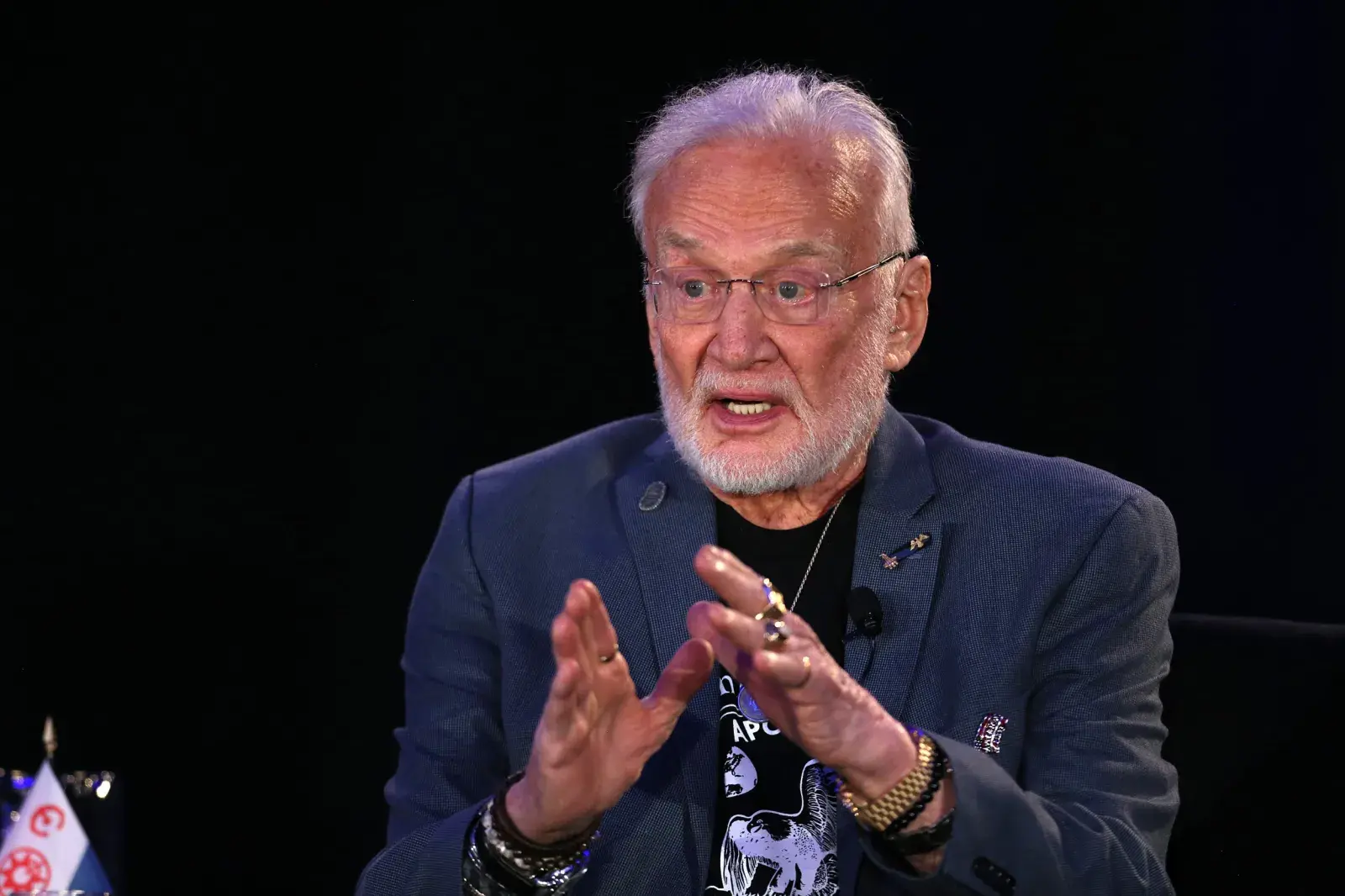
In the quieter years, he became a magnet for the wrong kind of attention. Invitations to “talk aliens” arrived with checks and smiles. He declined enough of them to earn a reputation for being difficult. Good. A legacy built on clarity does not coexist with a booking schedule of speculative shows. His line was simple: if something strange happens, he’ll be the first to say it, and he’ll say it clean. So far, despite the edits and the bait, it hasn’t happened.
What do we want from him at 95? Maybe not the truth so much as permission to keep entertaining the story we prefer. Aldrin gives us neither. He lives quietly in Los Angeles, health thinner than it once was, voice still steady when he records a video or speaks at a gathering. He married again late, found love late, lost it to cancer—real life intruding on the narratives of space. When he does speak, he keeps the sentences short. He knows the cost of being misquoted. His consistency reads like stubbornness until you count the decades.
There’s a version of journalism that would like him to open a secret drawer or whisper about a sighting he once chose not to report. He won’t. I respect that refusal more than any disclosure he could manufacture. In an era where attention has its own stock market, declining to feed the conspiracy crowd is a kind of public service. It protects the record and, not incidentally, protects the people who still take science as a discipline rather than a canvas for projection.
If you’re looking for meaning here, let’s keep it in the right register. The moon did not present Aldrin with aliens. It presented him with dust, silence, geometry, and the bureaucratic grind of experiments and sample bags. It presented him with history’s weight and the afterlife of becoming a symbol. He handled both with more discipline than romance. He believed, and still believes, that other life is plausible. He’s just not willing to turn plausibility into a claim. That kind of restraint is uncool online, but it holds up.
We’ve built a culture that rewards noise over signal. Aldrin has spent half a century choosing signal. It cost him attention. It sometimes cost him comfort. It gave him a reputation for being stiff, humorless, difficult—all the usual labels when you don’t play the game the way the market likes it. But if you strip away the hunger for a twist, what remains is sturdier than a viral headline: a witness who wouldn’t bend, an engineer who let facts have the last word.
At 95, the “truth about aliens” is exactly what it has always been from him: the universe might have neighbors; he hasn’t met them. That answer isn’t romantic, but it is honest. And in a marketplace flooded with monetized doubt, honesty is the last rare commodity.
News

A Mafia Boss Threatened Dean Martin on Stage—Dean’s Reaction Was Pure Genius
A Mafia Boss Threatened Dean Martin on Stage—Dean’s Reaction Was Pure Genius Prologue: A Gun in the Spotlight Dean…

The Billionaire Had No Idea His Fiancée Was Poisoning His Son—Until the Maid Exposed Everything
The Billionaire Had No Idea His Fiancée Was Poisoning His Son—Until the Maid Exposed Everything Prologue: A Whisper That…

The Billionaire Catches Maid ‘Stealing’ Food… But When He Sees Who It’s For, He Breaks Down in Tears
The Billionaire Catches Maid ‘Stealing’ Food… But When He Sees Who It’s For, He Breaks Down in Tears Prologue:…

The Billionaire’s Fiancée Sets a Trap for the Maid — Until His Silent Daughter Exposed the Truth
The Billionaire’s Fiancée Sets a Trap for the Maid—Until His Silent Daughter Exposed the Truth Prologue: The Whisper That…

The Billionaire Went Undercover as a Gardener — Until the Maid Saved His Children from His Fiancée
Richard Whitmore’s hands trembled on the garden shears as he watched through the kitchen window. His new wife, Vanessa, stood…

Three Flight Attendants Vanished From a Vegas Hotel in 1996 — 28 Years Later a Hidden Wall Is Opened
.Every hotel, every casino, every neon-lit alley has a story, most of them ending in forgetfulness or denial. But some…
End of content
No more pages to load






