
The claim arrived with all the trappings of modern royal drama: a sealed letter discovered in dusty archives, a pointed line disinheriting one senior royal and elevating another, and a cascade of insinuations about loyalty, legacy, and power inside the palace.
It is an irresistible frame for attention.
But separating a compelling narrative from a verifiable account is the first duty of anyone who wants facts to matter.
This feature traces what credible sources have published about Prince Philip’s estate, how royal wills are legally handled in the United Kingdom, what we know about beneficiaries and secrecy orders, and why the latest “sealed letter” storyline fails the basic tests of evidence.
What the record says about royal wills and secrecy
In the U.K., royal wills occupy a distinct legal niche.
For more than a century, courts have granted applications to seal the wills of senior royals to protect privacy.
After Prince Philip died in April 2021 at age 99, a High Court judge ruled that his will should remain sealed for at least 90 years, consistent with past practice.
That order means the contents are not public and will be reviewed privately in the future to determine whether any part should be released.
This legal reality is the keystone: anyone claiming knowledge of Philip’s detailed bequests faces a high evidentiary bar because the document itself is not available for public inspection.
Sealed does not mean shapeless.
Even sealed wills go through probate, and estate administration must comply with U.K.
law.
But specific distributions—who gets what—are not disclosed.
This formal arrangement exists to shield personal and family details while maintaining a lawful process for the estate.
What is known—and what is not—about Philip’s personal wealth
Estimates of Prince Philip’s personal wealth have appeared in various outlets over the years, usually characterized as a combination of savings, investments, and personal effects accumulated across a lifetime of public service and private frugality.
Those figures are estimates, not audited public disclosures.
Unlike the Sovereign Grant, which funds official duties and is publicly accounted, a consort’s private holdings are not itemized for public consumption.
There is no verified public ledger that lists Philip’s net worth at death, nor a public breakdown of beneficiaries.
Any number attached to his “personal fortune” is, by definition, an estimate unless accompanied by documents, filings, or named sources with direct access—and the sealed-will framework makes such access extraordinarily unlikely.
How the “Catherine not Camilla” narrative diverges from standard practice
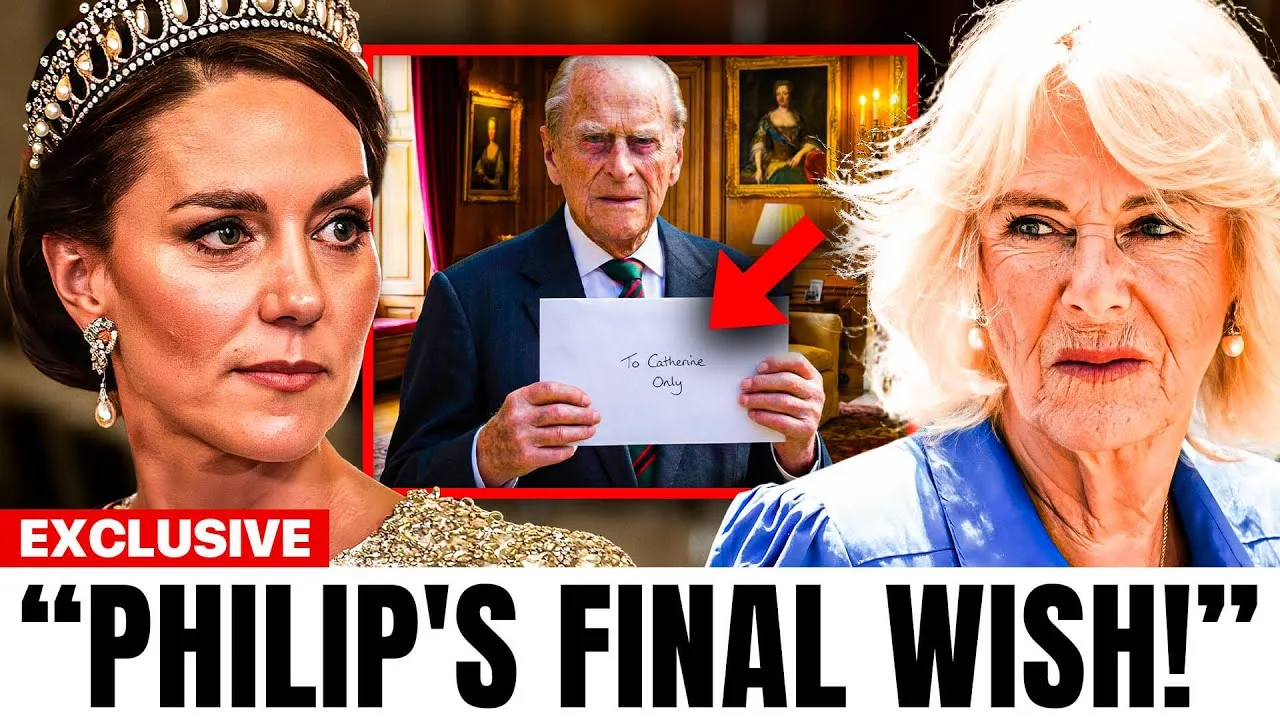
The viral storyline asserts that Prince Philip left a private directive granting Catherine, Princess of Wales, access to his personal fortune and explicitly excluding Queen Camilla.
That framing implies two concrete facts: a specific beneficiary designation for Catherine and an exclusion clause naming Camilla.
In ordinary estate reporting, such claims require corroboration from documents (the will or a codicil), trustee or executor statements, court filings, or named legal counsel.
The current public record provides none of the above.
There is also a structural point.
Prince Philip’s closest legal and familial link was to Queen Elizabeth II, not to the next generation by marriage.
While it is possible for any person to designate any beneficiary, significant, unexpected bequests to a daughter-in-law (rather than a spouse, children, or grandchildren) would be notable and almost certainly attract legal and press scrutiny.
In the absence of documentation, the “Catherine-only” claim reads as narrative convenience rather than verified fact.
What credible coverage looks like in a case like this
Responsible reporting on a sealed royal will would look and sound different:
– It would anchor claims in named sources—executors, solicitors, or the court—explaining how they have lawful knowledge despite the sealing order.
– It would reference formal steps in probate or trust administration: dates, filings, and the roles of specific trustees or executors.
– It would distinguish between personal property, trust assets, and official royal holdings, because different rules and privacy boundaries apply.
– It would state what cannot be known due to the seal, making the limits of reporting clear.
The current viral narratives do none of this.
Instead, they lean on anonymous “insiders,” cinematic archive scenes, and emotionally loaded contrasts that fit audience expectations about palace dynamics—stability vs.
unpredictability, tradition vs.
spectacle—without offering verifiable substance.
Why these stories catch fire anyway
Several forces propel royal rumor:
– Secrecy breeds speculation.
When documents are sealed, readers fill the void with imagination, and creators fill it with content.
– Archetypes do the work.
The “wise patriarch” choosing a steady heir and sidelining a rival is a timeless story.
It feels plausible even without proof.
– Platform economics reward certainty.
Ambiguous facts don’t travel; definitive-sounding lines do.
“Catherine will inherit” is more shareable than “we don’t know.”
– Parasocial familiarity.
Audiences watch royals closely and feel they “know” who is disciplined, who is volatile, and who “deserves” trust.
Projection becomes inference.
A short guide to reading claims like this without getting spun
– Ask for the paper trail.
If the will is sealed, what document supports the claim? Who has lawful access? Why can they speak?
– Separate inheritance from patronage.
Titles, patronages, and public roles are not the same as personal bequests.
– Distinguish rumor from record.
If multiple independent, reputable outlets corroborate a detail with named sources, it’s stronger than a single sensational post.
– Mind the verbs.
“Granted,” “excluded,” and “directed” imply documented actions.
Credible stories pair those verbs with proof.
– Beware the archive trope.
“A sealed envelope in dusty stacks” is a narrative flourish.
Without provenance, it’s atmosphere, not evidence.
What we can say with confidence—and what we cannot
– We can say Prince Philip’s will is sealed by court order, consistent with long-standing practice for senior royals.
– We can say there is no public documentation indicating that Catherine is the designated beneficiary of Philip’s personal fortune, nor that Camilla is explicitly excluded.
– We can say prior reporting about royal estate handling emphasizes privacy, lawful probate, and broad protections against public disclosure.
– We cannot assert the contents of Philip’s will or any annexes, directives, or clauses without verifiable documents or named, accountable sources.
– We cannot confirm any “sealed letter” discovered and opened by an archivist in a way that contradicts the High Court’s sealing order without extraordinary evidence.
The broader lesson for readers
There is nothing wrong with finding royal stories interesting.
The monarchy sits at the intersection of history and celebrity; it will always be compelling.
The task is to keep curiosity aligned with verifiability.
That means rewarding outlets that show their sourcing, penalizing stories that substitute mood for proof, and holding space for uncertainty when legal frameworks (like sealed wills) limit what can be known.
If a revelation of the scale described here were real, you would see migration from rumor to record: legal correspondence, trustee statements, court references, coordinated reporting from multiple major newsrooms, and clear, attributable quotes.
Until that happens, the fairest reading is the careful one: an engaging claim is circulating without corroboration; the public record does not support it; the legal status of the will makes detailed reporting inherently suspect.
A humane closing note
Stories like these attach themselves to real people—spouses, children, and extended family whose private relationships and grief do not belong to the internet.
Even as we ask for better evidence, we can choose a tone that respects privacy rather than treating personal legacies as raw material for outrage.
The difference between entertainment and truth is not only a matter of facts.
It is also a matter of care.
The bottom line
The “sealed letter” narrative asserting a personal fortune for Catherine and an explicit exclusion of Camilla is unverified.
Prince Philip’s will remains sealed under U.K.
law.
No credible, document-backed reporting has substantiated the specific claims now going viral.
In the absence of proof, the right posture is simple and sturdy: enjoy the history, demand the receipts, and let facts—not fables—decide what’s true.
News

A Mafia Boss Threatened Dean Martin on Stage—Dean’s Reaction Was Pure Genius
A Mafia Boss Threatened Dean Martin on Stage—Dean’s Reaction Was Pure Genius Prologue: A Gun in the Spotlight Dean…

The Billionaire Had No Idea His Fiancée Was Poisoning His Son—Until the Maid Exposed Everything
The Billionaire Had No Idea His Fiancée Was Poisoning His Son—Until the Maid Exposed Everything Prologue: A Whisper That…

The Billionaire Catches Maid ‘Stealing’ Food… But When He Sees Who It’s For, He Breaks Down in Tears
The Billionaire Catches Maid ‘Stealing’ Food… But When He Sees Who It’s For, He Breaks Down in Tears Prologue:…

The Billionaire’s Fiancée Sets a Trap for the Maid — Until His Silent Daughter Exposed the Truth
The Billionaire’s Fiancée Sets a Trap for the Maid—Until His Silent Daughter Exposed the Truth Prologue: The Whisper That…

The Billionaire Went Undercover as a Gardener — Until the Maid Saved His Children from His Fiancée
Richard Whitmore’s hands trembled on the garden shears as he watched through the kitchen window. His new wife, Vanessa, stood…

Three Flight Attendants Vanished From a Vegas Hotel in 1996 — 28 Years Later a Hidden Wall Is Opened
.Every hotel, every casino, every neon-lit alley has a story, most of them ending in forgetfulness or denial. But some…
End of content
No more pages to load






