
A single line can turn private grief into public speculation.
That’s what happened when Erika Kirk, the widow of conservative organizer Charlie Kirk, told an interviewer she had prayed to be pregnant when her husband died.
It was a poignant sentiment—wanting a lasting connection to someone gone too soon.
But as the internet does, it stripped emotion for arithmetic.
If Charlie’s death was ten weeks prior and Erika elsewhere mentioned being eight weeks pregnant, social media rushed to fill the gap with its favorite fuel: rumor.
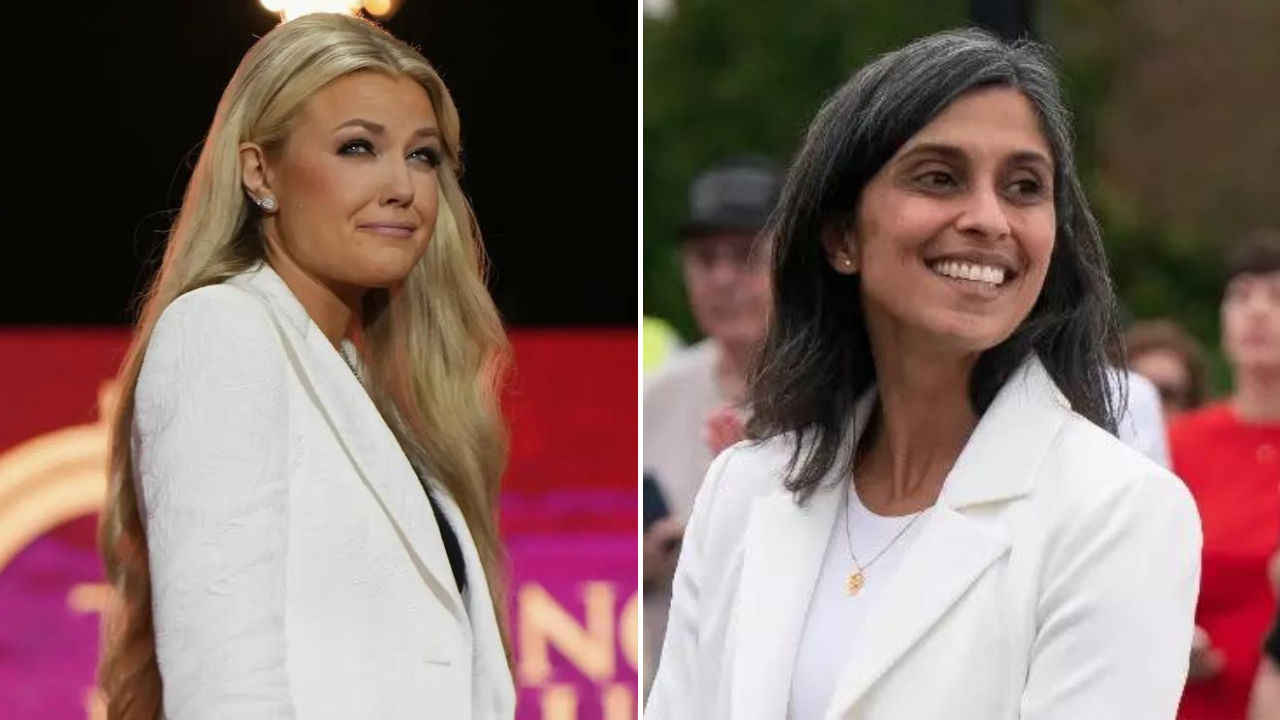
In short order, a viral hug between Erika Kirk and Vice President J.D.
Vance was reframed from comfort to alleged evidence, and Usha Vance—long praised for poise and privacy—was pulled into the narrative over photos where she appeared without a wedding ring.
This is how modern political scandals begin: not with verified documents, but with timelines, optics, and powerful insinuations.
The question is whether anything in this storm clears the basic bar for proof.
Start with what’s actually known.
Erika Kirk appeared in a high-profile interview and shared the vulnerable hope that she had wished for a pregnancy at the time of her husband’s passing.
That sentiment, however tender, is not itself a confession, and pregnancy timing is notoriously tricky.
Early gestational estimates can shift by days or even weeks depending on the method and the moment.
A two-week discrepancy does not, by itself, tell a complete story.
Without medical records, on-the-record confirmation, or a doctor’s timeline, the dating debate is speculation dressed up as certainty.
The hug between Erika and J.D.
Vance did happen, and it became widely shared.
In the aftermath of Charlie’s death, public displays of solidarity were common.
People touched, prayed, cried, and steadied each other on stage.
Body-language analysis might be entertaining, but it isn’t evidence.
Assigning motive or relationship from a short clip is a well-worn path to conclusions that can’t be sustained.
Usha Vance’s ring—or the absence of it in certain photos—has been used as a proxy for private answers.
Rings come off for ordinary reasons: childcare, travel, work, habit.
Some read the choice as deliberate messaging, a dignified signal of strain.
Others see the danger in making a piece of jewelry do the work of documentation.
If a marriage were changing in public, you would expect filings, statements, or named-source confirmations.
None exist on the record.
Candace Owens’ commentary amplified the timing questions and gave the rumor machine a new head of steam.
Her skepticism resonates with audiences who feel the movement has blurred lines between influence and accountability.
But skepticism about narrative is not proof of a different one.
Online standing and strong opinions are not equivalent to verified sources, documents, or testimony.
When claims move from critique to allegation, the standard must change with them.
What has followed is a familiar cycle: the rumor becomes a headline, the headline becomes a conversation, and the conversation begins to reshape reputations.
Inside political teams, silence is often the first response—less an admission than a calculation that any answer will be misread.
Crisis communications triage becomes visible only in the negative space: canceled appearances, tighter booking, internal phone calls that never make it to the public square.
It’s worth stepping back and asking why this story sticks.
Grief is hard to watch in public.
Viewers struggle to square emotion with optics and look for coherence in a medium that rewards intensity over nuance.

Faith makes the picture even more complicated.
When a public figure frames hope and loss in spiritual terms, audiences divided by politics and religion hear different things—sincerity to some, strategy to others.
And then there’s gender.
Women in public life are scrutinized through a different lens.
A touch, a phrase, a glance upward can become a Rorschach test for motives and morals.
Attention also rewards tidy narratives.
One involving three recognizable figures—a widow, a vice president, and a spouse—writes itself in the public imagination.
It offers roles: victim, betrayer, truth teller, quiet anchor.
Reality rarely cooperates with casting choices.
The overwhelming majority of complicated human stories unfold in private with few clean lines and fewer public admissions.
Rumor culture ignores that mess in favor of clarity that often isn’t true.
If readers want a straight, nonfiction account that respects American expectations of fairness and clarity, the ground rules are simple:
– Verify dates with primary sources.
Pregnancy timelines are medical facts, not social-media math problems.
Without records or on-the-record medical confirmation, gestational claims are an unstable foundation for accusations.
– Treat optics as optics.
A hug is a hug.
A ring is a ring.
Neither is a filing.
The strongest stories are built on documents, not photos.
– Demand names.
Anonymous “insiders” and “sources close to” carry value only as starting points.
Serious allegations require on-the-record witnesses willing to stake names and reputations.
– Require documents.
Screenshots, emails, logs, and statements need provenance.
Chain of custody matters.
Without it, artifacts are props.
– Watch for credible corroboration.
If a claim is significant, independent outlets will move to verify it.
True stories migrate.
They don’t remain siloed in channels built primarily for outrage.
Applied here, those rules move most of the narrative back to caution.
The claims about an affair or a pregnancy tied to someone other than Charlie remain unverified.
The suggestion that Usha signaled marital dissolution with the absence of a ring is interpretation, not proof.
The idea that timing alone proves betrayal relies on assumptions the record does not yet support.
That does not mean the public response is irrelevant.
At minimum, this episode shows how online communities now attempt to litigate private lives by crowdsourcing timelines and decoding gestures.
It reveals a hunger for accountability that sometimes outruns evidence.
It reveals a distrust of political proximity—people assume that shared stages and public warmth are prelude, not epilogue.
And it reveals how grief, faith, and gender interact in the digital theater: tender words become suspicious, comfort becomes scandal, privacy becomes a tell.
There’s also an organizational backdrop worth acknowledging.
Conservative politics—and the high-profile activism surrounding it—operate on networks: donors, staff, elected officials, influencers, allies.
Networks can be rife with competition and vulnerability, especially after a death that reorders power.
In those moments, rumor becomes a tool.
It can freeze rivals.
It can force clarifications.
It can also cause collateral damage with no upside for the truth.
No movement is immune from this dynamic.
So what happens next? Either the claims harden into facts—which means names, documents, and statements—or the story fades, leaving behind suspicion and a diminished reservoir of trust.
If something real is coming, expect multiple outlets to land with parallel reporting, expect medical or legal records to appear, and expect principals to speak in ways that can be checked.
If nothing real is coming, expect the cycle to move on and the clip to become just another artifact in a sprawling archive of moments that felt definitive and weren’t.
There is a humane option in the meantime: keep the grief in view.
Erika’s comments sounded like someone reaching for meaning amid loss.
You don’t have to agree with her phrasing to accept that grief bends language.
You don’t have to admire her optics to accept that people under pressure reach for touch.
You don’t have to share her faith to accept that prayer—especially a prayer for connection—is not a plot point.
And you don’t have to take sides in a marriage to accept that rings, photos, and silence are thin evidence for thick conclusions.
The American public square would be healthier if more conversations about personal lives asked for more than suggestive timelines and viral images.
The media would be better for resisting the rush to declare guilt while facts are still assembling.
And audiences would be better served by remembering that dignity sometimes looks like refusing to drag private pain into the middle of a public fight.
In politics, attention is a currency.
It can buy sympathy, outrage, or power.
It can also bankrupt trust.
The wisest response by readers is to spend it carefully—on stories that meet the standard for truth, not just the standard for virality.
For now, the accurate version is this: Erika Kirk shared a vulnerable hope; online commentators seized on a timing discrepancy and tethered it to a widely shared hug; photos of Usha Vance without a ring were folded into a narrative that remains unverified; and a week of theories turned into a test of whether rumor can be mistaken for reporting.
The answer should be no.
The next chapter, if there is one, will be written in documents and names.
Until then, the fairest stance is restraint.
News
A Mafia Boss Threatened Dean Martin on Stage—Dean’s Reaction Was Pure Genius
A Mafia Boss Threatened Dean Martin on Stage—Dean’s Reaction Was Pure Genius Prologue: A Gun in the Spotlight Dean…
The Billionaire Had No Idea His Fiancée Was Poisoning His Son—Until the Maid Exposed Everything
The Billionaire Had No Idea His Fiancée Was Poisoning His Son—Until the Maid Exposed Everything Prologue: A Whisper That…

The Billionaire Catches Maid ‘Stealing’ Food… But When He Sees Who It’s For, He Breaks Down in Tears
The Billionaire Catches Maid ‘Stealing’ Food… But When He Sees Who It’s For, He Breaks Down in Tears Prologue:…

The Billionaire’s Fiancée Sets a Trap for the Maid — Until His Silent Daughter Exposed the Truth
The Billionaire’s Fiancée Sets a Trap for the Maid—Until His Silent Daughter Exposed the Truth Prologue: The Whisper That…

The Billionaire Went Undercover as a Gardener — Until the Maid Saved His Children from His Fiancée
Richard Whitmore’s hands trembled on the garden shears as he watched through the kitchen window. His new wife, Vanessa, stood…

Three Flight Attendants Vanished From a Vegas Hotel in 1996 — 28 Years Later a Hidden Wall Is Opened
.Every hotel, every casino, every neon-lit alley has a story, most of them ending in forgetfulness or denial. But some…
End of content
No more pages to load






