
REWARD FOR KINDNESS
Rain hammered the shingles like a drum corps that wouldn’t be dismissed. Gutters gulped and overflowed; Maple Hollow’s narrow streets turned into dark mirrors that caught and broke the glow of a single streetlamp. In a two-room house at the town’s edge, Daniel Harper sat on a threadbare sofa counting the seconds between his son’s coughs. Leo—seven, fever-flecked, fierce even in sleep—twitched and murmured, a small fist unclenching against his father’s shoulder. The clock above the stove crept toward midnight. The diner’s double shift waited on the far side of sunrise; the rent whispered from the stack of unopened envelopes. Daniel rested his palm against Leo’s back, felt the small engine of the boy’s breath, and decided—again—that tomorrow he would simply be stronger.
The first knock was timid enough to dismiss. The second was a plea. Daniel opened the door into a wall of rain. Beyond the curtain of water, two teenage girls stood under the failing halo of the porch light—sodden, shivering, hair pasted to their faces, shoes sluicing mud onto the concrete like they’d been invented to carry riverbeds inside. The taller one tried for a smile that landed as a wince.
“Please,” she said, voice ragged. “The bus dropped us wrong. We’ve been walking. No one answered.” She didn’t finish the sentence. She didn’t have to.
Daniel’s house had no spare bed, no spare money, and only the memory of spare time. He looked past their dripping curls to the raw, red hands clutched together for warmth, then back at the couch where Leo slept under a thrift-store quilt. He stepped aside.
“Get in. We’ll sort it out.”
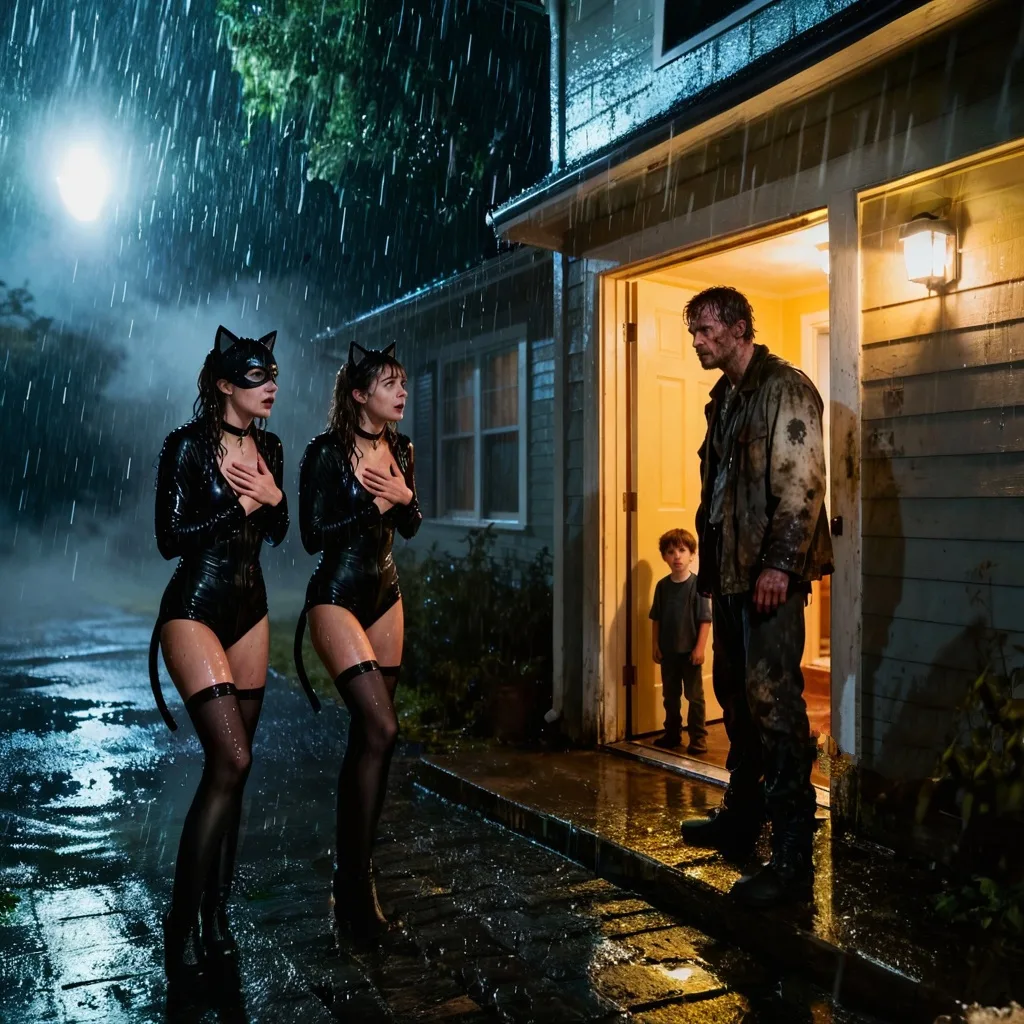
Inside, heat rose in gentle waves from the old radiator, more suggestion than guarantee. Daniel handed over the best towels he owned and two of Maya’s sweaters from the cedar trunk—thick, soft, still carrying a breath of the woman who’d worn them. The girls stripped off waterlogged coats and knuckled at their eyes in the way of people who are trying hard not to cry.
“I’m Daniel,” he said, moving through the kitchen he knew blindfolded—kettle on, two chipped mugs, instant soup a small miracle when coaxed into broth. “This is Leo.” The boy’s cough eased into sleep at the sound of his name, as if reassurance had weight.
“Emma,” said the taller one. “This is my sister, Lily.” They looked like twins at a glance, but the differences announced themselves in the quiet: Emma met questions head-on with a steadiness that felt older than her face; Lily’s gaze flickered like a bird, mapping exits and kindness in equal measure.
They held steaming mugs between both hands like campfires. Rain brayed at the windows. The small kitchen filled with chicken-salt fragrance and the ordinary comfort of a humming kettle.
“Parents?” Daniel asked, no edge in it. Just the shape you give to concern so it can be answered.
“Not here,” Emma said carefully. “Visiting a friend uptown. Our driver was supposed to take us home, but the bus—” She stopped, looked down at the soup. The quiet between them wasn’t a lie; it was a locked door.
Lily looked up. “We tried houses,” she whispered. “People saw us and…” She let the rest hang. The streetlight flickered. Somewhere far off, a transformer sighed.
Leo woke enough to sit up, eyes bleary, hair a startled nest. “Dad?” he asked, then saw the girls and blinked solemnly. “You can have my blanket,” he announced, thrumming with the fierce generosity of children. He dragged it to the table.
Daniel smiled at him, a soft, tired pride. “We’ll share.”
They ate. They thawed. The storm leaned in, then leaned back, like something that had been told to leave and was ignoring the house’s request. When the girls finally slept—Lily curled on the sofa with Leo’s blanket tucked under her chin, Emma in the reading chair with her chin on her chest—Daniel sat at the table with the bills and a pencil, the arithmetic of survival whispering its usual impossible sums. He didn’t finish the math. He listened to three patterns of breathing settle and thought: this is what a house sounds like when it is doing its job.
Morning ran gray along the horizon. The storm had wrung itself dry, leaving tree branches glittering with reluctant pearls. Daniel fried eggs he couldn’t spare and sliced the last apple thin to make it seem like more. As he poured tea, a black car glided into view at the curb. Not a town car—a creature from a different map altogether. Sleek, heavy, the kind that travels with courtesies. Two men in coats stepped out, scanned, then straightened as a third emerged.
The man who climbed the porch steps wore the kind of suit that never saw rain and a face that had learned how to move rooms by standing still. He carried the weather of money even before the credentials: crisp, polished, used to doors opening before he knocked. He didn’t knock. He hovered, uncertain—a rare expression in a man like that.
“Mr. Harper?” he asked.
Daniel had the instinct to widen himself in the doorway, to occupy the fragile span between strangers and sleeping children. “That’s me.”
“My name is Adrian Cole.” He glanced at the window, where a small face peered out through curtain lace—Lily, eyes wide, Emma’s silhouette rising behind. “My daughters are inside.”
The word daughters was both statement and apology. Emma stepped into the kitchen, jaw set. Lily took her hand. The man’s gaze softened with a relief that arrived as slow as contrition.
“Dad,” Emma said. Not accusation, exactly. Not welcome, either. A naming.
The room shifted, air choosing sides. Daniel looked from the girls to the man to the car that still dripped rain water like it had just been invented. He could hear the story in the silence: the wrong turn, the driver’s mistake, wealth as a bubble and as a blindfold. But he could also hear something else—the rasp in Adrian’s voice, the sleeplessness at the eyes, the hand that trembled half an inch when he reached toward his children and then stopped, unsure of the terms.
“Thank you,” Adrian said to Daniel. Two words, insufficient. He said them again, as if repetition could grow them bigger. “Thank you.”
Daniel nodded. “They were freezing.” He let the practical sit between them as a bridge.
An assistant materialized at Adrian’s shoulder with a velvet box and an envelope—gestures folded into his job. Adrian didn’t take them. “Not that,” he said quietly, to both men and impulse. He looked around the small kitchen: the dented kettle, the taped cabinet door, the drawing held to the fridge with a magnet shaped like a sun. He looked like a man revising a list mid-sentence.
He stepped back toward the door, then turned. “Would you all—would you humor me?” The question landed awkwardly in his mouth. “Breakfast. At our place. So I can… so we can say thank you properly.” He glanced at Leo, who blinked back at him with fever glassiness and a scientist’s interest in fancy shoes. “And so we can get your boy some proper cough medicine on the way.”
Emma weighed it. Lily nodded minutely. Daniel glanced at the clock—his double shift already a lost cause—and measured the distance between pride and grace. He zipped Leo into his coat and said, “We don’t have a car seat.”
Adrian exhaled, a man relieved to be useful. “We’ll fix that.”
The Cole house rose behind iron gates and patient hedges, a modern glass-and-stone composition that pretended it didn’t want to be looked at. Inside, warmth didn’t creep; it stated. Staff moved like kindnesses you weren’t supposed to notice. The girls disappeared up a staircase for dry clothes and returned as versions of themselves unburdened by damp—hair combed, color back in their cheeks, relief admitted.
A physician appeared like a spell and listened to Leo’s chest, scribbled a prescription, pressed a lollipop into his palm with the solemnity of a treaty. In the kitchen that could have hosted a small town meeting, a chef slid a plate of pancakes under Leo’s nose and watched awe replace caution. Emma ate with the focused gratitude of someone who has watched a night swallow choices whole. Lily laughed at the dog who was too dignified for begging and begged anyway.
Adrian stood, not at the head of the table but at the side, and let the room make him small on purpose. He tried to hand Daniel a check. Daniel looked at it once and shook his head, gentle but iron. “They needed a warm place to stand,” he said. “That’s not a bill.”
Adrian didn’t argue. Instead, he opened a different door. “Mr. Harper—Daniel—what hours do you work?”
“All of them,” Daniel said, and the table smiled.
“Come see me Monday,” Adrian said. “We’re opening a distribution center off Route 3. We need a foreman who knows how to keep a place running on not enough. Benefits. Predictable hours. I can’t buy what you did last night. But I can stop asking your kid to trade his father for a double shift.”
Daniel stared at him—the way a man looks at a bridge he didn’t know could hold him. Pride rose. So did the ledger of needs. He put out his hand. “I’ll show up,” he said.
Adrian shook it, relief loosening something hard behind his eyes. He turned to Emma and Lily. “And you,” he said, no longer the man in the suit so much as a father who’d learned something in the rain. “You will say thank you when it’s owed. And you will ask when you are lost. Not the driver. Me.”
They nodded. Lily slipped her hand into Daniel’s and squeezed once, a small, fierce punctuation.
By afternoon, the storm had rinsed the town clean, leaving puddles that held small skies and a sky that seemed to remember how to be blue. Daniel walked Leo home between shining oaks, a pharmacy bag whispering against his leg; in his pocket, a business card weighted the fabric as if it were a coin he hadn’t fully earned. At the corner, the black car turned the other way, waved once with its turn signal, and disappeared into a world that had always existed parallel to Maple Hollow and had rarely crossed it.
That night, in the two-room house, cough medicine worked the slow magic of sleep. Daniel watched his son’s fever recede and reheated the last of the pancakes, which tasted even better when they were stolen from morning. He stood at the window for a long time, looking out at his small yard with the broken birdbath, and imagined a version of Monday where work ended before dark and Leo’s school play didn’t need an empty seat next to Maya’s memory.
Some kindness is a door you hold for a stranger in a storm. Some kindness is the stranger refusing to walk through with muddy boots. He had opened his house because once, someone had done it for him, and once, no one had. He hadn’t asked for anything back because true help isn’t a ledger. But the world, fickle as weather, sometimes insists on balance.
In towns like Maple Hollow, people measure wealth by who shows up at midnight and who answers the knock. In houses like Adrian Cole’s, people learn that gratitude isn’t a gift basket or a number on a check; it’s a change of habit that lasts past morning.
The rain had come hard and left quiet. Daniel turned off the unreliable bulb, listened to the even breath of a sleeping child, and felt a light he didn’t have to pay for come up inside his chest. Tomorrow would be busy. The week would still be long. But a door had opened and did not swing shut.
Sometimes the storm brings trouble. Sometimes, if you’re lucky, it brings a way through. And sometimes it brings two shivering girls who remind a billionaire of the obvious and a single father of the fact that he is, against the odds, exactly the man he hoped he might be.
News

A Mafia Boss Threatened Dean Martin on Stage—Dean’s Reaction Was Pure Genius
A Mafia Boss Threatened Dean Martin on Stage—Dean’s Reaction Was Pure Genius Prologue: A Gun in the Spotlight Dean…

The Billionaire Had No Idea His Fiancée Was Poisoning His Son—Until the Maid Exposed Everything
The Billionaire Had No Idea His Fiancée Was Poisoning His Son—Until the Maid Exposed Everything Prologue: A Whisper That…

The Billionaire Catches Maid ‘Stealing’ Food… But When He Sees Who It’s For, He Breaks Down in Tears
The Billionaire Catches Maid ‘Stealing’ Food… But When He Sees Who It’s For, He Breaks Down in Tears Prologue:…

The Billionaire’s Fiancée Sets a Trap for the Maid — Until His Silent Daughter Exposed the Truth
The Billionaire’s Fiancée Sets a Trap for the Maid—Until His Silent Daughter Exposed the Truth Prologue: The Whisper That…

The Billionaire Went Undercover as a Gardener — Until the Maid Saved His Children from His Fiancée
Richard Whitmore’s hands trembled on the garden shears as he watched through the kitchen window. His new wife, Vanessa, stood…

Three Flight Attendants Vanished From a Vegas Hotel in 1996 — 28 Years Later a Hidden Wall Is Opened
.Every hotel, every casino, every neon-lit alley has a story, most of them ending in forgetfulness or denial. But some…
End of content
No more pages to load






