
The café windows were fogged at the corners where the morning couldn’t quite warm the glass. Outside, a strip of late-spring rain stitched the parking lot into a gray quilt. Emily Sanders sat at a small round table near the back, hands wrapped around a mug that had long stopped steaming, watching two figures step through the door and pause as if they’d misjudged the gravity in the room. Her parents—Richard and Helen—looked smaller than memory allowed, as though time had been subtracting, not passing. He held his hat like it might argue with him. She clutched her purse with both hands, the way you hold something you can’t afford to lose.
They spotted her, and something in their faces moved—shock, relief, fear—emotions that don’t like to be seen together. Helen pressed a hand to her mouth, already crying. Richard’s mouth worked around a word that didn’t make it out. The waitress set down fresh water with a soft apology and vanished. Emily set her mug aside, felt her pulse steady into a drumline she’d learned at seventeen: don’t flinch, don’t fold, don’t fill the silence for them.
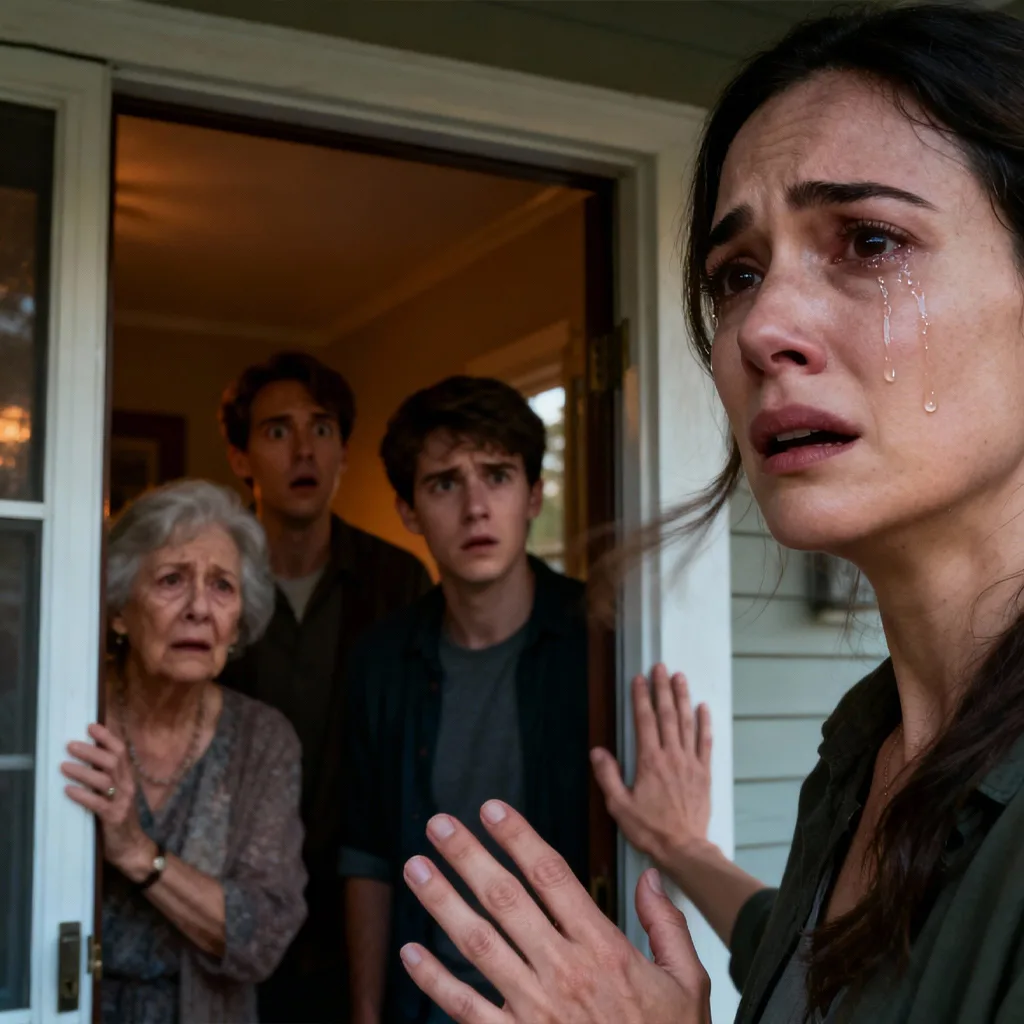
“Emily,” her mother whispered, as if the name might break if she said it too loud. “We’d like to meet our grandson.”
The room took a breath and held it. Outside, the rain lifted. Inside, the past cleared its throat.
Before the café, there was a kitchen—the Sanders’ kitchen—where the clock above the stove used to tick loud on Sundays, and where, one late afternoon, the spoon slipped from Helen’s hand and cracked against a coffee cup when her daughter said, “I’m pregnant.” The air had tightened, as if morality were a gas that expands to fill the container. Richard’s eyes went flat with a kind of principled fury that feels like clarity when you’re inside it. “Whose?” he demanded. “Ethan’s,” Emily said, and heard the rest of her life rearrange itself in the silence that followed.
She was out by Friday. A duffel bag, a phone with numbers that turned out to be more hope than help, a body learning to hold space for another heartbeat. Ethan lasted two months—fear is fast, and leaving is easier than staying when you’ve been taught that mistakes are contagious. Emily took a night shift at a diner where the coffee tasted like persistence, rented a room behind a house where the old couple whispered kindly through thin walls, and learned the arithmetic of survival. When Jacob was born, nineteen found her exhausted and terrified and entirely new. His hand wrapped around her finger, and something inside her locked into place—like a door finding its frame.
Years became a long, unglamorous kind of motion. Nursing school after midnight. Diapers in the trunk, flashcards in the break room, lullabies hummed to the rhythm of fluorescent lights. The town’s gossip ran like a creek in spring—noisy, constant, carrying sticks and small cruelties downstream. Her parents did not call. Birthdays went by like trains: scheduled, distant, noisy in passing. Aunt Lydia tried to patch the space with words the size of quilts—They still love you, they’re proud in their way—but the house never warmed. Emily learned not to place her hands over fires that weren’t lit.
Jacob grew toward the light she turned on each morning: gentle, bright, slow to anger the way some boys are when their first language is listening. He laughed with his whole face. He learned to read people the way other kids read maps. Emily told him the truth he could hold at each age. Your father couldn’t stay. I could. I did.
And then last spring, a letter with familiar loops and a tremble in the ink. We made many mistakes. We’d like to meet you—and Jacob—if you’ll allow it. The words landed with a dull thud in the mailbox of her chest. Emily stood at the sink, the paper gone soft where tears had touched it, and considered the physics of forgiveness: even when you’re done with the past, the past may not be done with you.
Back in the café, her parents sat like people waiting to be sentenced by a judge who might also be their child. The waitress hovered, delivered pie no one had ordered, and staged a retreat. Helen reached across the table. “We’re sorry,” she said, and the words moved like knees on gravel. “We want to know our grandson.”
“You’ll see him,” Emily said evenly. “But first, there’s something you need to understand.”
Memory stepped out of the corridor behind her, bringing with it the long detour neither parent knew they’d taken. At seventeen, overwhelmed and broke, Emily had been shepherded into an office where a social worker spoke in gentle imperatives about what was best. Papers pushed across a desk collect their own momentum. Under pressure she didn’t yet have language to refuse, she’d signed. A stable couple two towns over, faithful, well-off, connected to her parents through church dinners and committee rosters—the kind of people who send thank-you notes on cream paper. Years later, Emily had learned the connection and let the knowledge sit in her like a small stone she didn’t know how to put down.
The marriage unraveled when Jacob turned ten, the kind of adult failure that teaches a child to read exits. At twelve, he ran. Three months, then a state that didn’t find him so much as stumble over him. Foster homes that spun like a turnstile. Case files that grew heavy and impersonal. By the time he reached the rehabilitation center where Emily worked night shift as a nurse, he was a quiet, watchful teenager with a last name she didn’t recognize and a hunger that didn’t announce itself out loud.
He was assigned to her wing. Neither of them knew. Care is a practice that doesn’t ask for your history at the door. They learned each other’s silences. They learned the difference between the kind of pain that talks and the kind that goes very still. A look. A laugh that sounded familiar. A file. A test. A box of papers she’d kept because throwing them away had felt like throwing away a person. DNA doesn’t negotiate. When the results arrived, they didn’t explode a moment so much as click a lock. The boy she’d lost had found his way back, not as narrative payoff, but as what happens when chance and persistence bump into each other in a hallway at 2 a.m.
She adopted him back at sixteen, and they stitched a life with careful hands. She did not tell her parents. How do you explain to the people who signed church petitions encouraging “wayward girls” to give up their babies that the boy they’d praised another family for raising was the grandson they’d refused?
Now, at the café, she looked at them over a table set with apologies and lemon slices. “You already know Jacob,” she said. “You just didn’t know you knew him.”
Richard frowned, still proud enough to reach for indignation before comprehension. “What are you talking about?”
“The Harris family,” Emily said softly. “Sunday dinners. Potlucks. You held their boy at church. You called him a blessing. That boy was my son. Your grandson.”
Helen’s hand flew to her throat. “No,” she breathed, and the word folded in on itself. Richard’s face drained of its old colors, the ones anger used to paint him with. Shame arrived like a weather front—slow, inevitable, finally here.
“All those years,” Emily continued, not unkind, not sparing, “you praised them for goodness while pretending I wasn’t in the room. You had a chance to love him. You chose not to know.”
Richard groped for doctrine and found none. “Can we see him?” he asked. The question hung there, poor and honest.
“I won’t force him,” Emily said. “He decides.”
That night, she told Jacob. He listened the way he listens—eyes on a spot in the carpet where the light makes a shape. “Do I have to?” “No,” she said. “You never have to.” He thought about her alone at seventeen. He thought about a man at a kitchen table clutching a hat, a woman with a purse like a life raft. “I’ll go,” he said. “For you.”
They met at a park where the grass smelled like cut memory. Richard and Helen sat on a bench with an album in Helen’s lap, the kind with plastic pages that make photographs look like they’re holding their breath. Jacob approached, taller than Richard now, shoulders set in a way that said: I learned to carry my own weight.
“Jacob,” Helen said, voice a thread, “we’re so sorry.”
He nodded—a small courtesy—without offering a smile as a receipt. “You don’t need to say it for me.”
Richard tried to build a sentence out of habits that had failed him. “We thought we were doing right. Protecting our family.”
“By cutting part of it off,” Jacob said, not loud, not cruel, just accurate. “For appearances.”
The breeze moved through the trees like a patient explanation. Birds stitched sound into the pauses. Helen opened the album and showed pictures of Emily at ten on a bike, at sixteen in a dress that knew nothing of consequences, at eighteen holding a diploma with hands that would soon rock a child to sleep. “I looked at these every night,” she said. “I prayed you’d forgive us.”
“Forgiveness isn’t a prayer,” Emily said gently. “It’s what you do after the prayer.”
They talked for an hour. Not confessions performed as theater, not absolution granted as policy. Just words stacked carefully: we were wrong, we were hurt, we didn’t know how, we should have, we didn’t. Richard’s voice cracked on the place where certainty had once held him up. “I let faith blind me to love,” he said, and the sentence wore his whole life.
When they stood to leave, Jacob shook his grandfather’s hand and let his grandmother hold him for the length of one breath. In the car, he said, “They looked scared.” Emily kept her eyes on the road. “They are,” she said. “Truth is scarier than punishment. Punishment ends.”
Weeks gave way to a new routine. Not redemption with trumpets, but visits that showed up on a calendar. Helen brought casseroles whose recipes had survived decades. Richard sat at the kitchen table helping Jacob with college essay drafts, sounding out a world he hadn’t made room for before. They attended a soccer game and clapped like the past had hands. It wasn’t enough and it was something. Change rarely arrives in a convoy. It comes on foot.
The last time Emily saw her father, the hospital room had that bleached quiet, the window framing a sky trying its best. He took her hand with the grip of a man learning to relinquish. “I’m proud of you,” he said, and for the first time since the kitchen with the fallen spoon, she believed him.
People want stories that fold cleanly—sin to grace, exile to home, a single apology large enough to cover twenty winters. But most lives don’t rhyme on schedule. Emily’s didn’t. The miracle wasn’t the letter, or the park bench, or the late apologies that are better than none. It was the stubborn, ordinary love that strapped itself to her back at nineteen and never climbed down. It was a boy who learned to tell the truth without setting the room on fire. It was regret that finally learned to speak in actions instead of slogans.
Faith that cannot hold a daughter breaks under its own weight. Reputation that cannot weather a child’s mistake is not worth the starch. Love, the durable kind, makes room. It wastes no one. In the end, the town will tell a simpler version: parents return, daughter relents, family restored. Emily will remember the precise texture—the fogged glass at the café, the rain stitched across the parking lot, the way her mother’s hand trembled above a photograph as if the past were something you could lift.
She will also remember that forgiveness did not arrive like a pardon from a governor. It arrived like daylight through a thin curtain—gradual, honest, changing the room without asking permission. Her life did not begin again at the café. It kept going, carrying what hurt and what healed, setting one quiet proof beside another: a patched relationship, a college acceptance email printed and hung with a magnet, a hospital goodbye with a pride that finally said what it meant. The ending didn’t close like a door. It stayed open just enough for anyone willing to walk through.
News

A Mafia Boss Threatened Dean Martin on Stage—Dean’s Reaction Was Pure Genius
A Mafia Boss Threatened Dean Martin on Stage—Dean’s Reaction Was Pure Genius Prologue: A Gun in the Spotlight Dean…

The Billionaire Had No Idea His Fiancée Was Poisoning His Son—Until the Maid Exposed Everything
The Billionaire Had No Idea His Fiancée Was Poisoning His Son—Until the Maid Exposed Everything Prologue: A Whisper That…

The Billionaire Catches Maid ‘Stealing’ Food… But When He Sees Who It’s For, He Breaks Down in Tears
The Billionaire Catches Maid ‘Stealing’ Food… But When He Sees Who It’s For, He Breaks Down in Tears Prologue:…

The Billionaire’s Fiancée Sets a Trap for the Maid — Until His Silent Daughter Exposed the Truth
The Billionaire’s Fiancée Sets a Trap for the Maid—Until His Silent Daughter Exposed the Truth Prologue: The Whisper That…

The Billionaire Went Undercover as a Gardener — Until the Maid Saved His Children from His Fiancée
Richard Whitmore’s hands trembled on the garden shears as he watched through the kitchen window. His new wife, Vanessa, stood…

Three Flight Attendants Vanished From a Vegas Hotel in 1996 — 28 Years Later a Hidden Wall Is Opened
.Every hotel, every casino, every neon-lit alley has a story, most of them ending in forgetfulness or denial. But some…
End of content
No more pages to load






