
Snow had dusted Denver in the night, and the glass of our kitchen window wore a faint breath of frost. I was rinsing a mug, thinking of nothing, when Ethan’s voice—small, flat, not the way an eight-year-old should sound—cut through the hum of the heater. “Dad,” he said, hands pressed white against the laminate, “I saw Mom today.” Coffee slipped from my fingers and bled down my shirt in a slow brown bloom. He didn’t flinch. “By the playground gate after recess. She waved at me.” He swallowed, eyes fixed on a point far past me. “She said, ‘Don’t go with me anymore,’ and then she walked behind the parking lot and… she was gone.” The house went so quiet I could hear the clock breathe. Laura had been dead two years—Route 19, a jackknifed truck, a fire like day exploding at midnight. And yet the way Ethan said it—unadorned, convinced—set something ancient in me shivering.
Grief had taught us to love what remains. I learned to pack a lunch with one hand and send invoices with the other, to leave my code compiling while the dryer clicked off, to be two people stitched into one tired frame. At 2:50 each afternoon I parked across from Lincoln Elementary, watched the doors open like a sigh, and waved as a boy with my wife’s eyes ran into my ribs. We were fine, people said, with the careful warmth you reserve for fragile things. We were not fine; we were functioning. At night, when the house softened and the humidifier whispered, I told the dark truths I wouldn’t give voice to in daylight: that sometimes I woke convinced I could smell Laura’s shampoo in the hall, that on bad days I left her favorite mug facing outward in the cabinet so the world would keep remembering her mouth.
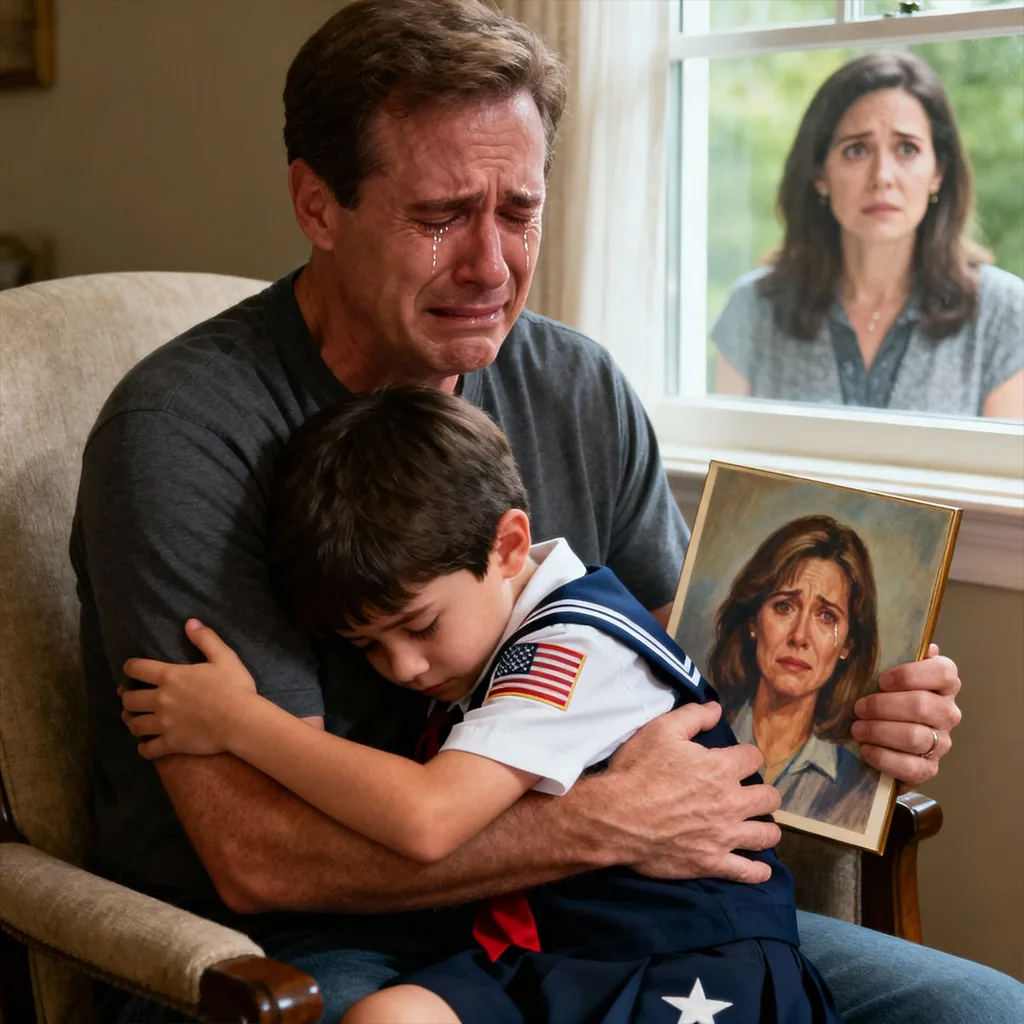
The morning after Ethan’s confession, logic and love wrestled in me until neither could stand. I drove to the school an hour early and idled with my hands at ten and two like a nervous student. Children spilled across the asphalt in bright, bobbing knots. Parents gathered, faces lit by phones, by worry, by the petty logistics of ordinary life. And then there she was—height, gait, the fall of auburn hair beneath a black jacket I had once zipped with my teeth, everything ghosted forward into a woman who looked like the answer to a prayer I no longer dared pray. She lifted her hand—just a small gesture, a muscle memory—and Ethan, catching the signal, took one step. “Ethan!” I shouted, the name tearing my throat raw. She turned. For a heartbeat I saw Laura looking out of another face. Then the woman bolted, keys flashing, a silver Honda snapping to attention like a startled animal. I ran, caught the license plate as gravel spat behind her tires: CKR-3182.
That night, the apartment felt like a set arranged for a play I didn’t want to watch. Ethan slept hard, a sweaty crescent pressed into his pillow. I sat at my desk and let the numbers throb: CKR-3182, CKR-3182, CKR-3182. A college friend owed me the kind of favor nobody writes down. The reply came back quick and clinical: registered to “Laura M. Reynolds.” Reynolds—Laura’s maiden name—like a hand reaching through water to cinch a knot. I didn’t tell my son. His small world had just stopped shaking; I wasn’t going to pick it up and rattle it for clarity.
I called Rachel, who had once slept on our couch after a breakup and now fronted a byline in Chicago. Journalists and grief share a verb: they keep digging. Forty-eight hours later she had an address in Fort Collins and a registration file so blotchy it felt like it wanted to be unread. “It’s a shell,” she said. “But the initials—L.M.R.—repeat.” I drove north under a slate morning. The house sat near a useless rail line and looked newly scrubbed, as if someone had been polishing a lie. No answer at the door. Through a slit in the blinds I saw the ache of familiarity: a photo I had never taken—Ethan at his last birthday, a cake we hadn’t baked, Laura’s body angled toward him in a way I knew in my bones. My hands shook so hard I had to brace them against the siding.
I took everything to Detective Harris: plate, address, the not-quite faces in the not-quite frames. He had the patience of a man paid to separate story from evidence; I had the urgency of a father whose universe is one boy wide. He opened a case—stalking, identity fraud—and tugged the first thread: the autopsy. Laura’s body, he said gently, had been identified by dental records; fire confuses eyes but not enamel. “Could records have been tampered with?” I asked, the floor tilting under the question. “Unlikely,” he said. “Not impossible.”
The days that followed felt like being haunted by a rational ghost. Blocked calls came at odd hours and went to breath. Ethan’s crayon worlds sprouted a new figure: a woman by a blue lake, always at the edge, never stepping in. One evening a note lay beneath our door, cheap paper creased by a hard grip: He’s safer without you. I sat on the sofa until the room went out of focus and counted my breath like rosary beads.
Then Harris called me into a briefing room that smelled faintly of toner and winter coats. He spread photographs, timelines, names—an altar to the ordinary way a life becomes evidence. “We found her,” he said. “Her real name is Lena McCarthy.” Former trauma nurse. Mercy General. The same ER that received Laura on the night of the crash. A domestic case three years back, reconstructive surgery after a beating that rearranged her face and future. “Our working theory,” he said, tapping a stack of forms, “is that she exploited chaos. Someone—likely a tech with debts—helped swap identifiers. She disappeared into your wife’s shadow.”
“Why the school?” I asked, already afraid of the answer.
Harris slid a still from our school’s security camera beside a logbook from Mercy General. “Delusion loves a pattern,” he said softly. “She lost a life and stepped into one. Trauma can convince you remembrance is ownership. She believes she is still his mother.”
They found Lena in the Fort Collins house, living small behind a false wall: cot, bottled water, a calendar with Ethan’s initials circling a handful of days. On her nightstand, a lined notebook full of apologies written to no one and everyone. She came quietly. In the video of her interview, I watched a woman trying to refit herself; her hands kept wandering up to a face that had once been a map and was now a mask. “I only ever watched,” she said, voice thin with sedation. “I told him not to go with me. I told him he was safe.” She cried—not the dramatic flood of a performance, but the messy, human leak of someone whose mind had run long and hard and finally hit a fence.
I drove home through a city that felt suddenly untheatrical. Ethan was drawing at the table—a lake again, a fence line, the suggestion of wind on water. “She said she was sorry,” he murmured without looking up. I sat beside him and rested a hand on the table so our shadows touched. “It’s over,” I said, though what I meant was: the immediate danger is gone, and the long conversation begins.
At bedtime I stood in the doorway and watched my son’s chest rise and fall in the blue glow of his nightlight. Laura’s sweater still hung on the back of my chair; sometimes honesty requires a shrine. I thought about the girl I loved at nineteen who became a woman who could make silence feel like a warm room. I thought about a nurse in a fluorescent corridor who learned the wrong lesson from survival. I thought about the systems that make vanishing possible and repair so slow.
Grief is a country with bad maps; strangers can take the roads we built to our dead and try to live there. What I saw outside that school fence taught me the boundary between memory and possession is not a line but a field where people get lost. My work now is not to salt the field but to plant guardrails for a boy who will one day ask why a woman with his mother’s hair stood at the edge of his life and beckoned. I will tell him his mother loved him, and love does not ask you to follow into danger. I will tell him a broken person tried to borrow our past to escape her own, and our job—when we can— is to choose mercy without surrendering safety. I will tell him some truths don’t resolve; they widen to make room for both the harm and the human who caused it. And when he asks if ghosts are real, I will say yes: sometimes they wear skin and carry photographs that never happened. The answer to them is not to chase or to flee, but to turn toward the living and lock our hands.
News
A Mafia Boss Threatened Dean Martin on Stage—Dean’s Reaction Was Pure Genius
A Mafia Boss Threatened Dean Martin on Stage—Dean’s Reaction Was Pure Genius Prologue: A Gun in the Spotlight Dean…
The Billionaire Had No Idea His Fiancée Was Poisoning His Son—Until the Maid Exposed Everything
The Billionaire Had No Idea His Fiancée Was Poisoning His Son—Until the Maid Exposed Everything Prologue: A Whisper That…
The Billionaire Catches Maid ‘Stealing’ Food… But When He Sees Who It’s For, He Breaks Down in Tears
The Billionaire Catches Maid ‘Stealing’ Food… But When He Sees Who It’s For, He Breaks Down in Tears Prologue:…
The Billionaire’s Fiancée Sets a Trap for the Maid — Until His Silent Daughter Exposed the Truth
The Billionaire’s Fiancée Sets a Trap for the Maid—Until His Silent Daughter Exposed the Truth Prologue: The Whisper That…
The Billionaire Went Undercover as a Gardener — Until the Maid Saved His Children from His Fiancée
Richard Whitmore’s hands trembled on the garden shears as he watched through the kitchen window. His new wife, Vanessa, stood…
Three Flight Attendants Vanished From a Vegas Hotel in 1996 — 28 Years Later a Hidden Wall Is Opened
.Every hotel, every casino, every neon-lit alley has a story, most of them ending in forgetfulness or denial. But some…
End of content
No more pages to load






