
The pill disappeared into the champagne like a secret swallowed by light. From across the reception hall—roses sweating perfume, band easing into a slow brass hush—I watched my mother-in-law’s hand hover over my glass, then retreat as if nothing had happened. Caroline’s diamonds threw constellations across the linen. The photographer laughed. The room clinked. I moved without thinking. By the time she returned to her seat, her smile lacquered and perfect, the switch was done: her glass for mine, mine for hers. “To family,” she sang, head tipped, camera-ready. Our eyes locked. I echoed her. Then she drank. A soft click, the flute against the table. Somewhere inside the glitter and applause, the night changed its temperature.
Weddings are choreography, not accidents. The reception had the practiced glow of a magazine spread: lacquered wood, roasted duck breathing out rosemary, laughter pasted to every surface like gold leaf. Ethan—my husband of four hours—was a good man in good light, all open grin and flushed cheeks, spinning his groomsmen into a loose orbit on the dance floor. I waved back when he cut a line through the crowd just to find me with his eyes. We had survived the vows, the photographs, the aunt who always cried before she spoke. We had not planned for this.
Caroline had never exactly hidden the terms of her love. Wealth shaped her vowels and her opinions; pedigrees were passports, and I had none. The first time she met me, she vacuumed the room with her gaze and said, “You must be… interesting,” as if kindness were something the help could fetch from the garage. Ethan called it nerves. I called it weather. We learned to forecast around it: careful invitations, neutral topics, the polite truce of holidays. A family map drawn with dotted lines.
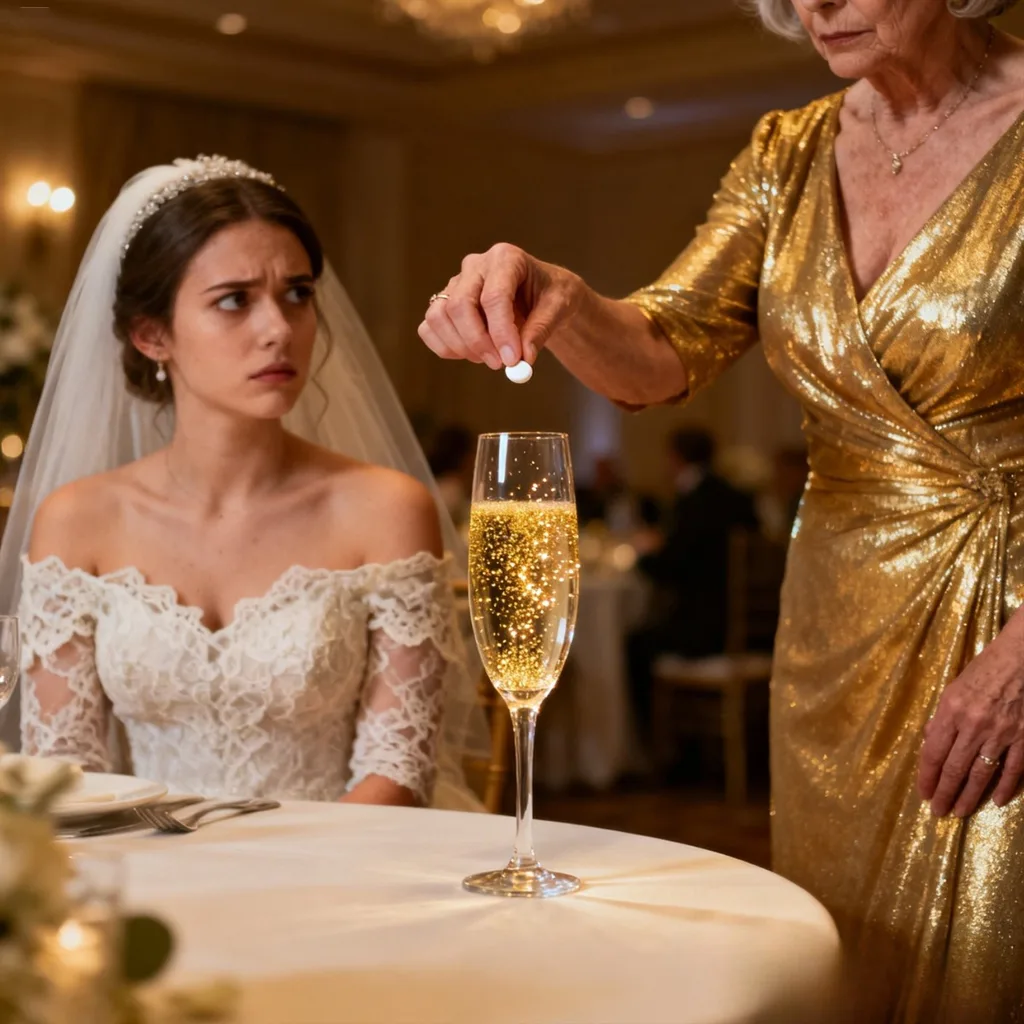
So when she faltered an hour after the toast—color draining, fingers slipping, that tight smile loosening like a bow—there was a second where I hoped I had misread everything. Then her chair scraped back. She stood. Swayed. Fell. The band stopped mid-glide. A plate shattered, a scream cut cleanly through the music, and Ethan’s voice—“Mom!”—punched a hole in the room. Sirens stitched the night to the door. I stood still with a glass gone warm in my hand, realizing that my silence had become part of the story.
Hospitals smell like inevitability. By morning, Caroline was upright, pale, pearl bracelet shivering against the rail. Ethan brought lilies and a boy’s hope the world might unknot itself. “Stress,” a doctor said. “Possibly an allergy.” When Ethan stepped out to take a call, Caroline turned her face to me and let the sugar burn off. “You switched the glasses,” she said. No question. “You clever little thing.”
“What did you put in mine?” My voice surprised me by not breaking.
“A sedative,” she said, almost bored. “Mild. You’d have wobbled. Perhaps fainted. Headlines are sticky—‘unstable bride’ plays forever.” The calm in her voice frightened me more than fury. She could have harmed herself—I told her so. For the first time I saw a sliver of fear in the woman who curated outcomes for sport. “I didn’t mean…” she began, then found her footing again. “But you don’t belong. He deserves better than a girl with no past.”
“You should have married him yourself,” I said, and left before my hands betrayed me.
For a while we pretended at normal. We said “allergic reaction” to anyone who asked, packed away cake in plastic, folded gifts into a closet like waiting flowers. But three weeks later a note arrived—plain envelope, no return address, handwriting I recognized from place cards and judgments. You should have taken your drink. I’ve started a game you can’t win. The same week, an anonymous complaint landed at Ethan’s firm: fraud, misuse of funds, words that stain even when they don’t stick. He worked until the hours went thin, turning spreadsheets into alibis. I drove to Caroline’s with the note in my pocket and the truth in my mouth. She smiled at the door, the kind that lands like a glove. “I protect my son,” she said. “Whatever it takes.”
So I learned the rules. I started where her reputation lived: the charities, the galas, the glossy reports written in benevolent ink. Cracks widen under quiet pressure. A foundation light by $200,000. A donor with an alias that matched an offshore account. A wire transfer stamped the day after our wedding to a pharmaceutical company whose product sheet listed the very sedative that made her fall. Paper is colder than rage and twice as useful. I printed, tabbed, carried the folder to her like a mirror. “Peace,” I said. “You stay out of our marriage, I stay quiet.”
For the first time, the floor shifted under her. “You’re your mother’s daughter,” she said, almost tenderly. The name slid into the room like a draft. “Ask Ethan about the woman who sang him to sleep,” she added. “You’ll find the answers in the attic.”
The attic smelled like dust and winter. Thomas, the butler, handed me a flashlight and the kind of look that says I’m sorry without touching a single word. Boxes labeled in Caroline’s perfect hand—Seasonal, Tax, Keepsakes—stacked like masonry. At the back, under a yellowed sheet, a trunk. Inside: a doll with one cloudy eye, children’s drawings, photographs. Caroline holding infant Ethan. A young woman in a maid’s uniform beside her—dark hair, brown eyes, my face returned to me across time. On the back: Marian—1998. Another photo: the same woman cradling a newborn with my mouth. The floor tilted.
I confronted Caroline in a voice I recognized only from other women’s stories. “Who was Marian?”
“Your mother,” she said simply. “My maid. My husband’s mistake. I paid her to disappear for the sake of the family. She died having you.” Calm as weather. Brutal as math.
When I told Ethan, he sat down like the room had lost its corners. “I remember her,” he said, voice gone young at the edges. “She sang to me. I thought…” He couldn’t finish. We traced the bloodline with our eyes and found it drew a circle around us. Half siblings. Love bent into something unlivable. There are truths that put out the lights in a house.
Caroline invited us to dinner the next night. Peace, she said. The long table was set like a stage—white linen, heavy silver, three slender flutes breathing small, gold storms. She raised her glass with a hand that shook just enough to admit being human. “To family,” she said. Neither of us moved. “For you,” Ethan replied softly, and I watched a lifetime pass through his eyes—bedtime songs, report cards, the first time a boy understands power dressed as love.
She drank. Set the glass down. The performance didn’t have applause to hold it together anymore. Hours later, another phone call, another hospital, a second siren swallowing the night. This time the doctors did not say allergy. They did not say stress. The polite phrases people use when they believe you will survive never arrived. I do not know what she poured into that glass: penance, control, a final argument with the only judge who never stops listening—herself. The paper I’d gathered stayed in its drawer. The folder slept. There are victories that shrink a person. I chose not to wear them.
We sold the house with the attic. We left the city where her name could open and close doors and lived among strangers who pronounced us without history. In the new place our mail came to a number and a street with no ghosts. We did not say the word mother for a long time. We learned to cook for two. We learned to sleep without waiting for a phone to ring.
On our first anniversary, Ethan brought out a single flute, the rim thin as a boundary. He poured until the bubbles lifted like a hush. “To family,” he said, “the kind we choose.” We drank. It tasted like something that could learn to be sweet again.
What happened in that reception hall wasn’t a crime novel’s twist; it was a diagram of power. Some people lace their love with tests and call it protection. Some build family like a museum—guarded rooms, velvet ropes, a plaque that names who’s allowed to look. The rest of us learn to survive with smaller tools: noticing, documenting, switching the glass. For a while I thought the lesson was simple: never underestimate a woman from nowhere. It isn’t. The lesson is quieter and harder.
Blood is a story we inherit; belonging is a story we write. Paper can wound or save. Truth, once spoken, is not a weapon but a weather change—you dress for it, you live through it, and one day you realize the air has cleared. Love is not what keeps you in a family; choice is. On some evenings, when the streetlamps lift their pale coins up the block and our windows hold our reflections like strangers we’re still learning, I think of a glass raised under a chandelier and a sentence said too easily: to family. It means nothing until you decide who sits at the table. Then it means everything.
News

A Mafia Boss Threatened Dean Martin on Stage—Dean’s Reaction Was Pure Genius
A Mafia Boss Threatened Dean Martin on Stage—Dean’s Reaction Was Pure Genius Prologue: A Gun in the Spotlight Dean…

The Billionaire Had No Idea His Fiancée Was Poisoning His Son—Until the Maid Exposed Everything
The Billionaire Had No Idea His Fiancée Was Poisoning His Son—Until the Maid Exposed Everything Prologue: A Whisper That…

The Billionaire Catches Maid ‘Stealing’ Food… But When He Sees Who It’s For, He Breaks Down in Tears
The Billionaire Catches Maid ‘Stealing’ Food… But When He Sees Who It’s For, He Breaks Down in Tears Prologue:…

The Billionaire’s Fiancée Sets a Trap for the Maid — Until His Silent Daughter Exposed the Truth
The Billionaire’s Fiancée Sets a Trap for the Maid—Until His Silent Daughter Exposed the Truth Prologue: The Whisper That…

The Billionaire Went Undercover as a Gardener — Until the Maid Saved His Children from His Fiancée
Richard Whitmore’s hands trembled on the garden shears as he watched through the kitchen window. His new wife, Vanessa, stood…

Three Flight Attendants Vanished From a Vegas Hotel in 1996 — 28 Years Later a Hidden Wall Is Opened
.Every hotel, every casino, every neon-lit alley has a story, most of them ending in forgetfulness or denial. But some…
End of content
No more pages to load






