
🚗 Chapter One: The Low Hum of Olives
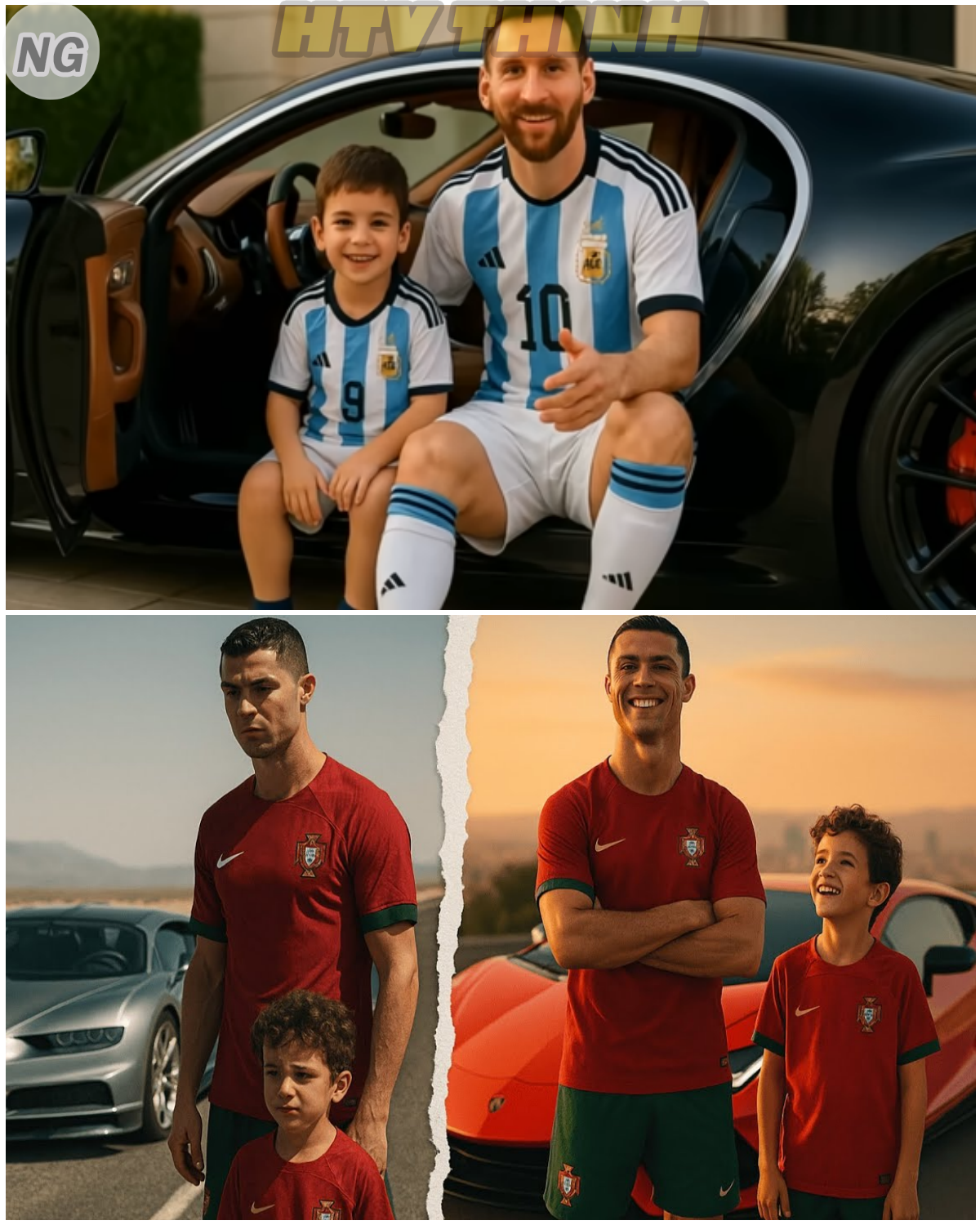
The late afternoon sun, thick and gold like aged honey, struggled to penetrate the dust-motes swirling in the narrow garage.
It wasn’t a proper garage, not in the sense of gleaming steel and organized tool chests.
It was a glorified shed, really, appended crudely to the back of a small, whitewashed house tucked into the folds of the Portuguese countryside.
The air inside was a heavy blend of olive oil residue, engine grease, and the faintly metallic tang of sweat.
Ronaldo Santos, the Ronaldo to precisely zero sports commentators but Dad to one small, perpetually wide-eyed boy, knelt on a worn scrap of sacking.
His large hands, scarred and calloused from years of doing everything but playing professional football, worked meticulously on a disassembled tire.
He didn’t just change tires; he ministered to them.
“See this, son?” he grunted, the effort pushing the words out low and ragged.
Leo, a boy whose namesake had brought no end of gentle, confusing ribbing, sat cross-legged a safe distance away, chin resting on his knees.
He looked barely seven, all spindly limbs and serious dark eyes.
“Real hard work.”
Ronaldo shifted the tire iron, the sound a sharp, unforgiving clank in the quiet space.
“Not like… not like just taking money for pocket change.”
He glanced up, catching the worried furrow in Leo’s brow.
The boy’s face was smudged with dirt, a tribute to their joint labors, but his expression was pure anxiety.
“Don’t cry, my love.”
Ronaldo forced a smile, stretching the tightness across his face.
He wiped a streak of grease across his forehead with the back of his hand.
“Dad got a plan. Always got a plan.”
He stood, dusting off his knees.
The movement was slow, deliberate, each joint a protest.
He was tall, but his frame was beginning to soften around the edges, a testament to endless nights spent working and insufficient ones spent resting.
“Let’s go.”
They stepped out into the blinding late light.
The ‘fans’ Ronaldo spoke of were not people, but the tall, slender olive trees that lined the property—a small, failing grove that nonetheless provided the family’s modest primary income.
The air here was cooler, scented with dry earth and the distant, pungent aroma of a neighbor’s cooking fire.
Ronaldo clapped a heavy hand on Leo’s shoulder.
“Son, look around. These all are my fans.”
He chuckled, a dry, rusty sound.
“They give me oil. They don’t judge the way I work with a wrench.”
He pointedly didn’t mention ‘Messy Uncle’ again.
He didn’t need to.
The memory of the affluent, flamboyant cousin, Ricardo ‘Messy’ Silva, who had made a point of comparing his state-of-the-art billiard room to Ronaldo’s dirt yard just last week, still stung like a wasp sting on the back of his neck.
“Don’t worry, son. I promise I will build a better car than… than anyone.”
The promise was big, perhaps foolishly so.
But it was a promise made to Leo.
It was more real, more immediate, than the rusted chassis of the half-finished project tucked under a tarp near the shed.
“Careful, son. It’s heavy.”
He was referring to a large, oddly shaped wooden crate that had arrived two weeks prior, a delivery requiring both a large truck and a strained, awkward silence with the driver.
It was hidden behind a stack of weathered terracotta pots near the edge of the property line.
Leo, despite his small size, grabbed a corner with surprising strength, his face screwed up in concentration.
They maneuvered the crate slowly toward the shed, the silence broken only by the scrape of wood on stone and Ronaldo’s occasional, encouraging grunt.
Inside the shed, away from the judgmental sun, the true work began.
The crate contained pieces of polished, deep vermillion fiberglass—the first, impossibly expensive components of Ronaldo’s mad project.
He had been slowly acquiring them over the past year, each purchase a painful extraction from the family savings.
“Finally, it’s ready. Let’s give it some final touches,” he murmured, kneeling beside the emerging outline of what was meant to be a car.
He carefully applied a strip of black trim to a curved panel, his concentration absolute.
The vehicle, which he envisioned as a rugged, beautiful, and slightly exaggerated off-road cruiser—a Lambo in spirit, if not in name or budget—was his answer to every laugh, every sneer, every comparison.
Leo watched, mesmerized.
Ronaldo turned, his face alight with a tired, genuine pride.
“Son, do you like it?”
The boy nodded enthusiastically, a genuine, unburdened smile finally breaking through his worry.
“Let’s go on a ride on our new Lambo!”
Ronaldo pulled him close, holding him tightly for a moment, burying his nose in Leo’s hair.
He smelled of dust and clean, small-boy scent.
“I am so glad you are here. Watching you smile makes me so happy.”
Across the small, unpaved lane, a sharp, echoing thwack suddenly cut through the air, followed by a peel of mocking laughter.
It was Ricardo.
He was outside, practicing his golf swing in the shade of his new, brightly painted gazebo.
Ricardo had never been an athletic man, yet he was always buying new, expensive sporting equipment.
Ronaldo felt the familiar tightening in his chest.
I always missing Los.
He mentally slapped himself for allowing the cousin’s antics to break his mood.
He looked at Leo, whose smile had instantly faded.
The boy was staring fixedly at the expensive, bright-white golf ball soaring over the olive trees.
“Son, do you like playing this game with me?” Ronaldo asked, gesturing to the oil-stained floor and the car parts.
“Dad, look.”
Leo pointed, not at the golf ball, but at a sliver of Ricardo’s extravagant house visible through a gap in the fence.
“Why can’t we have a snooker table like messy uncle?”
The snooker table.
Ricardo’s latest trophy.
It was an enormous, dark wood monstrosity that dominated his new leisure room.
The question, simple and innocent, landed like a physical blow.
Ronaldo felt the heat rise in his neck.
“I can’t let them make fun of my kid like that.”
He stood up, his jaw clenched.
The Lambo project, for all its emotional weight, felt suddenly insufficient.
It was a means to an end, not the end itself.
Leo needed more than a patched-up car; he needed protection from the world’s casual cruelty, symbolized by a ridiculous, perfectly leveled snooker table.
Ronaldo looked at the massive, unfinished project and then back at the tiny house and the vast, unyielding olive grove.
“It’s hard. But I made a promise to my son. I have to fulfill that.”
He needed more than just a car.
He needed a fortress.
A better house.
A snooker table.
And he needed it now.
The low hum of the olives, a sound that usually comforted him, now felt like a taunt, a reminder of the slow, grinding poverty he was trying to escape.
He stepped out of the shed and stared across the fence.
He was just in—just in some final touches for the house.
The house, their house, was a project long ignored, its faded blue trim peeling like old paint.
A small voice pulled him back.
“Huh? Daddy, look. Ronaldo Uncle made a better house and snooker than us.”
Leo was pointing at a glossy magazine Ricardo had dropped near the fence line—an advertisement featuring a pristine, modern villa with a sleek, impossible-looking billiard room.
Ronaldo knelt beside his son, took the magazine, and quietly crumpled it.
“Son, I built all of this only for you.”
He gestured to their small, dusty world.
“We’ll get our snooker table. But we’ll build it. Like we build everything else.”
🏗️ Chapter Two: The Heavy Lift
The rising sun, still weak and pink over the distant hills, found Ronaldo already several kilometers from home.
He walked quickly, his silhouette tall and slightly stooped against the dawn light.
His old, battered bicycle lay chained to a gnarled olive tree just outside the town limits of Silves.
He needed to keep the dilapidated vehicle out of sight.
It was an embarrassment he couldn’t afford to display at the new workplace.
The job was at a major construction site on the edge of the town—a sprawling complex destined to be luxury apartments.
Ronaldo had signed on as a general laborer.
It was brutal, non-stop physical work, a stark contrast to the methodical, contemplative nature of engine repair.
He needed cash, not contemplation.
His foreman was a squat man named Jorge, whose face was permanently set in an expression of patient annoyance.
Jorge handed Ronaldo a pair of heavy leather gloves and pointed to a stack of steel reinforcement bars.
“These need to go to the third floor, Santos.”
“One by one, or in a bundle?” Ronaldo asked, already calculating the weight.
“You’re strong. You tell me.”
Ronaldo took a deep breath, flexing his hands inside the stiff gloves.
He could handle the weight.
It was a matter of sheer will.
He hoisted a bundle of the long, cold steel bars onto his shoulder.
The immediate, sharp pressure made him grunt, the sound lost in the early morning clamor of the site.
He began the slow, arduous climb up the temporary, wooden stairs.
Near the top of the third floor scaffolding, a man wearing a bright lemon-yellow t-shirt leaned against a cement mixer.
This was Joaquim, a veteran bricklayer whose bright clothing was a strange fit for his deep skepticism.
“Careful, Ronaldo!” Joaquim shouted over the noise, smoke curling from a hand-rolled cigarette.
“That steel pipe doesn’t weigh as much as the promise to my boy, Joaquim!” Ronaldo gasped, pausing to adjust the load, his voice thick with the effort.
Joaquim laughed, a dry, rasping sound that echoed between the concrete walls.
“Ah, little Leo! Did he demand a pony now?”
“Worse,” Ronaldo admitted, his breath ragged.
“He wants a snooker table. A massive one. Because of… of that cousin, Messy Silva.”
Joaquim took a long drag from his cigarette, his eyes narrowing slightly in understanding.
“Ah, the rich nephew. That one’s a raw nerve, isn’t he.”
He flicked the cigarette butt away, pulled out a warm, sweating bottle of water, and offered it to Ronaldo.
“Drink. This is difficult, but you made a promise to your son.”
Ronaldo drank deeply, the tepid water providing minimal relief but the gesture itself, a small act of solidarity, offering more sustenance.
Ronaldo worked relentlessly for the next seven days.
He stayed long past the official quitting time, often negotiating small, extra tasks with Jorge for a few extra euros.
He mixed mortar until his arms felt like lead.
He moved wheelbarrows full of gravel until his feet ached with every step.
He did not allow himself to think about the finished Lambo, or the perfect leveling required for a snooker table.
He only thought about the snooker table fund.
Every crumpled, oil-stained euro note he earned went straight into an old tin biscuit box hidden beneath the loose floorboard in his kitchen.
He arrived home late one evening, exhausted beyond measure.
Leo was still awake, sitting at the small kitchen table, concentrating on a drawing under the dim light.
The boy rushed over, clutching Ronaldo’s thigh.
“I missed you, Ba. You’re very dirty.”
Ronaldo managed a tired smile, patting Leo’s small head, feeling the grit and dust in his own hair.
“Dad is working. Dad is building.”
He sank onto a wooden stool, momentarily unable to move.
He pulled out the tin box.
It was still mostly empty.
“Finally, I earned something,” he whispered, flattening the wrinkled bills.
But there was so much left to do.
It felt like trying to fill the ocean with a tea-cup.
His attention turned to the need for a second job.
A night job.
He thought of Elara, the local baker.
Her shop, O Pão da Noite, was known for its intense production schedule, often working through the small hours.
She was notoriously demanding but paid in cash.
He walked over to her house the next morning, before he even started his day job.
The scent of warm yeast and freshly ground flour preceded the woman herself.
She opened the door, flour dusting her dark apron.
“Ronaldo. What do you want?”
Her voice was businesslike, betraying no pleasantries.
“Elara, I need a job. An after-hours shift. A night shift.”
She crossed her arms, her expression unreadable.
“Do you know how to bake?”
“No. But I know how to work. Hard. I can clean, I can lift, I can do anything.”
He met her gaze, his own eyes burning with raw, desperate sincerity.
“I need the money. I made a very big promise to my son.”
Elara studied him for a long moment, taking in the exhaustion etched around his eyes.
She gave a brief, decisive nod.
“Fine. You can come in at midnight and scrub the kitchen. Ten euros an hour. Cash. No talk. No complaints.”
Ronaldo felt a surge of adrenaline cut through the fatigue.
Midnight.
It was a terrible time.
But it was a terrible promise, too.
“Thank you, Elara. We start tomorrow.”
He turned and headed toward his bicycle, feeling a slight lift in his step, already calculating how many trays he would have to scrub to buy one corner cushion of a snooker table.
🌙 Chapter Three: The Midnight Dough and the Sharp Wit
The air inside Elara’s bakery, O Pão da Noite (The Night’s Bread), at 12:05 a.m. was a stark contrast to the cold, dry air outside.
It was humid, yeasty, and overwhelmingly warm, a thick, comforting blanket of scent composed of fermentation and faint, sweet molasses.
Ronaldo pushed open the back door.
He felt the fatigue from a full day hauling sacks of cement still clinging to his muscles.
Elara was already there.
She wasn’t dressed in her usual starched apron.
She wore heavy, dark overalls and was wrestling with a massive, industrial dough mixer that groaned under the weight of its current batch.
“You’re five minutes late, Santos,” she clipped, not looking up.
Her voice, usually sharp, was slightly muffled by the roar of the machine.
Ronaldo checked the ancient watch strapped to his wrist.
“My watch says it’s exactly 12:05 a.m., Elara. And I had to cycle here. The truck broke down again.”
“Don’t make excuses. Just get to work,” she ordered, finally wrenching the mixer to a stop.
She pointed to a sink piled impossibly high with metal baking trays, crusted with the sticky, black residue of burnt sugar and flour.
“I need those clean. Spotless. The health inspector is due next week.”
Ronaldo rolled up his sleeves.
He looked at the mountain of trays.
He saw not greasy metal, but hundred-euro notes piled up—each one taking him closer to the snooker table.
He started scrubbing.
The process was brutally physical.
He had to use a steel wool pad, applying all his weight to scrape off the baked-on grime.
The work was heavy, but not as heavy as the promise made to my son.
Elara ignored him for a solid hour, moving through her chaotic kitchen with the focused efficiency of a surgeon.
She was petite, but she handled 50-kilogram bags of flour and trays stacked with bread loaves as if they were feather pillows.
Ronaldo watched her from the corner of his eye.
She had distinct personalities and traits that went beyond her tough exterior.
Her hair was always meticulously braided, even at this hour, and she hummed a complicated, minor-key fado tune under her breath as she worked.
She paused her kneading only once, walking over to the sink to refill her water bottle.
She glanced at Ronaldo’s progress.
“You’re using too much soap,” she observed, her dark eyes narrowing.
“It’s the only way to cut the grease,” he argued, wiping sweat from his brow.
She snatched the bottle of industrial-strength degreaser from his hand.
“No. This is the way to cut the grease,” she said, applying a single, measured squirt onto a particularly stubborn tray.
She handed him a specific kind of stiff plastic scraper.
“Use this first. Then a little bit of the soap. Efficiency, Santos. You waste soap, I waste money. You waste time, you waste mine.”
He took the scraper, feeling a wave of exasperation.
“Right. Got it. No unnecessary soap use. Duly noted.”
He started scraping.
The tool worked, surprisingly well, shearing off large sheets of grime.
“So,” Ronaldo grunted, trying to break the silence.
“Are you always up at this hour, Elara?”
She gave him a look that could curdle milk.
“This is a bakery, Santos. Bread waits for no man. Or his silly projects.”
“My project isn’t silly,” Ronaldo said defensively, momentarily stopping his scrubbing.
“It’s a… it’s a rugged, high-performance vehicle.”
Elara placed a newly proofed loaf onto a tray with deliberate care.
“It’s a half-finished fiberglass monstrosity that smells like old engine coolant, according to my nephew, Tiago. Who is, ironically, a Messy supporter.”
Ronaldo let out a short, surprised laugh.
He hadn’t expected her to know the details, let alone have a Messy supporter in her family.
“Your nephew is talking nonsense. I’m building it for Leo. It’s going to be a Lambo that shuts them all up.”
“A vehicle of vengeance,” Elara mused, a tiny, almost invisible upturn at the corner of her mouth.
“A noble goal. But I was talking about the other silly project.”
“What other project?”
“The house. You’re patching the roof with duct tape and hope. And I heard you are looking for a snooker table.”
Ronaldo leaned on the sink, tired but engaged in the conversation.
“Yes. That’s for Leo too. That’s the real fight. I can’t let them make fun of my kid.”
Elara picked up a long wooden paddle, ready to transfer a batch of loaves into the enormous stone oven.
“Well, you know what’s better than a snooker table, Santos?”
“What?”
“A good night’s sleep. Which neither of us is getting. Now, less talking about expensive pool games, and more scrubbing. I pay you to clean, not to plan your fictional luxury purchases.”
She pushed the dough into the oven with a smooth, practiced movement.
“But since you brought it up. I know where you can find a used, slightly water-damaged snooker table for cheap. A real one. Not one of your cousins’ shiny toys.”
Ronaldo froze, water dripping from his hands.
“You do?”
“Finish those trays. Then we’ll talk about prices and promises.”
The trays were eventually finished.
Ronaldo looked at the gleaming metal.
He finally felt a sense of accomplishment.
Elara was pulling the first batch of golden-brown sourdough out of the oven.
The smell was intoxicating.
“Thank you for the purchase, Ronald. This house along with the light is all yours now,” she said, completely deadpan, referencing his over-the-top pronouncements about the Lambo.
Ronaldo couldn’t help but grin.
“Very funny, Elara. So, the snooker table?”
News

🛥️ THE LUXURY YACHT PHOTO That CRUSHED Antonella: Who Was The Mystery Woman?! “She showed me the texts; they were discussing apartments, not just dinner plans.” 🤫
Lionel Messi, often revered as one of the greatest footballers of all time, has recently found himself embroiled in a…
🚨 THE ‘OWNER’S FAVORITE’ WAR: Did Beckham Force a Star Player OUT to Keep Messi Happy?! “He told the manager, ‘Either he goes, or the entire brand collapses tomorrow.’” 💸
The unfolding drama between Lionel Messi and David Beckham in Miami has become a focal point in the world of…

🎙️ MIC DROP MOMENT: Yamal’s One-Word Reply That SILENCED Edu Aguirre on El Chiringuito! “He just leaned into the camera and said, ‘Look at the table, not the speaker.’” 🤫
In the high-stakes world of professional football, where every move is scrutinized and every word dissected, moments of confrontation can…

🔒 THE ‘BECKHAM-FREE’ CLAUSE: Did Messi Pay MILLIONS to BAN David from Antonella’s Sight?! “The contract explicitly stated: ‘No physical proximity closer than 50 yards at all times.’” 📏
In a surprising turn of events, Lionel Messi has reportedly accepted a lucrative contract, not just for professional reasons, but…

👑 THE SILENT WAR: What Secret High-Fashion Brand Sparked the Posh vs. Queen Roccuzzo Rivalry? “She looked straight at me and said, ‘Only one of us can wear the crown in Miami.’” 👗
In the glamorous world of fashion and sports, where every move is scrutinized and every word analyzed, an unexpected confrontation…

🚨 MESSI’S $50M SCANDAL: The Shocking Demand That Could DESTROY the Club’s Future! “He told me, ‘If I don’t get the yacht, I walk away tonight.’” 💸
Lionel Messi, one of the most celebrated footballers of all time, has once again captured global attention with a new…
End of content
No more pages to load






