
Chapter One: Micah and the Thaw ❄️
By the fifth day, the storm had eased.
The sun shone pale over the snow fields, turning the frozen world into a sea of glittering glass.
Elias saddled his horse, ready to ride into town to check on Micah.
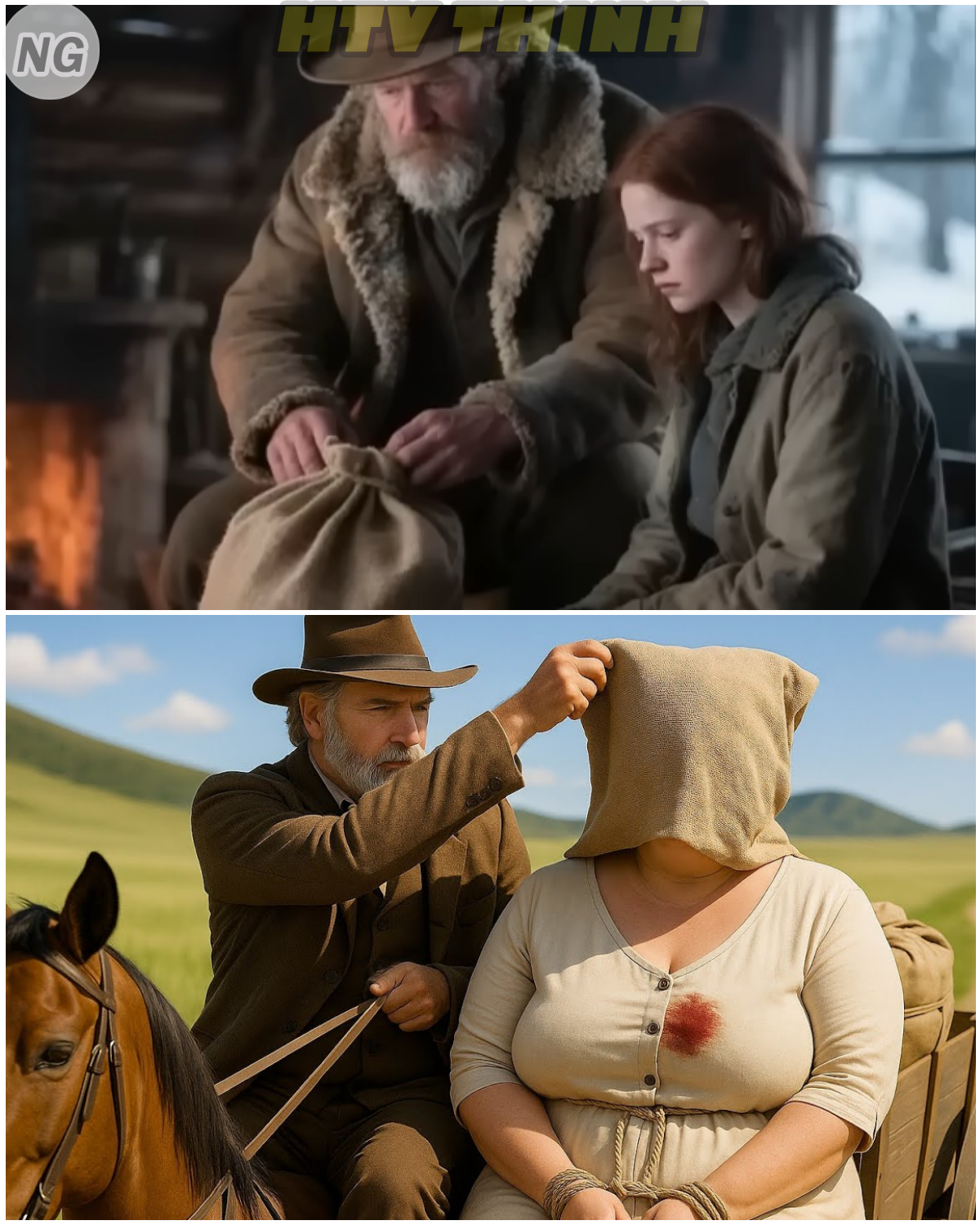
“I’ll be back by nightfall,” he told Mara.
“There’s jerky, tea, and flour if you need anything.
Keep the fire high.”
She nodded, though her chest felt tight.
It was strange how quickly she had grown accustomed to his presence, his quiet voice, and his steady hands.
He paused at the door, watching her for a moment.
“You did good here, Mara,” he said softly.
“You made this place feel alive again.”
Before she could answer, he was gone, his horse’s hooves crunching through the snow until only silence remained.
Mara spent the day cleaning the cabin, humming again, though the tune trembled now.
She found an old book on the shelf, the cover worn, the pages soft.
She read until the light faded, her eyes catching on a pressed flower between the pages, small, yellow, fragile.
When she heard hooves that evening, she jumped up, heart pounding.
The door opened.
Elias stepped inside, snow dusting his shoulders, a small boy clinging to his coat.
“This here’s Micah,” Elias said softly.
The boy peaked out from behind his father, pale and thin, his eyes weary.
Mara knelt slowly, offering a gentle smile.
“Hello, Micah.
I’m Mara.”
The boy didn’t speak, but after a moment, he reached out and touched her hand, a small, quiet gesture of trust.
And Elias.
He just stood there watching them, his eyes glimmering with something deeper than relief.
Because for the first time in a long time, his home didn’t just have walls and warmth.
It had laughter waiting to be born.
And the woman who’d come into his life wearing a sack on her head, had brought it there.
Chapter Two: Listening to the Mountain’s Breath 🌲
The mountain had begun to thaw by the third week.
The ice on the eaves dripped in steady rhythm, and the river below Elias’s cabin had started murmuring again, whispering to the earth that spring was near.
For Mara, every morning had become a ritual of quiet peace: fire first, then breakfast, then helping little Micah with small tasks.
The boy had taken to following her like a shadow, though he rarely spoke.
He’d point at things, tug on her sleeve, and sometimes when he thought she wasn’t looking, he smiled.
Elias noticed.
One morning, he leaned against the door frame while she showed Micah how to knead dough.
The child’s small hands pressed into the flour, leaving uneven shapes.
Mara guided him gently, her laughter soft like wind through pine needles.
“Not too hard, sweetheart,” she said.
“Let it breathe.”
Micah looked up at her, then at Elias.
Something flickered in his expression.
A question or maybe the start of trust.
When Mara turned, she found Elias watching her, his eyes unreadable.
“What?” she asked, brushing her floury hands on her apron.
He shook his head slightly.
“It’s been a long time since I’ve heard laughter in this house.”
Mara smiled faintly, but her eyes lowered.
“Maybe your home was just waiting for someone to remember how.”
Elias didn’t answer right away.
He crossed the room, set a hand on Micah’s shoulder, and said quietly, “Maybe you’re right.”
As the snow melted, the trails reopened.
Elias began traveling into town once every week for supplies, and sometimes Mara joined him.
The first time she stepped back into civilization since being sold, she felt every stare like a stone against her skin.
Whispers followed them from the general store porch, the blacksmith’s shed, even from the women gathering water at the pump.
“That’s the bride with the sack,” someone murmured.
“The mountain man’s purchase,” another snickered.
Mara kept her chin up, but inside something twisted.
Elias noticed again.
When they returned to the wagon, he stopped before mounting.
“You hold your head higher than most, Mara,” he said.
She shrugged, forcing a smile.
“If I let them see me break, they win.”
Elias gave a short nod, admiration flickering beneath his rough exterior.
“You’ve got more grit than most men I know.”
They rode back in silence, but it was a comfortable one, the kind that didn’t need filling.
A week later, the first wildflowers pushed through the snow melt outside the cabin.
Micah brought her one, a blue lupine, delicate as silk.
He handed it to her wordlessly, and she tucked it behind her ear.
“Thank you, Micah,” she whispered.
“It’s beautiful.”
Elias, watching from the porch, smiled slightly, though the expression was fleeting.
There was something different in the way he looked at her now.
Not pity, not curiosity, something quieter, deeper.
That evening, when the sky blazed orange and gold over the ridge, Elias spoke while sharpening his knife by the fire.
“I used to think beauty was a curse out here,” he said.
“It draws trouble, makes a man careless.
” He paused, the blade catching the light.
“But I think I was wrong.”
Mara turned from the stew pot.
“What changed your mind?”
He looked up slowly, meeting her gaze.
“You.”
The word hung there, gentle but heavy.
Mara froze.
She wasn’t sure what to say.
Wasn’t sure she could say anything.
Elias didn’t press her.
He went back to sharpening the knife, though his eyes stayed on her a moment longer than before.
That night she lay awake staring at the rafters, her heart thudding.
He can’t mean it, she thought.
Not me.
But when she closed her eyes, she could still see the look on his face, not one of hunger or desire, but of quiet recognition.
As if, for the first time he saw her as she truly was.
Chapter Three: The Unspoken Vow 🌻
Spring arrived in full, and with it came a sudden rush of life: melting creeks, blooming meadows, and the smell of wet pine.
Elias had begun taking Micah to learn to fish, and Mara often packed them bread and dried fruit for their trips.
When they returned, she’d hear laughter before she even saw them.
Micah’s voice light and free, calling out, “Mama, look.”
The first time he said it, she froze mid-step.
Elias looked just as startled, his eyes darting to her face.
Micah didn’t even realize what he’d said.
He just held up a fish, grinning.
“Mama, I caught it myself.”
Mara’s vision blurred.
She dropped to her knees, arms open, and he ran straight into them.
“Oh, Micah,” she whispered, holding him tight.
“You did so good.”
Elias stood there, his expression unreadable again, but his eyes softened as he looked at them.
“Seems like he’s got two things to thank God for now,” he murmured.
That night, the cabin was filled with laughter again.
For the first time, Mara sang, a soft tune from her childhood.
Elias leaned against the doorframe, listening quietly as Micah clapped along.
It felt right, like the world had stopped turning for just a while, content to listen.
A few days later, Elias hitched the wagon for a trip to town.
“You’ll come this time, too,” he said.
“Micah’s asking for a ribbon for your hair.”
Mara laughed, though her cheeks flushed.
“He has, has he?”
“He says blue suits you,” Elias replied.
“I’d say he’s got good taste.”
When they reached town, people stared again.
But something had shifted.
This time, Mara didn’t lower her gaze.
She walked beside Elias, calm, steady, radiant in her simplicity.
They passed Mrs.
Leland, the woman who’d once told her she’d never be chosen.
The older woman froze mid-step, eyes wide as she took in the sight before her: Mara with her head high, Elias’s hand resting gently on her back as they moved through the crowd.
Later that afternoon, while Elias loaded supplies, a young girl approached Mara outside the store.
“Ma’am,” she said shyly, “my ma says you’re the woman who made the mountain man smile again.”
Mara blinked, startled.
Then she smiled softly.
“Well,” she said, “maybe the mountain just needed a little warmth.”
Elias overheard.
When he climbed onto the wagon beside her, his voice was low.
“She’s right, you know.
” He looked at her, the sun catching the gold in his beard.
“I hadn’t smiled like this in years.”
Mara turned to him, meeting his gaze.
“You’re a good man, Elias,” she said quietly.
“You just needed to remember it.”
He nodded once, the corner of his mouth lifting.
“And you, Mara, you needed someone to see what was already there.”
The wind picked up then, carrying the scent of pine and earth, and for a long moment neither spoke.
There were no vows, no declarations, no promises carved in stone, just two souls, steady as the mountain around them, quietly beginning to belong.
Chapter Four: Where Home Resides 🏡
The following weeks turned the valley into a quilt of green and gold.
The thaw had finally broken, and the streams ran strong again.
Birds returned to the pines, and every dawn, sunlight poured through the cabin’s window like a blessing.
Life had settled into a rhythm: quiet, simple, almost tender.
Elias would rise before dawn to chop wood or ride out to check his herd.
Mara would wake soon after, fixing coffee, humming softly while she cooked.
Sometimes Micah would tumble sleepily into the kitchen, his hair wild, his laughter quick.
There were no grand gestures between her and Elias, only a thousand small ones.
The way he left her favorite mug near the fire before going out, the way she folded his shirts neatly by the hearth, the way their eyes sometimes met in silence, and neither needed to look away.
It was as though the mountain itself approved.
One morning, a thin mist wrapped around the trees when Elias saddled his horse.
Mara handed him a cloth-wrapped parcel—bread, dried meat, and apple slices.
“Be careful on the trail,” she said.
He adjusted the reins, glancing at her.
“I’ll be back before nightfall,” he said.
But Mara frowned.
“You said that last time, and you came home after midnight, bleeding from your arm.”
He tried to smile, but she caught the flicker of weariness behind his eyes.
“You worry too much,” he murmured.
She crossed her arms, her tone soft but steady.
“Someone has to.”
Elias paused, then chuckled quietly.
“You sound like you’ve always belonged here.”
“I’m starting to think I do,” she said.
That earned her a look she couldn’t quite read.
Something deeper, heavier, as though he wanted to say more, but didn’t know how.
He rode off down the trail, the fog swallowing him whole.
The day stretched long and lonely.
Mara kept herself busy washing linens, sweeping the porch, helping Micah gather wildflowers by the creek.
But as the sun began to dip behind the peaks, and Elias still hadn’t returned, a cold unease began to grow inside her.
When the first stars appeared, she finally saw a shape moving through the trees.
Elias rode in, slumped forward, his shirt torn at the shoulder.
Mara ran to him.
“Elias!”
“It’s nothing,” he muttered, though the blood on his sleeve said otherwise.
He tried to dismount, but his legs buckled.
She caught his arm, steadying him.
Inside the cabin by the firelight, she cleaned his wound.
A shallow gash, but long and angry.
“What happened?” she asked.
He winced as she dabbed the cloth against his skin.
“Coyote trap.
Old one.
Didn’t see it.”
She shook her head, muttering under her breath.
“You’re lucky it wasn’t worse.”
He smiled faintly.
“That’s what you’re here for, isn’t it? To save me from my own foolishness.”
Her hands froze.
The fire popped.
For a long moment, she said nothing, then softly.
“Maybe.
Or maybe you’re the one who saved me.”
Elias looked up then, really looked at her.
The lamplight played across her face, her soft features, her tired but steady eyes.
“I didn’t save you, Mara,” he said.
“I just gave you a home.”
Her voice trembled.
“That’s more than anyone ever gave me.”
Something in his chest tightened.
He reached out, taking her wrist lightly, not to stop her, but to hold her still, to make her listen.
“You weren’t meant to live small,” he said.
“You were meant to be seen.”
She blinked fast, swallowing back the tears that threatened to spill.
“You see me now,” she whispered.
“I’ve never stopped,” he said.
“From the first moment you lifted that sack.”
The room went utterly still.
The fire crackled softly between them.
Then she smiled through her tears, a trembling thing that shone like dawn after a storm.
“Then I reckon I’m glad you looked,” she said.
Chapter Five: Where Love Resides 🌅
Spring deepened into early summer.
The mountain was alive again.
Deer in the meadows, hawks gliding low over the trees, and laughter echoing from the cabin porch.
One evening, Mara stood outside, her hands dusted with flour, watching Micah chase fireflies.
Elias stepped out beside her, the sky behind him painted in fading gold.
“He’s happier,” he said quietly, nodding toward his son.
“So are you,” she answered.
He chuckled.
“I haven’t heard anyone say that in a long time.”
Mara turned toward him.
“Maybe you needed someone to remind you.”
He studied her for a moment, then spoke carefully, as if weighing each word.
“I used to think the mountain would be my only companion till I died.
Quiet, cold, predictable.
But then you came.”
She felt her heart lurch.
“And.
.
.
”
“And now it feels like home.”
For a heartbeat, neither moved.
The wind tugged gently at her hair.
Elias took a slow breath.
“Mara,” he said, his voice low and certain.
“You’ve filled this place with more warmth than I thought it could hold.”
Her eyes glistened.
“I was never looking for much, Elias, just a place where I could belong.”
He reached for her hand, rough palm against soft fingers, and held it tight.
“Then stay,” he said simply.
“Stay because you already do.”
Weeks passed and talk in town began to change.
People still whispered about the mountain man and his strange bride.
But now, when Elias rode down with Mara beside him, they spoke differently.
There was no mockery in their voices, only quiet curiosity, even admiration.
Some said she’d tamed him.
Others said she’d healed him.
But those who looked closer saw something simpler: two souls who had found, against all odds, a kind of peace that didn’t ask for permission.
Mrs. Hattie Crowell, the matchmaker who had once sneered at Mara’s lot in life, saw them one afternoon at the market.
Elias was loading flour sacks while Mara helped Micah choose apples.
Hattie watched as he brushed a stray curl from Mara’s face, a small, unthinking act of care.
When their eyes met, Mara only smiled.
“Afternoon, Mrs. Crowell,” she said gently.
The older woman blinked, thrown off.
“You look well, Mrs. Ren.”
Mara tilted her head.
“I am.”
As they turned to leave, Hattie whispered to herself.
Maybe some stories do end right.
That night, Elias sat by the porch while the crickets sang.
Mara joined him, resting a blanket around his shoulders.
“Do you ever regret it?” she asked softly.
“Buying a woman with a sack on her head?”
He smiled at that, slow and a little sad.
“Only that I didn’t take the sack off sooner.”
Mara laughed quietly, then grew thoughtful.
“You really did freeze that day, didn’t you?”
He nodded.
“Couldn’t move.
Not because of surprise, but because I realized something.”
She looked at him, waiting.
“I’d spent years building walls up here,” he said.
“Thought I wanted solitude.
But then I saw your face, and I knew I’d been lonely, not free.”
Her throat tightened.
She took his hand, her voice barely a whisper.
“And now?”
“Now,” he said, brushing his thumb across her knuckles, “I don’t see a cage.
I see a home.”
Later that night, as the moon rose silver over the peaks, Mara lay awake beside him, listening to the quiet rhythm of his breathing.
Micah slept in the next room, the house wrapped in peace.
She closed her eyes and thought of the day she was sold, the laughter, the shame, the sack that hid her from the world.
And then she thought of this: the mountain wind, the warmth of the fire, the man who had seen her not as a burden but a beginning.
For the first time in her life, Mara Lawn smiled in the dark, knowing she would never again have to hide her face.
Because someone, a man as strong and scarred as the mountains themselves, had looked once and never looked away.
And that is how a woman once hidden beneath a sack, found a love strong enough to face any storm.
Mara and Elias proved that sometimes the world’s cruelest moments lead to the gentlest hearts.
News

🛥️ THE LUXURY YACHT PHOTO That CRUSHED Antonella: Who Was The Mystery Woman?! “She showed me the texts; they were discussing apartments, not just dinner plans.” 🤫
Lionel Messi, often revered as one of the greatest footballers of all time, has recently found himself embroiled in a…

🚨 THE ‘OWNER’S FAVORITE’ WAR: Did Beckham Force a Star Player OUT to Keep Messi Happy?! “He told the manager, ‘Either he goes, or the entire brand collapses tomorrow.’” 💸
The unfolding drama between Lionel Messi and David Beckham in Miami has become a focal point in the world of…

🎙️ MIC DROP MOMENT: Yamal’s One-Word Reply That SILENCED Edu Aguirre on El Chiringuito! “He just leaned into the camera and said, ‘Look at the table, not the speaker.’” 🤫
In the high-stakes world of professional football, where every move is scrutinized and every word dissected, moments of confrontation can…

🔒 THE ‘BECKHAM-FREE’ CLAUSE: Did Messi Pay MILLIONS to BAN David from Antonella’s Sight?! “The contract explicitly stated: ‘No physical proximity closer than 50 yards at all times.’” 📏
In a surprising turn of events, Lionel Messi has reportedly accepted a lucrative contract, not just for professional reasons, but…

👑 THE SILENT WAR: What Secret High-Fashion Brand Sparked the Posh vs. Queen Roccuzzo Rivalry? “She looked straight at me and said, ‘Only one of us can wear the crown in Miami.’” 👗
In the glamorous world of fashion and sports, where every move is scrutinized and every word analyzed, an unexpected confrontation…

🚨 MESSI’S $50M SCANDAL: The Shocking Demand That Could DESTROY the Club’s Future! “He told me, ‘If I don’t get the yacht, I walk away tonight.’” 💸
Lionel Messi, one of the most celebrated footballers of all time, has once again captured global attention with a new…
End of content
No more pages to load






