The Oldest Cold Case Solved by a Single Drop of DNA
On the afternoon of March 6th, 1959, she walked out of her front door carrying seven small boxes of mints and never came home.
That is not a story about a child who wandered off.
That is a story about a predator who chose the smallest, most harmless target on the street.
And it would take 62 years, three generations of detectives, and a glass jar sitting untouched in an evidence locker to finally expose him.
But before we get to any of that, we have to go back to that Friday afternoon because to understand what was lost, you first have to understand who Candy Rogers was.
Spokane, Washington in 1959 was the kind of place where kids walked to school alone and neighbors left their doors unlocked.
West Central Spokane was a working neighborhood, modest homes, familiar faces, the kind of street where everyone knew your name.
Nobody watched the clock when children went outside.
There was no reason to.
Candi lived in an apartment above a neighborhood grocery store on the 2,000 block of West Mission Avenue with her mother, Elaine, a high school history and PE teacher.
Her grandparents lived right next door.
She had a dog named Shep.
It was small for her age, 4′ 4, 60 lb, and shy by nature, but she was a bluebird, the junior level of Campfire Girls of America, and that mattered to her.
It gave her something to work toward.
March 6th, 1959 was the first day of the campfire mint selling season.
Andy got out of school at 3:15.
By 3:30, she was at her troop leader house picking up her boxes.
She had a plan.
Sell enough mints to earn a sales badge and be in the running for a free week of summer camp.
She could only carry seven boxes.
She was too small for more.
They came home and waited for 400 p.m.
the official start time.
In that half hour, she sat with her grandmother and ate an oatmeal cookie.
She played with Shep.
She talked about which neighbor she was going to visit and who would definitely buy.
She was not nervous.
She was excited.
At exactly 400 p.m., Candy Rogers stepped out into the cold March air and started knocking on doors.
In the Pacific Northwest in early March, darkness falls fast.
By 5:40 p.m., the street lights were coming on.
Candi knew the rule.
Be home before the lights came on.
So when 5:30 passed with no sign of her, her grandfather went outside to look.
He checked the neighbors.
He walked the block.
Nobody had seen her recently.
Her mother, Elaine, had been at a hair appointment and arrived home to find her daughter missing.
Within the hour, family members were searching the streets.
By nightfall, police had been called.
There were plenty of other campfire girls out that evening.
Dozens of little girls in the same uniforms carrying the same boxes.
That made it nearly impossible to trace Candy’s exact path.
Witnesses thought they saw her, but they couldn’t be sure which child was Candy.
Then, at around 900 p.m., searchers found something that changed everything.
On Pettit Drive, a road climbing a hill known locally as Doomsday Hill, boxes of campfire mints were scattered across the ground, not dropped.
Scattered.
Some looked like they had been thrown from a moving car window as someone drove away fast.
The trail of boxes led south across the Fort George Wright bridge away from Candy’s neighborhood.
One box had a partial fingerprint.
It was lifted, preserved, and sent to the FBI.
It was never identified.
By 900 p.m.on March 6th, 1959, Spokane understood one thing with terrible clarity.
Candy Rogers had not wandered off.
She had not gotten lost.
Someone had taken her.
The question was who, and why this little girl, out of all the children out that evening carrying seven boxes of mints on a cold Friday afternoon? The answer was hiding in plain sight, but it would take 62 years to find it.
By the morning of March 7th, every person in Spokane knew Candy Rogers was missing.
And more than 12,200 of them showed up to find her.
1,200 people for one little girl, Marines, Boy Scouts, utility workers, mail carriers, horseback riders, alls of them descended on West Central Spokane before sunrise.
A command post was set up at the intersection of Pettit Drive and the TJ Minoch bridge, right where her mint boxes had been found.
The US Air Force sent helicopters for aerial coverage.
They had no cell phones, no GPS, no cameras.
They had scattered mint boxes, one unidentified fingerprint, and a trail that ended at the edge of a bridge.
On March 7th, just one day after Candi disappeared, a US Air Force helicopter flying low over the search area struck high-tension power lines and crashed into the Spokane River.
Three crew members were killed.
Airman Marles D.
Ray, Staff Sergeant William A.
Macdonald, and Lieutenant Kenneth G.
Fout.
Two others survived.
Three men died searching for one child.
The city was now grieving in two directions at once, and Candy had still not been found.
The days that followed were silent in the worst possible way.
Tips flooded in from across the country.
Hundreds then thousands.
Detectives followed every lead.
They contacted anyone with a relevant criminal history.
In 1959, there was no sex offender registry.
Several suspects were developed.
None could be tied to Candi’s disappearance with evidence.
16 days went by.
On March 21st, two airmen from Fairchild Air Force Base were hunting in the woods off Old Trails Road about 7 miles from Candy’s home.
Moving through the trees near an abandoned rock quarry, they noticed something near a tree, a pair of small girls shoes placed there.
Not dropped in a hurry, just left.
They went back to base and reported it.
The next morning, a search party arrived at Daybreak.
Within minutes, one of the searchers pushed aside a pile of brush and pine needles and found Candy Rogers.
She had been buried under branches and dead tree boughs about 50 yards off the road.
Retired Spokane Police Captain Richard Obering was one of the officers who found her that morning.
He would carry that image for the rest of his life, and he would still be alive 62 years later when the man who put her there was finally named.
The cause of death was strangulation.
The weapon was a strip of cloth torn from Candy’s own slip, the garment she had been wearing when she left home that Friday.
Her feet were bound with another strip of the same slip.
There was a mark around her waist suggesting she may have been restrained with a rope at some point, but no rope was found at the scene.
Medical examiners found evidence of a much darker physical violation that added a layer of horror to the crime.
Every piece of evidence was carefully cataloged and preserved.
The investigators in 1959 had no idea what future technology would be able to extract from biological material decades later, but they preserved it anyway.
The discovery of Candi’s body changed Spokane in ways that lasted for generations.
Parents who had never thought twice about letting children walk alone now watched from windows and set strict rules.
The case became part of how Spokane parents raised their children for decades.
A warning carried from one generation to the next.
Police had evidence.
They had a DNA sample they didn’t yet know how to use.
They had hoped that science would eventually hand them an answer.
But before that could happen, a serial killer was about to walk into the investigation and send everyone chasing in the wrong direction for the next 40 years.
Every case on this channel isn’t just a story.
It’s weeks of digging through records, verifying facts, and piecing together real lives that were lost.
Each episode takes nearly 15 days of research and long nights chasing the truth.
We do this because these stories matter and someone out there still deserves to be remembered.
If you want us to keep uncovering the truth behind these mysteries, please take a second to like, subscribe, and tell us in the comments which part of today’s case hit you the hardest.
Your support keeps us going.
And if you want to watch more solved cold cases, the links are waiting for you in the description below.
Now, let’s get back to the case.
For decades, Spokane detectives believed they knew who killed Candy Rogers.
They had a name, a history, and a piece of evidence that seemed to point directly at one man.
For 40 years, that case felt solid.
It was completely wrong.
And here is what makes it worse.
The real killer had never appeared in a single tip, a single witness statement, or a single police report in 62 years of investigation.
While detectives chased the wrong man, the real one lived quietly in the same city, raised a family, and died before anyone ever looked at him.
His name was Hugh Beion Morse.
He was a member of the Spokane Motorcycle Club, the kind of man who moved through the community without raising alarm.
When Candy went missing, he showed up to help search.
He walked those streets alongside grieving neighbors and determined officers, looking for a little girl he almost certainly already knew was dead.
He lived just a couple of blocks from Candy’s home.
And four years before her murder in California, he had been picked up for attempting to molest two Girl Scouts selling cookies doortodoor.
A chilling echo of exactly what happened to Candi.
Less than a year after Candi’s body was found, Morse raped and murdered two women in Spokane, then continued across the country, committing at least seven more violent crimes before being caught in Minnesota in 1961 after a neighbor recognized him from an FBI wanted poster.
He died in a Minnesota prison in April 2003, serving two life sentences.
The profile fit Candy’s case almost perfectly.
He prayed on young girls selling things doortodoor he was in the area.
And then there was the gum Hugh Morris had a habit.
At almost every crime scene, investigators found grape flavored gum consistent enough across multiple locations that it became a known detail linking him to his crimes.
During Cand’s autopsy in 1959, a detective noted a stain on her clothing, purple in color, and when examined closely, it had a grape smell.
That single observation took on a life of its own inside the investigation.
As Morse’s profile as a killer became clearer over the years, that stain became the centerpiece of the case against him.
It was never tested, never proven.
It was an assumption that hardened into near certainty over time and pointed every subsequent investigation in the wrong direction for four decades.
Then came 2001.
Detective Mindy Connelly submitted Candy’s clothing to a forensic lab.
Scientists isolated a seaman sample from the preserved evidence and built a full DNA profile.
The first time in 42 years that investigators had anything beyond circumstantial suspicion.
They tested it against Hugh Morse.
It did not match.
The grape stain, the parallel crimes, the geography, none of it mattered.
The DNA said no.
The profile was uploaded to Cotus, the national DNA database.
Zero hits, complete silence.
The real killer had never been arrested for anything requiring a DNA sample in the database.
He had never surfaced as a person of interest.
In 62 years, his name had not appeared once, not in a tip, not in a report, not anywhere.
He had been right there the whole time and nobody had ever looked at him.
There is one reason and only one reason that this case was ever solved.
Not the detectives, not the technology, not the lab in Texas.
All of those things mattered.
But none of them would have worked without a single decision made by an unknown investigator in 1959, long before DNA testing existed.
Someone put Candy’s underwear in a glass mason jar and sealed it shut.
That is the thread that connects a 9-year-old girl murdered in 1959 to a confirmed DNA match in 2021.
Glass does not degrade.
Glass does not absorb moisture.
It does not interact with what is stored inside.
That airtight seal made in an era with no reason to think about genetic evidence created a nearperfect preservation environment.
When forensic scientists finally opened that jar in the early 2000s, the DNA inside was not just present.
It was strong enough to build a full profile from the 1959 investigators could not have known what they were saving.
But they saved it anyway.
Britney Wright grew up in Spokane.
As a child, her parents told her about Candy Rogers, not as a news story, but as a warning.
Watch where you go.
Remember what happened to that little girl.
The case was woven into how Spokane parents raised their children decades after the crime itself.
Wright grew up to become a forensic scientist with the Washington State Patrol Crime Laboratory Division.
And in 2018, when the Spokane Police Department began reassessing its cold cases, Candi’s file landed on her desk.
The timing was not random.
In 2018, California investigators used a then new technique called forensic genetic genealogy to identify the Golden State Killer, a serial rapist and murderer who had evaded capture for 40 years.
The technique worked by running crime scene DNA through consumer ancestry databases to find distant relatives of the unknown suspect.
Genealogologists then built family trees until they narrowed the search to a single name.
The moment that arrest made international news, law enforcement agencies across the country pulled out their oldest cold cases and asked, “Could this work for us?” Spokane asked that question about candy immediately.
There was a serious problem.
The DNA sample, while well preserved compared to what it could have been, had degraded over 60 years.
It was also burdened with nonhuman contamination.
In 2020, Wright submitted it to a private genealogy laboratory.
They sent it back.
too degraded, they said.
They declined the case.
That rejection was close to the end of the road.
Cotus had returned nothing.
Every traditional lead had been exhausted.
If genealogy could not be done with what remained, the case was effectively finished.
Then Wright heard about a laboratory in Texas called Oram.
Oram specializes in exactly the kind of work other labs turn away.
They developed a proprietary method called forensic grade genome sequencing built specifically for degraded, contaminated, or near depleted biological samples.
In February 2021, Wright described the sample to them.
They said they could try.
She packaged up what remained of the evidence.
By this point, she described it as being down to the very last drops and sent it to Texas.
Oram had finished.
They had built a genealogical profile and run it through an ancestry database.
The results had narrowed the field to three brothers, all deceased, all from Spokane.
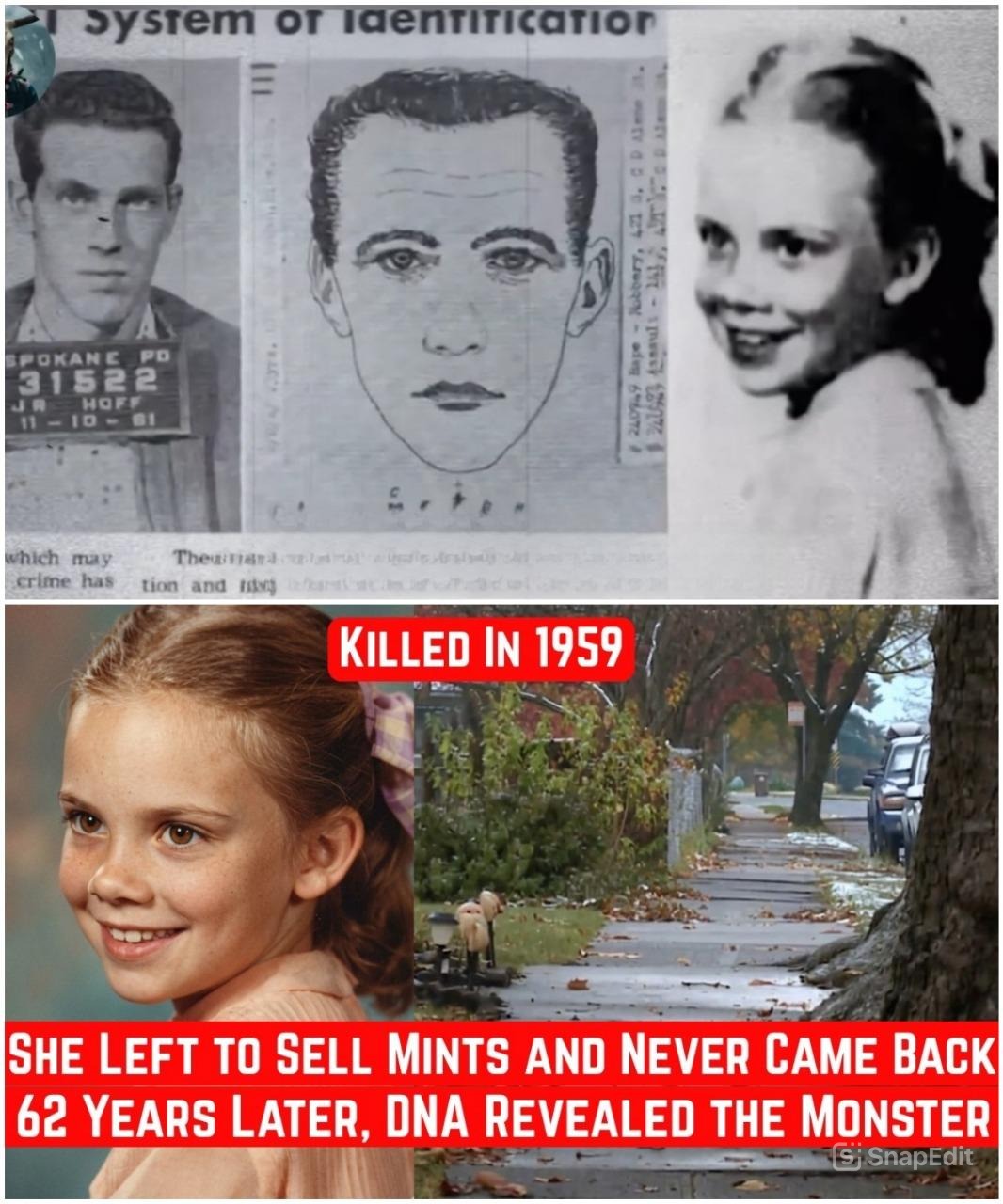
John Ray Hoff, James Andrew Hoff, Terry Allen Hoff.
Genealogy cannot distinguish between brothers.
Their DNA looks nearly identical in a family tree to identify which one had left his DNA on Candy’s clothing.
Investigators needed a living relative.
Only one of the three brothers had children.
Only one path forward existed.
Stormant picked up the phone and called a woman who had spent her entire life believing her father died because he was depressed.
She had no idea what was coming.
In 62 years of investigation, John Rayhoff’s name had never appeared in a single police report, not as a suspect, not as a witness, not as a passing mention.
Detective Storm said it plainly at the press conference.
He wasn’t on their radar at all until September 6th, 2021.
That was the day everything changed.
When Stormant called Kathy Hoff, he identified himself as a cold case investigator who needed her help.
Within 45 minutes of that call, she was at Spokane police headquarters.
But she already knew.
She had not waited passively after a mysterious call from a detective.
She had gone online.
He had searched.
Somewhere in those 45 minutes, she had found the story of a 9-year-old girl murdered in Spokane in 1959 while selling camp fire mints.
She walked into that police station already carrying the weight of what she suspected.
Kathy volunteered her DNA without hesitation.
The results came back on September 8th, 2021.
The DNA recovered from Candy’s clothing was 2.
9 million times more likely to be related to Cathy than to any random person from the general population.
Her father was the man who left that DNA.
But investigators were not done.
John Hoff was deceased.
There would be no trial, no cross-examination, no defense.
That meant the burden of certainty rested entirely on the investigators themselves.
They needed to be as sure as science could make them.
They obtained a warrant and exumed John Ray Hoff’s body on September 23rd, 2021.
The result came back on October 1st.
The probability that the DNA from Cand’s clothing belonged to Hoff rather than an unrelated person was 25 quintilion to 1.
The number 25 followed by 18 zeros.
That is not a number that leaves room for doubt.
The case was solved.
John Ray Hoff was born on August 11th, 1938 in Spokane, his own hometown.
He grew up on the 2,500 block of West College Avenue.
He was not a drifter.
He was local, known, familiar.
His early life showed the warning signs that, in hindsight, form a recognizable pattern.
In 1955 at 16, he escaped from a state juvenile reform facility near Olympia and was caught near Yakima.
That brush with the law pushed him into the military.
He joined the US Army at 17 and was assigned to the Nike missile sites protecting Fairchild Air Force Base right outside Spokane, his own city.
On March 6th, 1959, he lived at 221 West Broadway Avenue.
Candi’s home was on the 220 block of West Mission Avenue, one mile apart.
In 1961, 2 years after Candi’s murder, Hoth was arrested in West Spokane.
The charge was seconddegree assault.
What he had done, he grabbed a woman, forcibly removed her clothing, tied her up using her own garments, and strangled her before fleeing.
She survived.
Read that carefully.
He used his victim’s own clothing to bind her.
He used her own clothing to strangle her.
That is an exact match to what was done to Candy Rogers.
The liature around Cand’s neck was torn from her own slip.
Her ankles were bound with another strip of the same garment.
The 1961 victim survived only because something interrupted him.
Candy did not.
Hoff served 6 months.
As a result of that conviction, the army declared him a deserter and dishonorably discharged him.
He drifted between jobs, selling cutlery doortodoor, working at a lumber yard, putting time in at a meatacking plant where he suffered a chemical burn on his face.
He was not a man building a life.
And then there is the detail about Hoff that cuts deeper than all the others.
He had a stepsister.
She was 10 years old in 1959, a campfire girl.
She was Candy Rogers’s assigned big sister in the program, the older girl whose job was to guide the younger Bluebird.
She knew Candy.
She cared about Candy.
When Candy disappeared and the city fell apart searching for her, this girl was devastated.
She sat next to her brother, next to John Hoff, and cried.
She told him how much she missed her little campfire sister.
She told him how terrible it was.
He sat there and said nothing.
John Ray Hoff died in 1970 before anyone could hold him accountable.
He shot himself in the head.
The date he chose was his daughter’s birthday, the day she turned 9 years old, the same age as Candy Rogers, when he raped and murdered her.
Whether that was guilt or coincidence or something darker, he took that answer with him.
And when investigators went to find out where he had been buried, they discovered something that made the room go quiet.
For 51 years, John Ray Hoff was buried in the same cemetery as Candy Rogers.
The little girl he abducted, the child he strangled with her own clothing, she was buried there, and so was he, just yards away for over five decades.
While her family visited her grave and wondered who had done this to her, her killer lay in the same ground, in the same silence, in the same city, nobody knew.
His name had never once entered the investigation.
When Detective Storm told Hoff’s surviving family what the DNA had confirmed, he described it this way at the press conference.
I took those people’s lives and their childhood and dumped it on its head.
He was not being dramatic.
Kathy had spent her entire life believing her father died because he struggled with depression.
That was the story the family carried.
How they made sense of losing him.
And in one conversation with a detective, that story was replaced by something no one could have prepared for.
The grief did not disappear.
It became something far more complicated.
When the family learned he was buried in the same cemetery as Candi, they made a decision without being asked.
They arranged to have his remains moved to a different cemetery so that Candi, as Stormmit put it, could enjoy some peace.
When Candi’s family heard that, her cousin Joanne was overcome with emotion.
That gesture from the killer’s family to the victims was not justice.
But it was the only thing they had the power to give.
There is still the matter of Hoff’s stepsister.
She is in her 70s now.
After the case was solved, Stormmit tracked her down and told her what her brother had done.
She was, in his words, absolutely heartbroken.
He told him she remembered sitting next to John Hoff and crying about losing Candy, telling him how devastated she was, how much she missed her little campfire sister.
He sat there, listened, and said nothing.
He had spent her entire life carrying that grief as an innocent bystander, never knowing that the person responsible for it was sitting right beside her, absorbing her tears without flinching.
Kathy Hoff gave a videotaped statement played at the November 19th press conference.
It did not hide.
She did not deflect.
I’m very, very sorry for what my dad did that he took her life horribly.
I hope that it gives her peace knowing that even though it’s not really justice because he doesn’t get any punishment, his name has this on it now.
And they can know it’s solved.
That statement is worth sitting with.
There would be no trial, no sentence, no courtroom moment where the law looked John Hoff in the eye and called him what he was.
He had already escaped that.
But Kathy was offering the only thing that remained.
Acknowledgement.
His name attached permanently to what he did.
The record corrected, the truth on paper.
It is not justice, but it is not nothing.
At the press conference, retired Captain Richarding sat in the audience.
He was one of the officers who had found Candi’s body on March 22nd, 1959.
He had pushed aside that pile of brush and pine needles and seen what John Hoff had left behind.
He had carried that image for 62 years.
He was still alive to hear the answer.
I thank God, he said that I lived long enough to see the end of this case.
Detective Stormant, visibly emotional throughout the conference, was asked how many hours had been invested in the Candy Rogers investigation over 62 years.
He did not give a number.
He said, “This isn’t measured in hours.
This is measured in careers.
Three generations of detectives had worked this case.
Three generations had handed it forward with the same silent plea.
Don’t give up on her.
The last generation did not.
Candi’s cousin Joanne wiped tears from her face and said simply, “I feel like Cand’s loss was just a horrible loss.
She was so cute and she didn’t have much time.
She didn’t have much time.
Candy Rogers was 9 years old.
She wanted to earn a badge.
She had a dog named Shep and a grandmother who gave her oatmeal cookies and a whole street full of neighbors she was excited to visit.
They had a future that belonged to her by right, and it was taken from her on a cold Friday afternoon in March 1959 by a 20-year-old soldier who lived one mile away and was never once suspected.
We will never know who she would have become.
What we know is this.
She mattered enough that 1,200 people showed up to find her.
She mattered enough that three generations of detectives refused to close her file.
It mattered enough that a forensic scientist who grew up hearing her name sent one last sample to one last lab and refused to accept that the answer was gone forever.
And she mattered enough that the daughter of her killer looked into a camera and made sure the world knew his name and what he did with it.
62 years, 8 months, and 13 days.
That is how long Candy Rogers waited.
The clock has finally stopped.
How many other cold cases from the 1950s and60s still have biological evidence sitting in an evidence locker waiting for technology that already exists to finally give them an answer? John Hoff committed a nearly identical assault in 1961 and served just 6 months.
If that sentence had reflected the true danger he posed, would Candy Rogers’s case have ever needed to be solved? What does it mean for justice when the only punishment a killer ever faces is having his name permanently attached to what he did long after he is gone?