
JonBenét Ramsey Case REOPENED?! New DNA Evidence Changes EVERYTHING!
It has been nearly three decades since the Christmas morning that shattered an American dream.
The case of JonBenét Ramsey — the six-year-old girl found dead in her Boulder, Colorado home — has never stopped echoing.
It remains both a tragedy and a mirror: reflecting our obsession with beauty and innocence, our distrust of privilege, and the haunting truth that justice can vanish even in plain sight.
Back in 1996, it seemed unthinkable that a child could be taken, harmed, and left behind in her own home — her family asleep upstairs, her life extinguished before sunrise.
But what began as a kidnapping report became one of the most complex and controversial investigations in modern history.
The story has everything a tabloid could crave: a wealthy family, a mysterious ransom note, a house filled with contradictions.
Yet beyond the noise — beyond the sensational headlines, the conspiracy theories, and the cable-news melodrama — lies a deeper American story: about failure, faith, and the way grief mutates under the hot light of fame.
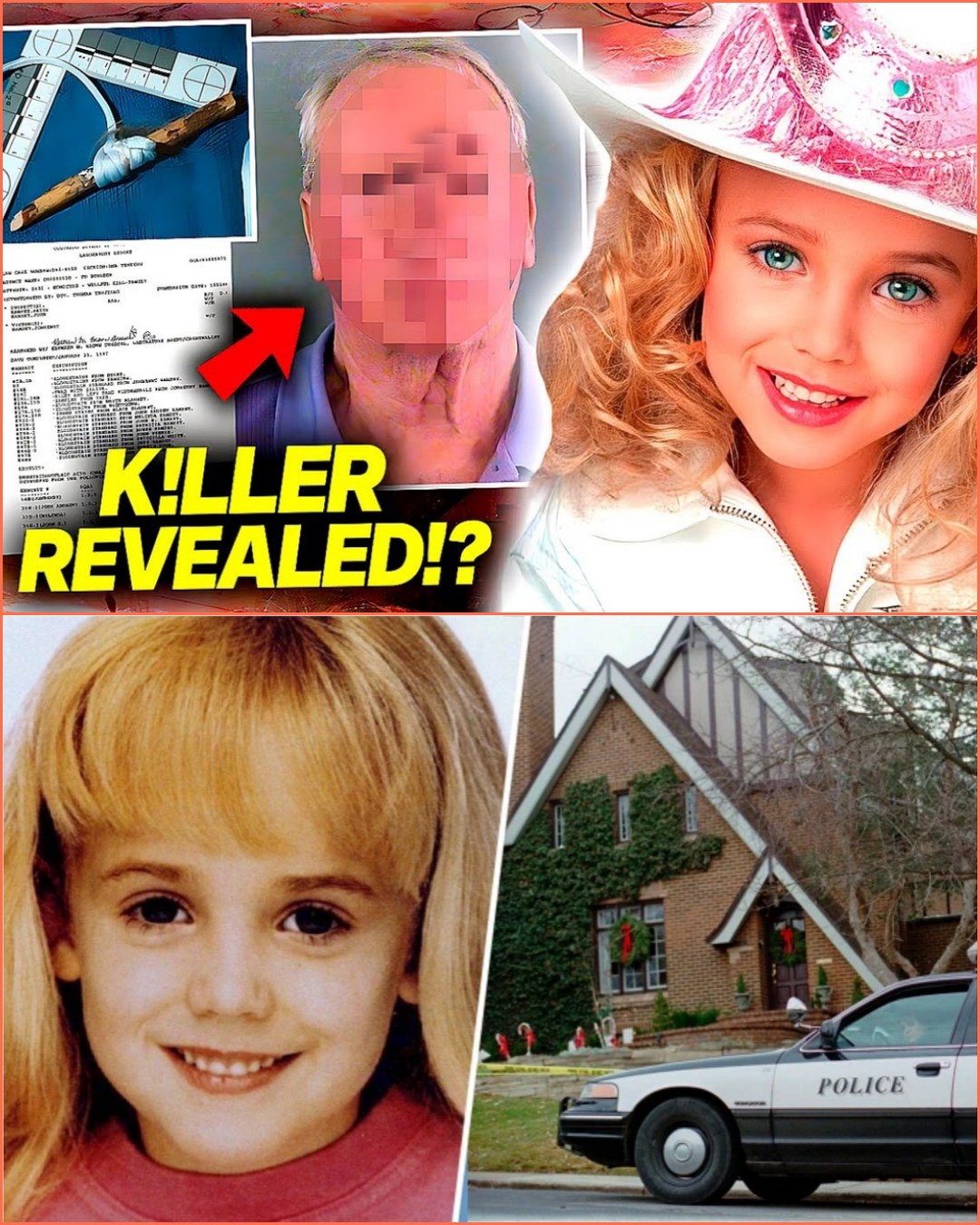
The Morning After Christmas
The Ramseys lived in a sprawling home on 15th Street, a three-story mansion decorated that winter in white lights and holiday garlands.
Inside, it was all warmth and success.
John Ramsey, a tech entrepreneur, had built a company worth hundreds of millions.
His wife, Patsy, a former beauty queen, poured her charm into the life of their children — Burke, nine, and JonBenét, six, a vivacious, curious girl who loved performing in child pageants.
On the morning of December 26, 1996, Patsy descended the staircase to find a handwritten ransom note sprawled across several pages.
It demanded $118,000 — an oddly specific amount equal to her husband’s recent Christmas bonus — and instructed the family not to contact police.
She dialed 911 anyway.
Boulder officers arrived at the house, but what followed was a string of mistakes that would haunt the investigation for decades.
The police treated the scene as a kidnapping, not a potential homicide.
They focused only on JonBenét’s bedroom, leaving the rest of the house open.
Friends and neighbors were allowed to come and go, stepping over evidence, moving objects, even cleaning surfaces.
By afternoon, John Ramsey searched the basement and found his daughter’s body.
The crime scene — already fragile — collapsed into chaos.
That day, the city’s trust in its police force began to unravel, and America’s fascination with the case began to grow.

The Note and the Nation
The ransom note remains one of the strangest artifacts in American criminal history.
Two and a half pages long, written on paper from inside the house, it reads less like a message from a hardened criminal and more like a script — florid, dramatic, oddly polite.
It was signed “S.B.T.C.”, letters that have never been fully decoded.
Forensic linguists still debate its tone: some say it was written to sound foreign; others see deliberate mimicry.
Handwriting experts disagreed for years on whether Patsy Ramsey could have written it.
Some similarities were found, others dismissed.
The ambiguity fed a national obsession — and a presumption of guilt that the Ramseys would never escape.
Theories multiplied.
Was it an intruder, or a family cover-up? Was the ransom a distraction, or the work of someone who knew the family intimately? Cable networks turned the case into spectacle; tabloids sold millions of copies.
Late-night comedians joked.
Talk shows speculated.
JonBenét’s face — that angelic smile, the bright blond curls, the stage lights of her pageant days — became both symbol and scapegoat.
America projected its unease onto her: the culture that glorified child beauty now recoiled from its own creation.
The Investigation That Failed
Behind the headlines, the investigation fractured under its own pressure.
The Boulder Police Department and the district attorney’s office turned against each other.
Detectives insisted the killer had to be inside the house.
Prosecutors warned that the evidence pointed elsewhere.
At one point, the police publicly declared that they had “no reason to look beyond the family.” That early certainty hardened into tunnel vision.

Thousands of leads were ignored.
Reports of possible intruders went unpursued.
A window in the basement — open, with a suitcase beneath it — was never properly examined.
Even after DNA evidence emerged that excluded the Ramseys, some investigators refused to let go of their theory.
Pride, it seemed, had become stronger than truth.
The case’s flaws became a case study in what not to do.
Evidence was mishandled.
Witnesses weren’t separated.
The family was allowed to speak to the media before formal questioning.
The public, watching the chaos unfold, turned the family’s grief into a referendum on guilt.
For every new development, two more mistakes surfaced.
By the time the district attorney convened a grand jury in 1999, the investigation was in tatters.
The jury secretly voted to indict John and Patsy Ramsey for child neglect resulting in death.
The DA refused to sign it, citing lack of evidence.
The public never knew until years later.
Science Steps In
For a long time, it seemed the case would remain a ghost story — one of those tragedies frozen in amber, discussed endlessly, solved never.
But time, ironically, began to work in the family’s favor.
As DNA technology advanced, so did the chance for truth.
In 2003, a forensic re-examination found traces of unknown male DNA on JonBenét’s clothing — not a family member’s.
It was the first solid scientific sign of an intruder.
But the sample was too small to identify anyone.
Two decades later, that changed.
In 2024, Boulder authorities quietly partnered with Parabon NanoLabs, a private company specializing in forensic genealogy — the same kind of technology that solved the Golden State Killer case.

By comparing the old DNA sample with public genetic databases, analysts began to trace the family tree of the unknown suspect.
The results were startling.
A line of distant relatives led to one man, now in his sixties, living in Washington State.
In 1996, he had lived just two miles from the Ramseys’ home.
He had worked for a catering company that serviced neighborhood holiday parties that winter — including one on the Ramseys’ street.
Investigators retrieved a discarded cup from him and tested it.
The DNA matched.
Statistically, the chance of error was near zero.
Police have not yet released his name, citing the need for corroborating evidence, but the match — if confirmed — could close one of the longest-running chapters in modern American crime.
A Web of Missed Chances
If the genetic link holds, it exposes something larger than one man’s guilt.
It shows how an entire system failed a six-year-old girl.
Within months of JonBenét’s death, another child in the same Boulder neighborhood was attacked in her bedroom by an intruder who escaped through a deck window.
The girls knew each other from a dance school.
The cases were never compared.
Evidence from the second scene — including bed sheets that might have held DNA — was later discarded.
“It was a pattern of neglect,” says a retired investigator familiar with both cases.
“They were looking in the wrong direction.
By the time they realized it, the trail was gone.”
That failure would come to define the Boulder Police Department for a generation.
Public trust eroded.
Veteran officers resigned.
The Ramseys sued several media outlets for defamation and eventually won settlements, but the damage was irreversible.
Patsy Ramsey died in 2006, still pleading her innocence.
John Ramsey, now over eighty, continues to push for full release of the case evidence to independent forensic teams.
“We’re not asking for miracles,” he said recently.
“Just for the truth.”

The Media and the Myth
No other crime blurred the line between journalism and entertainment quite like JonBenét’s.
News anchors spoke in hushed tones, narrating theories like serialized drama.
Every detail — the Christmas lights, the handwriting loops, the child’s pageant dresses — became a symbol to dissect.
The story outgrew the facts.
It became a lens through which America examined itself — wealth, beauty, innocence, ambition, and the uneasy relationship between private tragedy and public fascination.
The 2023 Netflix documentary reignited that fascination, introducing a new generation to the mystery.
It revisited not only the forensic evidence but the human cost: a family vilified before the evidence was even analyzed.
Viewers were left asking how a case with so much attention could remain unsolved for so long.
For many journalists who covered it, the case became a moral reckoning.
The press, they admit, was complicit — feeding public hunger for scandal without questioning its own appetite.
In the end, the narrative consumed its subjects.
The Human Remains
Beneath all the analysis, theories, and documentaries, there remains a simple, devastating truth: a child lost her life.
JonBenét Ramsey was not a symbol or a mystery when she was alive.
She was a six-year-old who loved to sing, who decorated Christmas cookies, who wrapped her arms around her brother’s neck in every photo.
Her joy was real, her light unmanufactured.
Burke Ramsey, now an adult, has spoken publicly only a handful of times.
“People forget she was my sister, not a headline,” he said in one interview.
“She was funny.
She made up songs.
She wanted to be a singer.”
He, too, carries the weight of suspicion — not from evidence, but from the culture of conspiracy that grew around the case.
For years, he lived in silence, watching strangers debate his family’s grief.
Now, as new technology offers hope of closure, he and his father have reemerged, advocating for transparency and the release of remaining DNA evidence.
They are no longer defending themselves.
They are demanding what should have been done thirty years ago: a proper investigation.
The System on Trial
If the Boulder Police mishandled JonBenét’s case, it wasn’t just incompetence — it was culture.
The culture of small-town policing faced with national scrutiny.
The culture of blame before proof.
The culture of protecting reputations instead of solving crimes.
The department’s early fixation on the Ramseys created a blind spot that years of forensic progress still struggle to correct.
In the simplest sense, the case is a tragedy of human ego: a family destroyed, a child lost, and a truth ignored because it was inconvenient.
Former FBI profiler Candice DeLong puts it bluntly: “You don’t get justice from an investigation that refuses to admit it failed.
That’s why this case still hurts — because it’s not just about who killed JonBenét.
It’s about who failed her afterward.”
Today, the Colorado Cold Case Review Team is re-examining every piece of evidence, using technologies that didn’t exist in 1996.
There is cautious optimism — but also frustration.
The Boulder Police still control access to certain materials, slowing progress.
“It’s like they’d rather keep it unsolved than admit their mistakes,” one forensic analyst told me.

The Legacy of a Name
If JonBenét Ramsey were alive today, she would be thirty-three.
Her classmates have long since grown up, had families, moved on.
But her name remains frozen in time, a permanent headline in American consciousness.
The Ramseys’ house was sold years ago, renovated, stripped of its ghostly history.
Yet the name still draws passersby — people who stop on the sidewalk, lower their voices, and whisper: That’s where it happened.
What “it” is, no one fully agrees.
A murder? A media failure? A national obsession? Perhaps all three.
But for those who have followed the case for decades — detectives, journalists, citizens — the lesson is clear.
Justice is not just about catching the guilty; it’s about protecting the innocent from the machinery of assumption.
JonBenét’s case, for all its pain and spectacle, forced America to confront uncomfortable truths: about wealth and bias, about media ethics, about the fallibility of systems we trust.
And yet, despite everything, there remains a stubborn hope that truth will emerge — that science will do what human judgment could not.
An Ending Still Unwritten
In a quiet interview not long ago, John Ramsey said something that lingers.
“I still believe in justice,” he said.
“Not because I’ve seen it, but because I have to.”
He paused, then added, “We’ve already lost our daughter.
The least the world can give her now is the truth.”
In Boulder, the lights on 15th Street still shine each December.
Strangers drive by, some out of curiosity, others out of reverence.
The house no longer belongs to the Ramseys, but its shadow remains.
The case endures because it represents more than one family’s nightmare.
It represents the fragility of truth — how easily it can be buried beneath noise, ego, and time.
Whether the new DNA technology finally unmasks the killer or not, JonBenét’s story will remain what it has always been: a warning about how a society obsessed with answers can so easily lose sight of the child at the heart of the mystery.
For all the theories, documentaries, and debates, one fact remains untouched — on that cold morning after Christmas, a small girl’s laughter went silent, and a nation began searching for it ever since.
News

James Webb Telescope CONFIRMS Neptune is NOT What We’re Being Told
James Webb Telescope CONFIRMS Neptune is NOT What We’re Being Told For centuries, Neptune has been an enigmatic sentinel at…

Voyager 2 Sent Back Its Final Images After 47 Years in Space
Voyager 2 Sent Back Its Final Images After 47 Years in Space Launched in 1977, Voyager 2 was never meant…

Voyager 1’s Final Message JUST STOPPED THE WORLD!
Voyager 1’s Final Message JUST STOPPED THE WORLD! For over 45 years, Voyager 1, humanity’s furthest-reaching spacecraft, has been silently…

Voyager 1 just made an IMPOSSIBLE discovery at the edge of the Solar System
Voyager 1 just made an IMPOSSIBLE discovery at the edge of the Solar System For over 45 years, Voyager 1…
James Webb Telescope’s Final Discovery about Betelgeuse JUST WENT TOO FAR
James Webb Telescope’s Final Discovery about Betelgeuse JUST WENT TOO FAR For decades, astronomers have kept a close watch on…

Comet SWAN Is Closing in on Earth as Solar Storms Strike It
Comet SWAN Is Closing in on Earth as Solar Storms Strike It For centuries, comets have been regarded as ominous…
End of content
No more pages to load






