
😲 What Are Malta’s Cart Ruts Really? Scientists Finally Reveal the Astonishing Origins of These Ancient Grooves—And It Will Change Everything You Thought You Knew! 🔎

The cart ruts of Malta and Gozo form one of the most intricate networks of ancient rock-cut features in the Mediterranean, captivating the imagination of all who encounter them.
These parallel grooves, carved deep into solid limestone, stretch across the islands, crisscrossing fields, vanishing at cliff edges, and even disappearing beneath the sea.
With over 150 distinct rut systems catalogued, the sheer scale and complexity of these formations have led to endless speculation about their origins and purpose.
Early studies suggested they might be remnants of prehistoric highways or paths used for transporting goods, while others proposed they were associated with ancient temple complexes or quarrying activities.
The most densely concentrated area of cart ruts is found at Misraħ Għar il-Kbir, where a bewildering maze of intersecting tracks creates a pattern reminiscent of a railway yard carved in stone.
Here, over a dozen ruts crisscross one another across approximately 500 square meters of exposed limestone terrain, forming a network that has fascinated explorers and researchers alike.
The irregularity of these ruts adds to the mystery; some run parallel for hundreds of meters before suddenly terminating, while others curve, fork, or merge with other tracks, complicating efforts to determine their original purpose.
Geologically, Malta’s limestone landscape offers a unique backdrop for these ancient features.
The islands are primarily composed of two types of limestone: the harder Upper Coralline Limestone and the softer Globigerina Limestone.
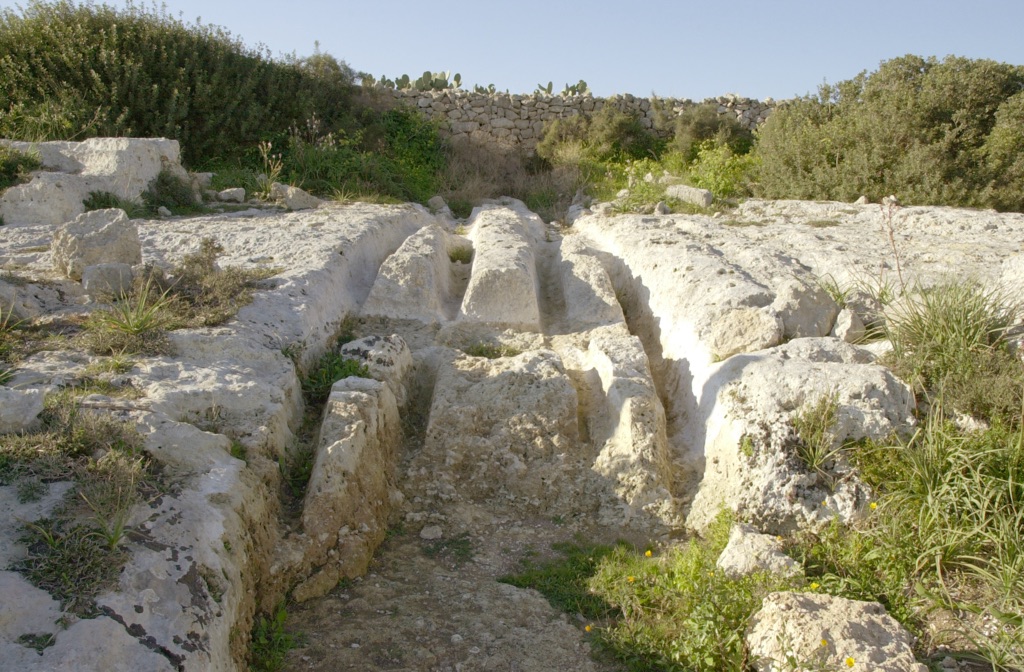
The latter is particularly susceptible to erosion, especially when saturated with water, allowing for the deepening of the ruts over time.
Researchers have employed advanced techniques such as 3D laser scanning and LiDAR mapping to analyze the ruts, revealing micro-erosional patterns consistent with long-term natural deepening.
These findings suggest that the cart ruts were not merely the result of human activity but were shaped significantly by environmental processes as well.
Despite extensive research, a definitive chronological framework for the cart ruts has remained elusive.
Unlike other archaeological features, such as megalithic temples or burial sites that yield pottery fragments or organic material for dating, the ruts exist as bare impressions in bedrock.
This absence of stratigraphic context has led archaeologists to infer their age through comparisons with nearby archaeological features and typological parallels.
Initial assumptions placed the ruts within the Phoenician or Roman periods, but later discoveries near prehistoric temples prompted a reevaluation, linking them to Malta’s Temple Period, which flourished between circa 3800 BC and 2500 BC.
The hypothesis that the ruts might be associated with the movement of large stones for temple construction gained traction through experimental archaeology.
Studies demonstrated that dragging sledges over wet limestone could produce grooves similar to those observed in Malta.
However, critics pointed out that many ruts occur far from known temple sites, raising questions about their singular purpose.
The debate continued as new interpretations emerged, suggesting that the ruts might span multiple cultural phases, originating as Neolithic sledge paths that were later adapted for wheeled traffic during the Bronze Age or Phoenician periods.
A landmark study published in 2008 by geomorphologists David Mottershead, Alastair Pearson, and Michael Schaefer revolutionized the understanding of Malta’s cart ruts.
Their research proposed a dual formation mechanism, emphasizing the role of both mechanical abrasion from human traffic and chemical dissolution from rainwater in shaping the ruts.
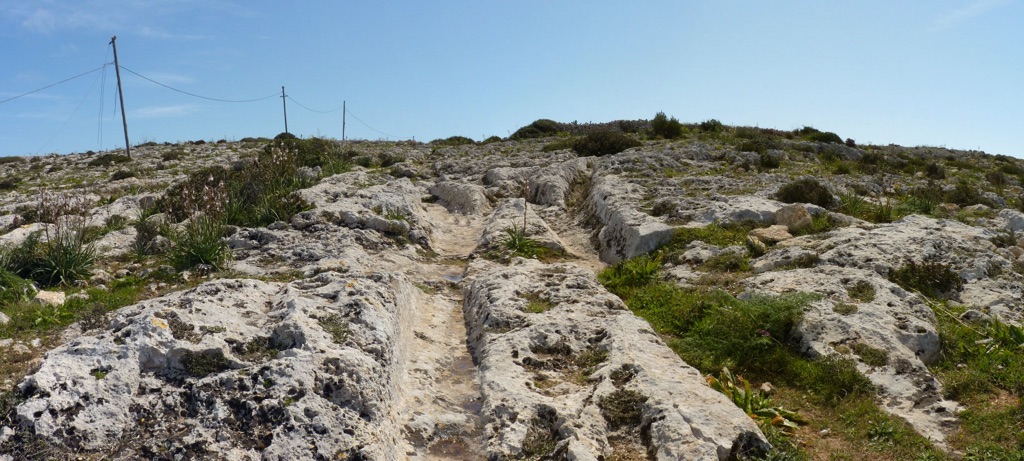
This approach provided a credible naturalistic framework that explained the grooves through measurable physical processes rather than speculative cultural theories.
As researchers delved deeper into the cart ruts’ origins, competing theories continued to emerge.
The transport hypothesis remains one of the most widely supported interpretations, positing that the ruts were worn by the movement of heavy materials such as stone or agricultural goods.
This idea is bolstered by the spatial association of rut systems with known quarry zones and ancient temples.
However, the presence of isolated ruts in rural areas and their abrupt terminations complicate this narrative, suggesting that not all ruts can be easily explained by transport or quarrying activities.
The underwater cart ruts off Malta’s coasts add another layer of intrigue to the mystery.
These submerged grooves share identical spacing with their inland counterparts, implying they formed when these areas were dry land.
Geological data indicates that sea levels have risen significantly since the last Ice Age, suggesting that some of these ruts may predate the Neolithic Temple Period.
This possibility has led to further speculation about the age and purpose of the ruts, with some scholars attributing their submersion to localized tectonic subsidence or Holocene sea-level rise.
In recent years, the advent of digital media and speculative documentaries has reignited interest in the cart ruts, sometimes blurring the lines between fact and fantasy.
Nonetheless, the scientific consensus in 2025 maintains that the ruts are anthropogenic, created through repeated human movement across soft, moisture-laden limestone.
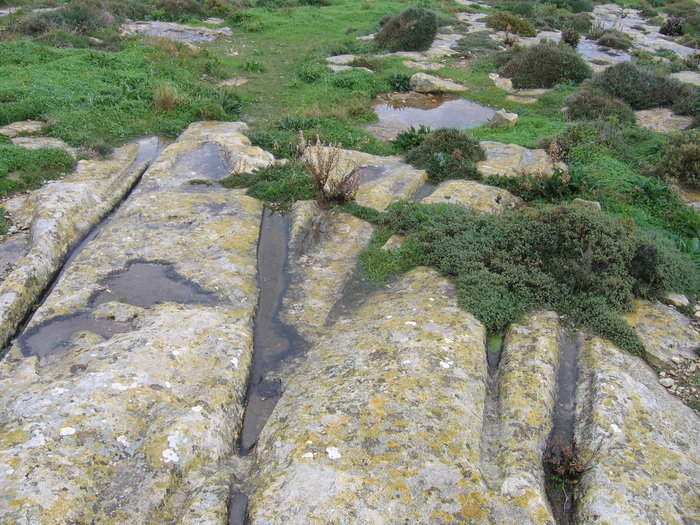
While no single explanation fits every site, the evidence supports a composite model: transport and quarrying activity, combined with environmental erosion, gradually sculpted the ruts over centuries.
Today, most scholars view Malta’s cart ruts as enduring testaments to prehistoric ingenuity, reflecting human adaptation to the island’s unique geology.
The ongoing research continues to refine this understanding, employing advanced technologies to map rut networks and measure erosion rates.
As we uncover the layers of history embedded in these ancient grooves, we gain valuable insights into the lives of those who once traversed this remarkable landscape.
In conclusion, the cart ruts of Malta remain a captivating mystery that invites exploration and inquiry.
The recent revelations about their origins and formation not only enhance our understanding of Malta’s prehistoric culture but also highlight the intricate relationship between human activity and the natural environment.
As we continue to investigate these enigmatic features, we are reminded of the timeless quest for knowledge and the enduring power of the past.
News

🔍✨ Unlocking the Secrets of the Herculaneum Scrolls: How AI Decoded Ancient Texts Buried for 2,000 Years—And What It Means for History!
🔍✨ Unlocking the Secrets of the Herculaneum Scrolls: How AI Decoded Ancient Texts Buried for 2,000 Years—And What It Means…

🚨 Is Earth in Danger? NASA & Harvard Reveal 4,000 New Meteors Escorting 3I/ATLAS—The Truth Behind This Cosmic Threat! 🌍
🚨 Is Earth in Danger? NASA & Harvard Reveal 4,000 New Meteors Escorting 3I/ATLAS—The Truth Behind This Cosmic Threat! 🌍 On June…

🎬 Ron Howard SHOCKS Hollywood by Revealing the Dark Secrets of Its Most Notorious Stars—You Won’t Believe Who Made the List! 😱
🎬 Ron Howard SHOCKS Hollywood by Revealing the Dark Secrets of Its Most Notorious Stars—You Won’t Believe Who Made the…

😱 The Shocking Truth Behind Audie Murphy’s Mysterious Death—Was It Really an Accident or Something More Sinister? 🔍
😱 The Shocking Truth Behind Audie Murphy’s Mysterious Death—Was It Really an Accident or Something More Sinister? 🔍 The tale…

💔 Tom Cruise’s Daughter Suri Null FINALLY SPEAKS OUT—The SHOCKING Truth Behind Their Distance Will Leave You Speechless! 😱
💔 Tom Cruise’s Daughter Suri Null FINALLY SPEAKS OUT—The SHOCKING Truth Behind Their Distance Will Leave You Speechless! 😱 The…

🎭 Russell Crowe SPILLS the TRUTH About Tom Cruise—Fans Are SHOCKED by Their Complicated History! 😲
🎭 Russell Crowe SPILLS the TRUTH About Tom Cruise—Fans Are SHOCKED by Their Complicated History! 😲 Russell Crowe and Tom…
End of content
No more pages to load






