
😱 When the Sun Throws a Tantrum, 3I/Atlas Gets a Cosmic Makeover – Who Knew? 😱
On October 21st, 2025, a powerful coronal mass ejection (CME) exploded from the far side of the Sun, unleashing a shockwave traveling at nearly 2,500 kilometers per second.
This immense burst of solar energy coincided with a rare celestial event: the interstellar comet 3I/Atlas slipped directly behind the Sun from Earth’s perspective, entering what astronomers call superior conjunction.
This alignment, combined with the new moon phase, created a perfect cosmic blind spot, rendering 3I/Atlas invisible to telescopes across the electromagnetic spectrum.
With Earth, the Moon, and the Sun lined up precisely, no visible light, infrared, or radar observations could penetrate the Sun’s overwhelming glare and plasma environment to reach the comet.
For a brief but critical window, 3I/Atlas became a ghostly presence, unreachable by direct observation and entirely at the mercy of whatever solar fury awaited it on the Sun’s far side.

3I/Atlas is no ordinary comet.
Discovered on July 1st, 2025, by the Atlas Survey team at the Cheropon Observatory in Chile, it was quickly identified as the third confirmed interstellar object to visit our solar system, following ‘Oumuamua and Borisov.
Its hyperbolic orbit, steeply tilted at 175° and nearly aligned with the ecliptic plane, meant it was moving against the flow of the planets at a blistering speed of nearly 68 kilometers per second.
As 3I/Atlas traveled inward, its exposure to sunlight increased dramatically—from a faint trickle of less than a millionth of a watt per square meter in interstellar space to an intense flood of about 735 watts per square meter near perihelion.
This surge in solar radiation caused rapid heating of the comet’s nucleus, triggering fracturing, volatile outgassing, and a swelling coma accompanied by a growing dust tail.
Yet, the October 21st CME introduced a new and unpredictable factor.
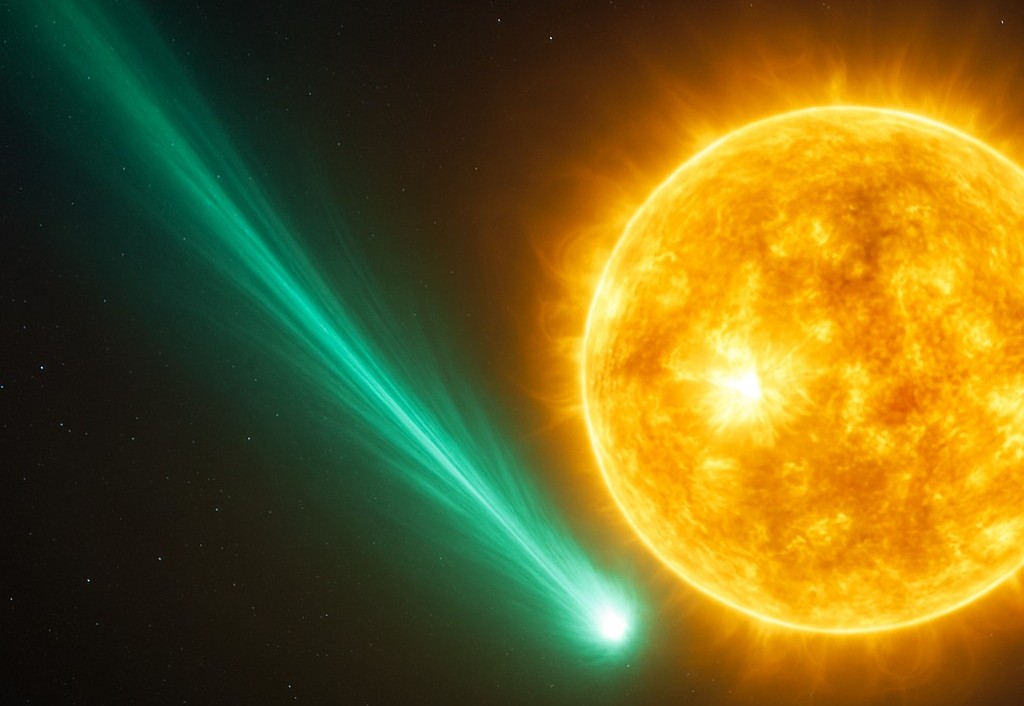
Originating from sunspot region 4246 on the Sun’s far side, the eruption was both powerful and asymmetrical, sending a dense shock front racing through the solar system.
Using data from coronagraphs aboard SOHO and the Stereo A spacecraft, space weather analysts mapped the CME’s trajectory with high confidence, confirming that both Venus and 3I/Atlas lay directly in its path.
Spacecraft monitoring the inner solar system, including the Parker Solar Probe and BepiColombo near Venus, recorded sharp spikes in energetic particles—electrons, protons, and heavy ions—validating model predictions of the CME’s arrival.
Meanwhile, Earth was spared the worst effects, experiencing only a glancing blow and a typical Forbush decrease, a temporary reduction in galactic cosmic rays caused by the CME’s magnetic field sweeping past.
For 3I/Atlas, however, the encounter was nearly head-on.
The comet faced a barrage of high-energy particles and intense magnetic turbulence, conditions that could dramatically alter its chemistry, trigger sudden outbursts, or even cause structural changes to its nucleus.
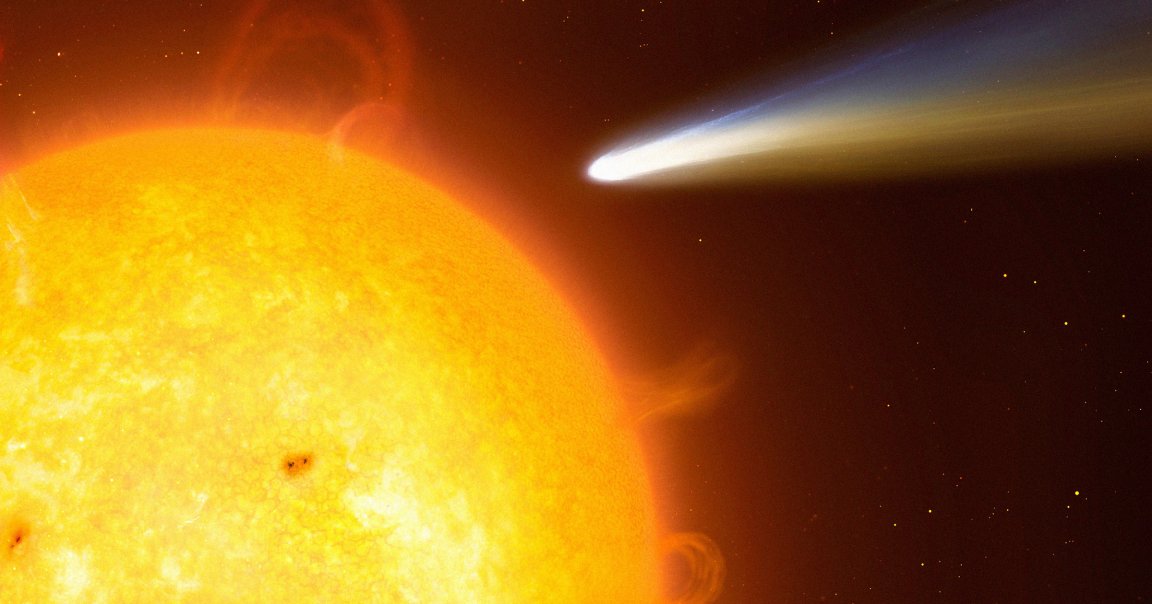
Unfortunately, the superior conjunction prevented direct observations during this critical period, leaving scientists to rely on indirect evidence and future data once the comet reemerged from behind the Sun.
The timing of this solar storm also ignited public speculation about possible connections between solar activity and seismic events on Earth.
Minor earthquakes near Katavitz, Poland, and Scotland’s northwest coast occurred within hours of the CME eruption, prompting social media theories linking solar storms to earthquakes.
However, seismologists from the USGS and British Geological Survey quickly dismissed these claims, citing decades of research that show no causal relationship between solar energetic particles and tectonic activity.
While some fringe researchers continue to explore subtle electromagnetic effects on fault lines, the scientific consensus remains skeptical.
The saga of 3I/Atlas exemplifies both the challenges and excitement of studying interstellar visitors.

Unlike typical solar system comets, 3I/Atlas carries exotic ices and unique chemical signatures, making its reaction to intense solar radiation a natural laboratory for understanding materials formed around other stars.
Since its discovery, the comet has been the focus of intense observation and analysis.
Its hyperbolic trajectory guarantees it will never return, making this its only passage through our solar system.
Its closest approach to Earth is predicted for December 19th, 2025, at a safe distance of 1.8 astronomical units, but the effects of the recent solar storm on its physical and chemical properties remain unknown.
As new observations resume, scientists eagerly await data that may reveal how 3I/Atlas fared after this cosmic encounter.
Did the solar storm trigger unexpected outbursts?
Did it alter the comet’s surface or composition?
These questions remain open, with answers poised to deepen our understanding of how interstellar objects interact with extreme stellar environments.
This event also underscores the dynamic nature of our solar system, where even distant visitors can be dramatically shaped by the Sun’s volatile temperament.
The interplay of solar physics, planetary science, and interstellar astronomy converges in this rare moment, offering a glimpse into the complex forces that govern our cosmic neighborhood.
In the coming months, as 3I/Atlas returns to view, researchers will scrutinize its behavior, searching for clues that could revolutionize cometary science and illuminate the mysteries of material from beyond our solar system.
News

😱 Is Ian Gillan Next? Shocking Retirement Rumors Emerge After David Coverdale’s Exit! 😱 – HTT
😱 Is Ian Gillan Next? Shocking Retirement Rumors Emerge After David Coverdale’s Exit! 😱 In the world of rock music,…

😱 The Shocking Truth Behind Ian Gillan’s Retirement Plans: Is It Time to Say Goodbye? 😱 – HTT
😱 The Shocking Truth Behind Ian Gillan’s Retirement Plans: Is It Time to Say Goodbye? 😱 Ian Gillan, the legendary…
😱 Is 3I/ATLAS a Cosmic Seed or a Galactic Trojan Horse? Prepare to Be Amazed! 😱 – HTT
New Evidence Sheds Light on the Enigmatic 3I/ATLAS: A Cosmic Visitor Defying Expectations Since the dawn of telescopic astronomy, interstellar…

😱 From Waltz to Heartfelt Confession: Andre Rieu’s Emotional Birthday Surprise! 😱 – HTT
😱 From Waltz to Heartfelt Confession: Andre Rieu’s Emotional Birthday Surprise! 😱 What’s the one love song that always melts…
😱 From Wedding Fiddler to Billboard King: How Andre Rieu Redefined Classical Music! 😱 – HTT
😱 From Wedding Fiddler to Billboard King: How Andre Rieu Redefined Classical Music! 😱 Andre Rieu did the unthinkable. He…

😱 Heartbreak in Rock: The Real Reason Behind Ace Frehley’s Untimely Death! 😱 – HTT
😱 Heartbreak in Rock: The Real Reason Behind Ace Frehley’s Untimely Death! 😱 Ace Frehley, the legendary guitarist and founding…
End of content
No more pages to load






