
The state’s decision to release thousands of eastern indigo snakes into the wild as a means to combat the invasive Burmese python population has drawn laughter from many quarters.
However, beneath the surface of this seemingly reckless gamble lies a desperate attempt to restore balance to a devastated ecosystem.
The story of Florida’s ecological crisis began long before the indigo snakes were released.
The Everglades, once a thriving ecosystem worth an estimated $31.5 billion annually, was slowly succumbing to an invasion that went unnoticed for years.

This invasion started with Hurricane Andrew in 1992, which destroyed a reptile breeding facility near Miami, allowing a few exotic snakes to escape into the wild.
Simultaneously, pet owners were releasing their Burmese pythons, believing they were setting them free.
What began as a few released pets quickly spiraled into a full-blown invasion.
Today, experts estimate that between 100,000 and 300,000 Burmese pythons now slither through the swamps of South Florida.
These apex predators have wreaked havoc on local wildlife, leading to a staggering decline in native species.
Raccoon populations have plummeted by 99.3%, opossums by 98.9%, and bobcats by 87.5%.

The once vibrant ecosystem was falling silent, and yet, few seemed to notice the impending disaster.
The pythons thrived in Florida’s warm climate, with no natural predators to keep their numbers in check.
Their ability to camouflage and their sheer size made them nearly impossible to control.
As the years passed, their population exploded, and the ecological balance of the Everglades was shattered.
Despite efforts to combat the invasion, including capturing over 23,000 snakes, this number represents less than 1% of the estimated population.
Desperate for solutions, Florida officials turned to unconventional methods.
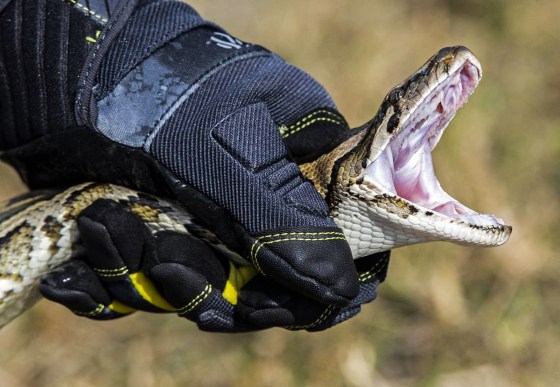
In 2013, the Florida Python Challenge was launched, inviting hunters from across the country to help capture the invasive snakes.
The event attracted hundreds of participants, but the results were disheartening.
Even as the number of captured pythons increased, the overall population continued to grow unchecked.
In an effort to combat the crisis more effectively, Florida employed high-tech strategies, from robotic rabbits designed to lure pythons to trained dogs that could sniff them out.
Yet, despite these innovative approaches, the snakes continued to multiply, and the sense of defeat among researchers and conservationists grew.
Amidst this struggle, a new threat emerged—an unseen parasite known as Relatella orientalis, or the snake lungworm.
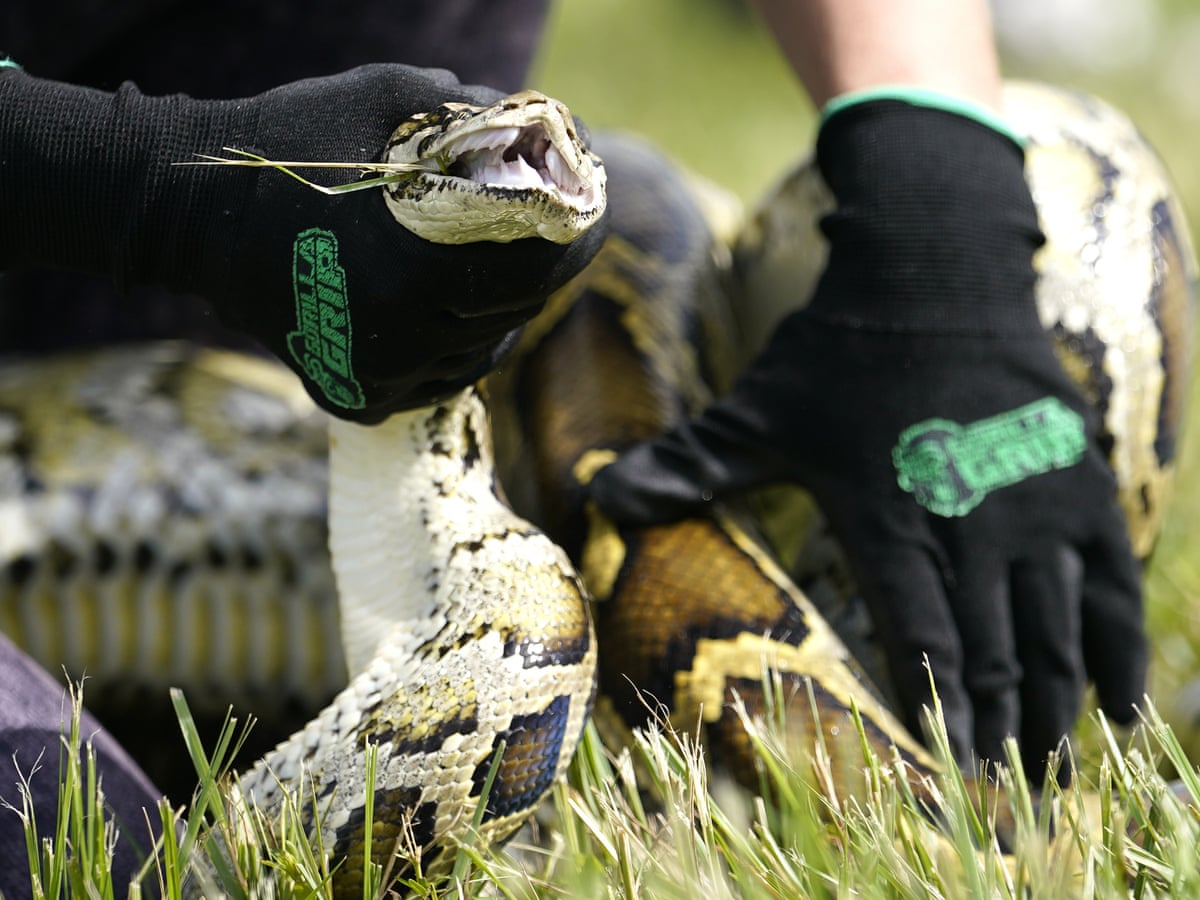
This parasite, hitching a ride with the Burmese pythons, began infecting native snake species, leading to further declines in their populations.
The lungworm’s spread has added another layer of complexity to an already dire situation, as it disrupts the food chain and threatens the very fabric of Florida’s ecosystems.
In the face of such overwhelming challenges, Florida officials made the controversial decision to release eastern indigo snakes back into the wild.
This move was met with skepticism and laughter, as it seemed counterintuitive to introduce more snakes into an environment already plagued by invasive ones.
Critics recalled the disastrous introduction of mongooses in Hawaii as a cautionary tale of ecological mismanagement.
However, what many failed to recognize was the unique role of the eastern indigo snake in Florida’s ecosystem.

Once common throughout the southeastern United States, this nonvenomous snake had nearly vanished due to habitat loss and overcollection.
The indigo snake is a natural predator of other snakes, including venomous species, and its reintroduction was part of a long-term plan to restore balance to the ecosystem.
Behind the scenes, scientists and conservationists had been working tirelessly to breed indigo snakes in captivity and prepare for their reintroduction.
This effort was not a haphazard response to a crisis but rather a calculated move aimed at restoring a predator that had once played a crucial role in maintaining the ecological balance before the python invasion.
As the eastern indigo snakes were released, the public mockery began to fade, replaced by a cautious optimism.
The indigo snake, often referred to as the “emperor of the forest,” is a formidable predator capable of taking on pythons.

Its return signaled a potential shift in the dynamics of the Everglades, offering a glimmer of hope in a seemingly hopeless situation.
In a surprising turn of events, reports began to emerge of native predators, including bobcats and alligators, successfully taking down pythons.
This shift indicated that the balance of nature was beginning to reassert itself, as Florida’s wildlife adapted to the presence of these invasive snakes.
The most encouraging news came in late 2023 when biologists confirmed the first successful breeding of wild eastern indigo snakes in North Florida in nearly half a century.
This breakthrough demonstrated that the reintroduction efforts were not only working but also revitalizing the ecosystem.
As more indigos were spotted across the landscape, it became clear that the indigo snake was reclaiming its place in the natural order.

While the battle against the Burmese python is far from over, the story of Florida’s ecological crisis serves as a reminder of the resilience of nature.
The initial laughter surrounding the release of eastern indigo snakes has given way to a deeper understanding of the complexities of ecological restoration.
It highlights the importance of patience and collaboration in addressing the challenges posed by invasive species.
In conclusion, Florida’s gamble to release eastern indigo snakes may have seemed absurd at first, but it has opened a new chapter in the fight against ecological imbalance.
As the indigos establish themselves and native predators begin to adapt, there is hope that Florida’s ecosystems can heal and thrive once more.
News

😱 Is Ian Gillan Next? Shocking Retirement Rumors Emerge After David Coverdale’s Exit! 😱 – HTT
😱 Is Ian Gillan Next? Shocking Retirement Rumors Emerge After David Coverdale’s Exit! 😱 In the world of rock music,…

😱 The Shocking Truth Behind Ian Gillan’s Retirement Plans: Is It Time to Say Goodbye? 😱 – HTT
😱 The Shocking Truth Behind Ian Gillan’s Retirement Plans: Is It Time to Say Goodbye? 😱 Ian Gillan, the legendary…

😱 Is 3I/ATLAS a Cosmic Seed or a Galactic Trojan Horse? Prepare to Be Amazed! 😱 – HTT
New Evidence Sheds Light on the Enigmatic 3I/ATLAS: A Cosmic Visitor Defying Expectations Since the dawn of telescopic astronomy, interstellar…

😱 From Waltz to Heartfelt Confession: Andre Rieu’s Emotional Birthday Surprise! 😱 – HTT
😱 From Waltz to Heartfelt Confession: Andre Rieu’s Emotional Birthday Surprise! 😱 What’s the one love song that always melts…

😱 From Wedding Fiddler to Billboard King: How Andre Rieu Redefined Classical Music! 😱 – HTT
😱 From Wedding Fiddler to Billboard King: How Andre Rieu Redefined Classical Music! 😱 Andre Rieu did the unthinkable. He…

😱 Heartbreak in Rock: The Real Reason Behind Ace Frehley’s Untimely Death! 😱 – HTT
😱 Heartbreak in Rock: The Real Reason Behind Ace Frehley’s Untimely Death! 😱 Ace Frehley, the legendary guitarist and founding…
End of content
No more pages to load






