
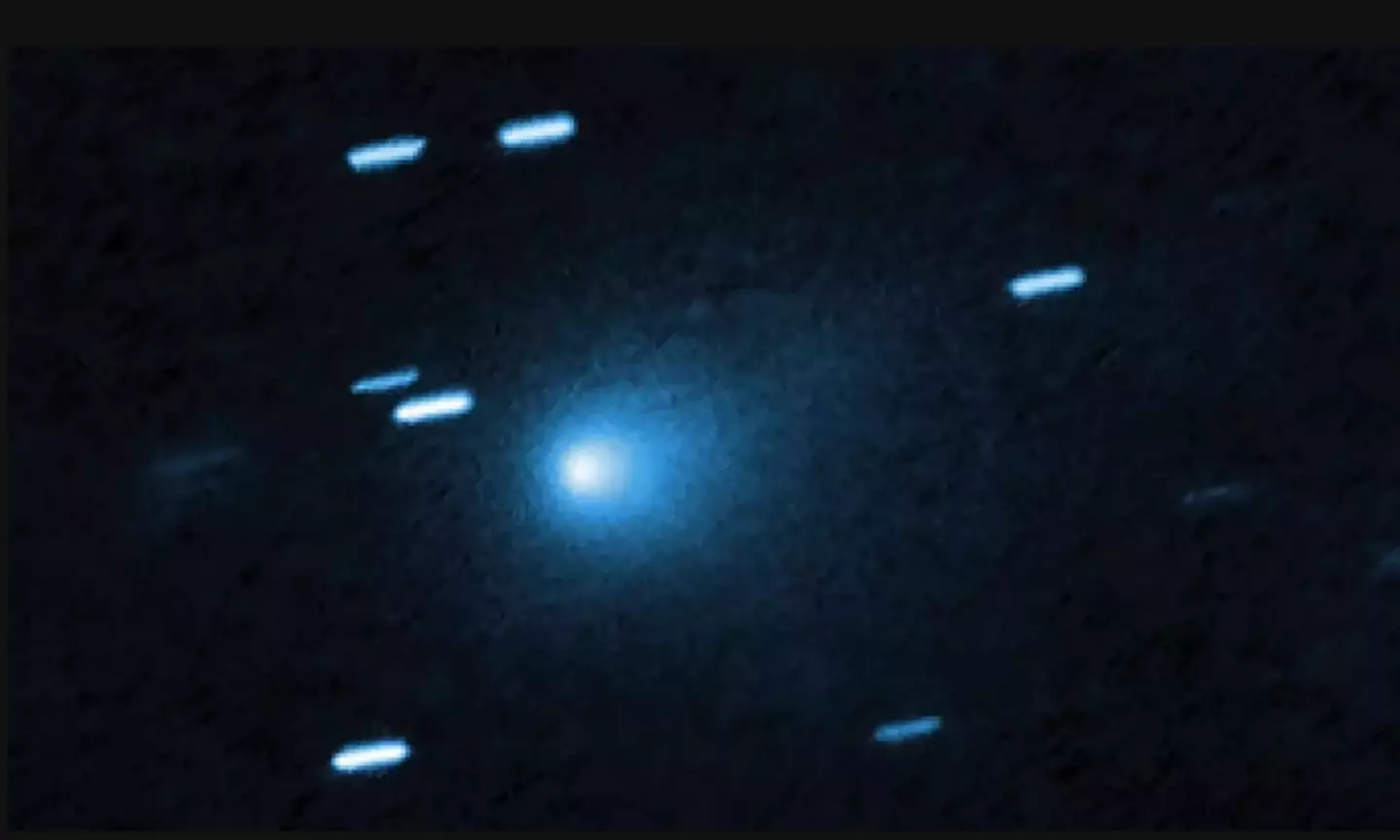
After its close pass by the Sun on October 29, 2025, interstellar comet 3I/ATLAS shocked astronomers with strange brightening patterns and jets that defied gravity models, prompting Congress to demand NASA’s hidden data and reigniting public tension over scientific transparency and possible extraterrestrial implications.

A new chapter in the mystery of interstellar object 3I/ATLAS has ignited scientific debate — and now, political scrutiny — after NASA confirmed a series of unexplained changes in the comet’s behavior just days after it passed closest to the Sun on October 29, 2025.
Once thought to be a typical interstellar traveler, 3I/ATLAS has instead grown brighter, exhibited erratic jet activity, and shown subtle but measurable deviations in its trajectory — movements that standard gravitational models can’t explain.
Researchers from the International Asteroid Warning Network (IAWN) have been monitoring the object’s evolution closely through a dedicated campaign running from November 2025 to January 2026.
Using instruments from Chile’s Rubin Observatory, Europe’s 4MOST spectrograph, and China’s FAST radio telescope, teams are mapping the comet’s fading coma — the cloud of gas and dust surrounding its icy nucleus — while searching for signs of an ion tail that could indicate intense chemical reactions or magnetic interactions in deep space.
But what has truly sent shockwaves through both the scientific community and Washington is the revelation that NASA has been quietly collecting detailed radio and optical data on 3I/ATLAS for months, even during the recent government shutdown.
This has prompted concerns over transparency, especially after Florida Representative Anna Paulina Luna formally requested NASA to “release all data and internal communications related to 3I/ATLAS” in a letter to the agency on November 10.
“Public trust in our space institutions depends on open science,” Luna wrote.
“When an object from another star system behaves in ways that contradict established astrophysical laws, the American people deserve to know what their scientists are seeing.”
Her demand followed a viral interview with Harvard astrophysicist Avi Loeb, who suggested that NASA’s hesitation to publish raw measurements might indicate that the data “raises questions they’re not yet prepared to answer.
” Loeb, who previously led the controversial Galileo Project investigating potential extraterrestrial artifacts, emphasized that the new anomalies in 3I/ATLAS “don’t fit comfortably within known cometary behavior.”
In a statement released late Monday, NASA attempted to calm the speculation, confirming that 3I/ATLAS had displayed “increased jet activity and small non-gravitational accelerations consistent with asymmetric outgassing.
” The agency insisted that “all available data will be made public following peer review.
” However, several independent researchers have pointed out discrepancies in the timing of NASA’s official updates compared to telescope logs obtained from the IAWN database.
“This isn’t about aliens — it’s about physics acting weirdly,” said Dr.Ellen Rodriguez, a planetary scientist at the University of Arizona.
“If you’re seeing deviations from Newtonian predictions on an interstellar scale, you question everything — your models, your instruments, and maybe even the assumptions we make about how matter behaves in deep space.”
Still, some astronomers can’t help but notice the eerie coincidence: 3I/ATLAS’s current path passes within just four degrees of the same region of sky where the famous “Wow!” signal — a one-time unexplained radio burst — was detected in 1977.
And the comet’s recorded spectrum includes faint emissions of hydroxyl (OH) at frequencies of 1665 and 1667 MHz — precisely the same range associated with natural maser activity in interstellar clouds, but also, intriguingly, with several past “unidentified” cosmic signals.
“It’s probably chemistry, not communication,” said Dr.Loeb in a recent forum, “but chemistry has a funny way of mimicking intention when you don’t yet understand the process.”
Behind the scenes, the tone inside NASA reportedly shifted after the Oct.
29 perihelion, when the object unexpectedly brightened by 0.
7 magnitudes in less than 24 hours — far more than predicted by thermal models.
Internal emails obtained by science reporters suggest that some data teams labeled the behavior “non-linear sublimation” while others argued it resembled “controlled venting,” a term normally reserved for artificial propulsion.
As public curiosity surges, social media has become a battleground of theories — from plasma discharges to alien probes — with many pointing to the agency’s silence as proof of a deeper mystery.
NASA’s upcoming December briefing may finally shed light on the truth, but until then, both scientists and the public are left staring at a wandering visitor that refuses to behave like anything we’ve seen before.
If 3I/ATLAS truly is just a comet, it’s the strangest one yet.
But if it’s something more — something designed — then humanity may be standing on the edge of the most profound discovery in modern history.
News

Chrisean Rock Explodes After Secret DNA Test Reveals Shocking Truth About JR
Chrisean Rock erupts in anger after Karlissa secretly conducts a DNA test on JR, revealing that years of Chrisean’s claims…

Chrisean Rock Church Member Drops Bombshell on JR’s Condition — Allegations of Lies and Neglect Rock the Community
Church members have exposed shocking claims that Chrisean Rock neglected her son JR’s medical needs by prioritizing prayer over therapy,…

Kevin Beets Outsmarts Tony Beets — Uncovers Secret $85M Gold Tunnel in Alaska!
Kevin Beets has stunned the Alaskan gold mining world by discovering a hidden $85 million gold tunnel long overlooked by…

Kevin Beets Outsmarts Tony Beets — Uncovers Secret Tunnel Holding $85 Million in Gold
Kevin Beets outsmarted his father Tony by uncovering a secret, long-forgotten tunnel containing an estimated $85 million in gold on…

Alaska Gold Shock: Freddy & Juan Pull $120 Million Record-Breaking Haul From Montana Creek Dredge
Freddy Dodge and Juan Martinez achieved a record-breaking $120 million gold haul from Montana Creek in Alaska through skill, patience,…

Alaska Gold Rush Shock: Freddy and Juan Pull $120 Million Record-Breaking Haul From Dredge
Freddy Dodge and Juan Martinez achieved a record-breaking $120 million gold haul from a single dredge in Alaska’s Montana Creek,…
End of content
No more pages to load






